

A Shrinking Fleet and Slower Shipyards are Forcing Unsustainable Deployments for the U.S. Navy
Premium domains for sale
Freedom Is Back In Style
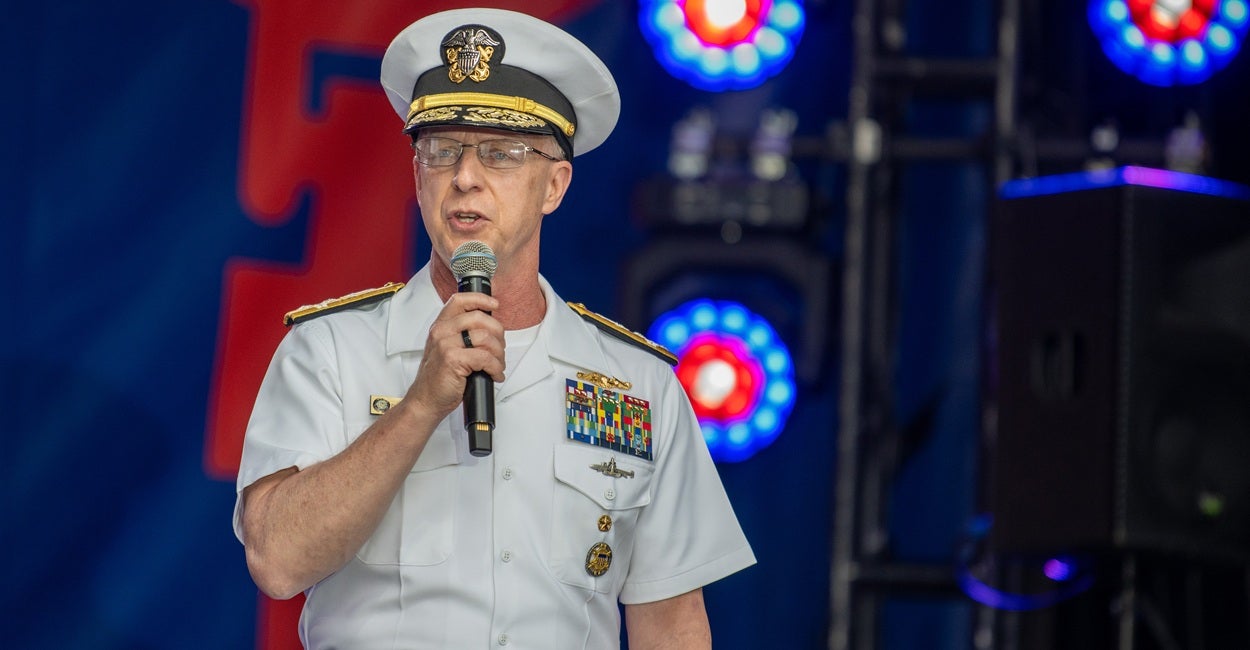
Since the end of the Cold War, for 30 years the U.S. Navy has sustained a third of its fleet deployed on the backs of sailors and sometimes taking shortcuts at the shipyard—this approach is breaking down according to Government Accountability Office and the Congressional Budget Office.
Freedom Is Back
In Style
Premium domains for sale
But with what is being called a New Cold War with China potentially heating up, the luxuries of the past are now urgent necessities—needed are more sailors, warships, and shipyards.
Each week, the U.S. Naval Institute Fleet Tracker has for years been reporting roughly 100 U.S. Navy warships deployed overseas. This total of warships deployed has remained remarkably consistent from the 1980s through today. But the fleet supporting that presence has been halved. In the late Cold War, the Navy peaked at 594 battle?force ships in 1987. Today’s fleet hovers around 293 ships, which is well below what is assessed as necessary by The Heritage Foundation’s 2026 Index of U.S. Military Strength.
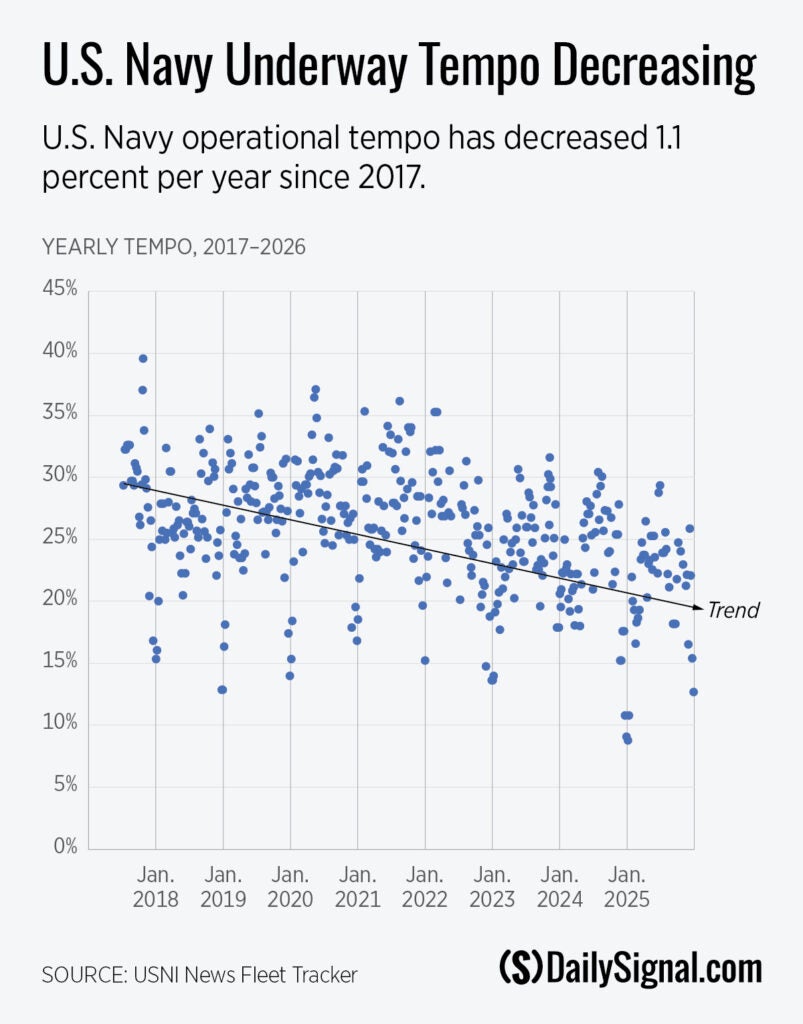
Sustaining 100 deployed warships with a smaller fleet has doubled the operational wear on ship and crew. The result today is that deployed operational tempo (time a ship is at sea or deployed versus time in home port) averages 33%, meaning one?third of the entire fleet is forward at any given moment. During the 1980s, by contrast, the Navy’s deployed Op-Tempo averaged 17%.
Sustaining a 33% Deployed Op-Tempo is placing unsustainable stress on sailors, ships, and shipyards. The Government Accountability Office has reported on this readiness problem repeatedly, noting the consequences of extended deployments, elevated crew fatigue due to shortages of sailors at sea, and the concomitant expanding maintenance backlog.
A consequence is that sailors are spending more time in shipyards as well as more time deployed on mission, taking away from precious commanding officers’ discretionary time to address the specific training needs of the crew. This has resulted in declining underway time for all the Navy’s warships as maintenance backlogs build up and national mission tasking on deployed ships remains unrelenting.
There are no simple or cheap solutions to reducing deployed operational tempo without increasing risks to the nation given ongoing combat operations in the Middle East and Caribbean and rising tensions in Asia.
Prudence would dictate sustaining a persistent forward deployed fleet of 100 warships and avoiding any major changes in deployed force levels for now. As such, lowering deployment demands on the fleet to a more healthy 20% in line with Cold War levels.
To sustain 100 deployed ships at a fleet wide 20% operational tempo, the Navy would need roughly 500 ships, nearly the size of the Navy during the Cold War. For a Navy struggling to sustain its too modest 293 warships today, it is likely a generational endeavor to deliver the fleet needed—this is unacceptable and late to task. As such new approaches are needed to get an economy of naval power where it can best deter foes—top of the list is China.
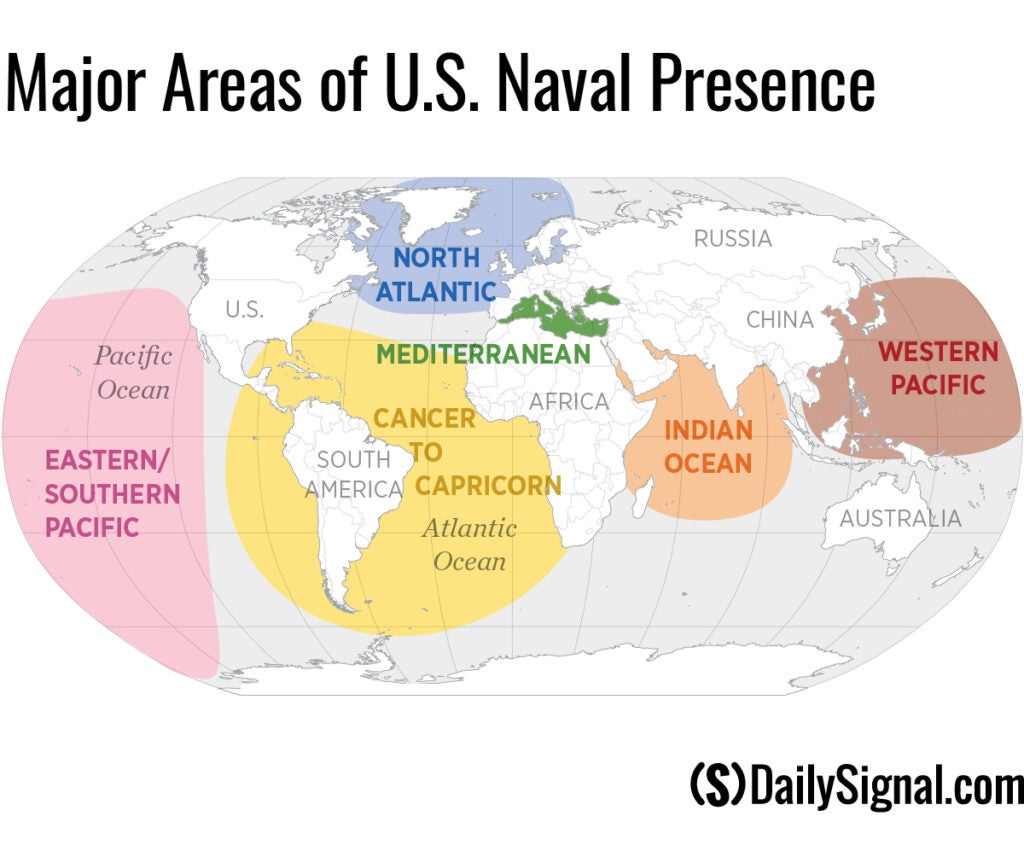
When the Navy has attempted to reduce deployments without growing the fleet, it has abandoned regions where its presence had long been felt. Case in point, in 2022 the Indian Ocean had virtually no U.S. carrier strike group presence nor large amphibious warship formations (expeditionary strike groups or amphibious ready groups).
Chaos loves a void, and it was therefore no surprise that absence coincided with a return of piracy and preceded the attacks on Israel on Oct. 7, 2023, which saw an expansion of Houthi attacks on shipping in the Red Sea and Gulf of Aden. The lesson was clear: rapid changes in naval presence to insufficient levels invites instability.
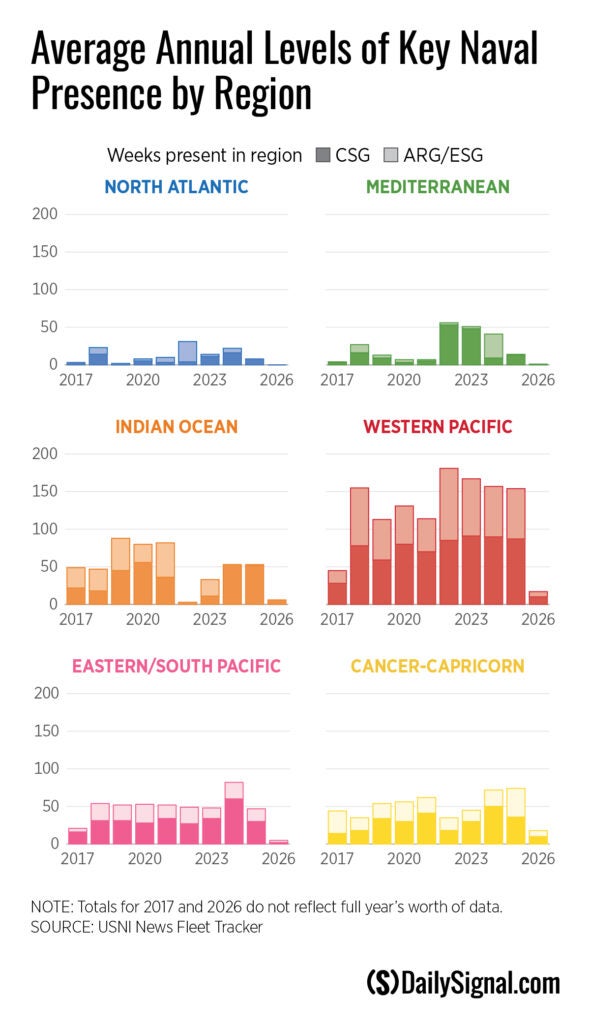
The ensuing maritime insecurity has directly affected global trade and the ability of the U.S. to deter opportunistic aggression. Without a persistent naval presence in the right places, i.e., decisive theaters, America’s security and prosperity that is reliant on a secure maritime, becomes too vulnerable to revisionist powers like China.
Simply brining the Navy’s warships home would invite more Oct.-7?style shocks or worse. An option to address this present problem is forward based and rotational forces that keep warships and their crews nearer where they are needed—such as Seventh Fleet in Japan, Fifth Fleet in Bahrain, Submarine Squadron 15 in Guam, and from 2027 a soon to be established submarine rotational force in Sterling, Australia. However, such forward basing options are rare given the inherent political costs here at home and for any host nation.
Which returns the Navy to an unavoidable point: The only sustainable way to lower deployed operational tempo and maintain a global presence is to grow the fleet.
Only with more ships at sea can the Navy give sailors and shipyards needed time for maintenance planning and quality of life predictability, while providing Commanding Officers discretionary time at sea to train their crews. In the meantime, until the Navy grows its fleet, the priority is deterring aggressors and preventing crises before they erupt by deploying and sustaining naval presence augmented increasingly by America’s air and ground forces and backstopped by friendly militaries and navies – far from an ideal option as many of our allies have more limited militaries.
The Navy is not being asked to do more than it did during the Cold War (though arguably it will need to, given the scale of the China threat). Rather, it is being asked to do the same amount but with half the fleet. America’s foes will not allow a “training timeout” to pull the fleet back and reset, Congress and the Pentagon must embark on a tangible naval fleet revival.
The post A Shrinking Fleet and Slower Shipyards are Forcing Unsustainable Deployments for the U.S. Navy appeared first on The Daily Signal.
More from this network:
Domains for Sale · GOTPeople.org · TheDSAPlatform · The Truth About Socialism
What's Your Reaction?
 Like
0
Like
0
 Dislike
0
Dislike
0
 Love
0
Love
0
 Funny
0
Funny
0
 Wow
0
Wow
0
 Sad
0
Sad
0
 Angry
0
Angry
0

I am just an average American. My teen years were in the late 70s and I participated in all that that decade offered. Started working young, too young. Then I joined the Army before I graduated High School. I spent 25 years in, mostly in Infantry units. Since then I've worked in information technology positions all at small family owned companies. At this rate I'll never be a tech millionaire. When I was young I rode horses as much as I could. I do believe I should have been a cowboy. I'm getting in the saddle again by taking riding lessons and see where it goes.
Premium domains for sale
























Comments (0)