

Academic Who Exposed Arday: DEI Elites Escaped Scrutiny
Premium domains for sale
Freedom Is Back In Style
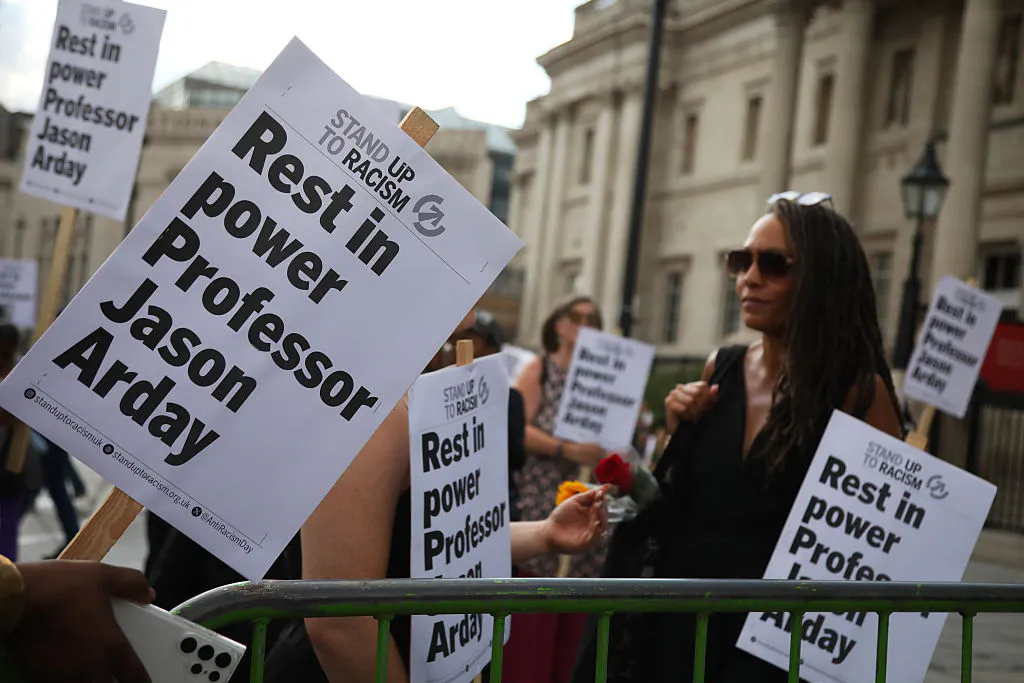
The scandal that led to Jason Arday’s apparent suicide may seem like a major setback for the diversity, equity and inclusion movement.
Freedom Is Back
In Style
Premium domains for sale
Once celebrated as a symbol of that movement, Arday — Cambridge University’s youngest-ever black professor — appears to have taken his own life last month at 41, nine days after the university opened an investigation into allegations of extensive plagiarism and other misconduct.
But Nathan Cofnas, the New York-raised academic who exposed evidence of plagiarism in Arday’s work, draws a different conclusion from the affair.
The episode amounted to “an embarrassment at most” for Cambridge and the institutional champions of DEI, “who, for now, have escaped any accountability,” Cofnas told The Daily Wire earlier this month in Brussels, where he lives.
University administrators had known about Arday’s alleged inadequacies for years but “threw him under the bus when he became an inconvenience,” Cofnas said. Cambridge presented Arday as an isolated case, shielding itself and its diversity policies from serious scrutiny, Cofnas argued.
Arday’s death then shifted attention from the institutions that had promoted him to the people who exposed the allegations, allowing them to be portrayed as the affair’s villains, Cofnas said.
“This story is not about plagiarism,” he said. “This is about how dozens of institutions and thousands of individuals collaborated to cover up fraud because of Arday’s position in the woke racial hierarchy. And it’s not just Arday.”
In the aftermath of Arday’s death, Cofnas was condemned by commentators and briefly suspended from his postdoctoral position at Ghent University in Belgium.
The backlash extended beyond Ghent. In a statement following Arday’s death, Laura Davison, general secretary of Britain’s National Union of Journalists, identified Cofnas — and no other individual critic of Arday — by name.
“That one of the highest-profile critics of Arday was Nathan Cofnas, a former Cambridge academic and self-described ‘race realist,’ is deeply concerning,” Davison wrote.
“Racism, ableism and pernicious rhetoric against diversity, equity and inclusion has become increasingly normalised in our society,” she added. This was a reference to Cofnas’s controversial view that genetic differences contribute to average racial differences in cognitive performance.
Chris Smith, the chancellor of the University of Cambridge, also referred to a “now-discredited researcher” in an opinion article published by The Telegraph. Smith did not explain what he meant by “discredited.”
Cofnas, 39, earned a master’s degree in history and philosophy of science at Cambridge. After receiving a PhD from Oxford, he returned to Cambridge and continued working there as a researcher before moving to Belgium. His academic work concerns evolution, human behavior and morality.
Smith wrote that “the very worst recent comment” about the Arday affair came from Cofnas when he claimed that, under a colorblind, merit-based appointment system, “the number of Black professors would approach zero per cent.”
Commenting specifically about Harvard, Cofnas made that assertion in a 2024 Substack essay. He based it partly on evidence from the 2018 federal litigation over Harvard University’s affirmative-action policies. A Harvard expert projected that removing race from undergraduate admissions decisions would reduce Black representation from approximately 14% to 6%. With such low admission rates, faculty hires at Harvard would at least be considerably lower than 6%, Cofnas projected.
An earlier 2013 internal Harvard study found that, without affirmative action, the undergraduate population would be 0.7% black, Cofnas noted.
Smith also wrote that “Cambridge has lessons to learn from the tragedy of Jason Arday, but the media does too.” Any decisions concerning Cambridge’s investigation of Arday were “now understandably on hold in the immediate aftermath of what has happened,” Smith added.
Evidence of apparent plagiarism in Arday’s work — including comparisons showing passages resembling material published by other academics in the sociology of education — had been an open secret at Cambridge, according to Cofnas. Yet the concerns prompted no public action while Arday was being celebrated in the media as an academic star who had overcome disability, disadvantage and institutional racism.
“I wasn’t even the only person who exposed Arday,” Cofnas said.
David Harris, a professor emeritus at Plymouth Marjon University, had investigated Arday’s academic work before Cofnas did. In May 2023, shortly after Arday’s appointment at Cambridge, Harris sent him a document identifying apparent errors, repeated passages, questionable data and possible plagiarism.
Arday rejected Harris’s criticism as bullying and harassment and reported him to the police, who took no further action.
Cofnas said a Cambridge source later alerted him to Harris’s findings. He declined to identify the source, describing the person only as “a faculty member at Cambridge who, for reasons of wanting to continue living, doesn’t want to be named.”
Cambridge’s first public response to the mounting scrutiny was a forceful defense of Arday. In a statement reported by The Guardian on August 1, a university spokesperson characterized the allegations surrounding him as a “vile campaign.”
Days later, Cambridge reversed course after receiving what it called “new information” and opened an investigation into Arday’s qualifications, claimed honorary appointments and complaints of misconduct.
Arday resigned the same day. He appears to have taken his own life nine days later.
Cofnas said he was surprised by how quickly Cambridge withdrew its support.
“I predicted that he would not be fired or pushed out of his job,” he recalled. Cambridge’s reversal demonstrated what Cofnas called the “DEI class’s ruthless self-preservation instinct,” which he said he had initially failed to take into account.
Cofnas argued that Cambridge had helped create the crisis by promoting Arday while allegedly ignoring repeated warnings about his work.
“If anybody would be to blame for the suicide besides Arday himself, it was Cambridge, which set him up for failure,” Cofnas said. “They covered it up for three years.”
Cofnas’s own position at Ghent appeared imperiled following Arday’s death. He said an email detailing the allegations against him reflected “a determination to fire me.” The accusations drew on years of his academic writing and public statements, he said.
“I thought, ‘Okay, this is over. They’re going to fire me,’” Cofnas recalled.
Ghent initially suspended Cofnas while it opened a disciplinary inquiry. The university subsequently ended that suspension but imposed a three-month disciplinary measure requiring him to work remotely and prohibiting him from teaching. The wider inquiry remains open.
Cofnas dismissed the allegations against him at Ghent as trumped up. He said Ghent administrators had been trying to build a case for dismissing him because of his controversial view that genetic differences contribute to average racial differences in cognitive performance.
He was on his way to getting fired, he said, when “something extremely unexpected happened”: U.S. Ambassador to Belgium Bill White intervened.
White publicly condemned Cofnas’s suspension and contacted Ghent Rector Petra De Sutter, a male former Green deputy prime minister who identifies as a woman. Cofnas’s suspension was rescinded, but he was barred from campus and prohibited from teaching for three months. The disciplinary inquiry remains ongoing.
Cofnas is also involved in a dispute over Ghent’s handling of two alleged assaults against him earlier this year.
In April, after Cofnas delivered a talk about racial differences to a Catholic Flemish student organization, two men riding a motorcycle allegedly threw yogurt at him. Cofnas said that about 40 minutes later, another person hurled a heavy bottle filled with yogurt at his head, causing a concussion.
Cofnas reported the second incident to police. He said CCTV footage allowed the alleged attacker to be identified, but prosecutors declined to pursue the case. The Belgian League Against Antisemitism is now examining the matter.
Cofnas, who is Jewish and a supporter of Israel, noted that at least one of the alleged assailants was wearing a keffiyeh. He believes hostility toward his Zionism may have been one factor in the attack, along with opposition to his research and political views.
Ghent University did not respond by press time to questions about its handling of the alleged assaults or Cofnas’s claim that it sought to silence him for exposing Arday.
The Arday affair has not changed Cofnas’s pessimistic assessment of conservatism’s prospects among young people and within elite institutions.
Part of the problem, he argued, is that conservative thinkers refuse to acknowledge — or even investigate — the possibility that genetics contributes to racial differences in measured intelligence.
This leaves conservatives without a coherent alternative to left-wing explanations attributing racial disparities to discrimination and historical injustice, Cofnas said.
“The only way to create an intellectually coherent right-wing philosophy that would attract cognitive elites and cause them to defect from the left is to accept the truth of hereditarianism—that certain group disparities are not necessarily the result of injustice, but may be rooted in natural differences for which no one can be blamed,” Cofnas told Winston Marshall on his podcast last month.
Cofnas does not regard Donald Trump’s election as president as evidence that woke ideology has been defeated.
“Wokeism is just beginning,” he said. “The idea that wokeism is over, or even that it has waned at all, is based just on Twitter vibes and the fact that the plebeians managed to elect their candidate, who is Trump.”
“But all the data show that young people and elites remain overwhelmingly on the side of woke and cancel culture,” he added. “We are in a deep hole.”
Hereditarianism entered Cofnas’s thinking at 17, when he was taking classes at Columbia University as a visiting high school student, he said.
“I grew up on the Upper West Side of Manhattan with all the taboos around race. One of the classes I took at Columbia was on anthropology, where the professor said that Australian Aborigines have a part of the occipital cortex responsible for vision, which is 30% larger than it is in Caucasians. And he added: ‘Does that mean there’s less room for something else? I don’t know.’ I realized in that moment that I had been lied to about this subject and I became extremely interested in it,” Cofnas recalled. “I was so obsessed with it I brought it up in two college interviews.”
Expressing unpopular views has exposed Cofnas to attacks equating him with neo-Nazis, he acknowledged. It may also have sabotaged his academic career.
Many people advised him to conceal his beliefs until he obtained tenure at a major university, which would have made him less professionally vulnerable.
But Cofnas rejected that strategy.
“You can’t pretend to be a conformist for 25 years and then say it was all an act,” he said. “You will end up being a conformist. You’ll have some reason why now is still not the right time.”
***
Canaan Lidor is a special correspondent at Jewish News Syndicate.
More from this network:
Domains for Sale · GOTPeople.org · TheDSAPlatform · The Truth About Socialism
What's Your Reaction?
 Like
0
Like
0
 Dislike
0
Dislike
0
 Love
0
Love
0
 Funny
0
Funny
0
 Wow
0
Wow
0
 Sad
0
Sad
0
 Angry
0
Angry
0

I am just an average American. My teen years were in the late 70s and I participated in all that that decade offered. Started working young, too young. Then I joined the Army before I graduated High School. I spent 25 years in, mostly in Infantry units. Since then I've worked in information technology positions all at small family owned companies. At this rate I'll never be a tech millionaire. When I was young I rode horses as much as I could. I do believe I should have been a cowboy. I'm getting in the saddle again by taking riding lessons and see where it goes.
Premium domains for sale















Comments (0)