

America Let This Palestinian Refugee In — Now He’s Taking His Award-Winning Science To China
Premium domains for sale
Freedom Is Back In Style
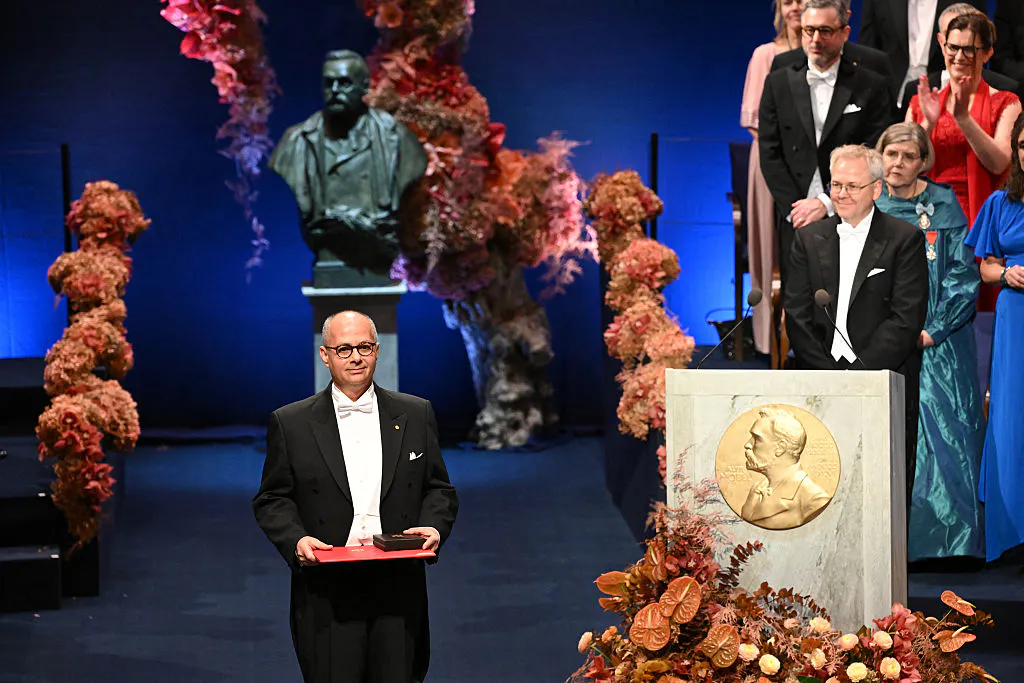
Nobel Prize-winning chemist Omar Yaghi, who arrived in the United States as a teenage refugee and built one of the world’s most celebrated scientific careers at American universities, is leaving the country for a full-time position in China.
Freedom Is Back
In Style
Premium domains for sale
Yaghi, who shared the 2025 Nobel Prize in Chemistry, has accepted a faculty appointment at Beijing’s Tsinghua University, where he will lead a newly created artificial intelligence research institute focused on accelerating the discovery of advanced materials.
The move comes as China continues to aggressively recruit top Western scientists while expanding government investment in scientific research and artificial intelligence, against the backdrop of the Trump administration’s efforts to rein in federal research spending and refocus taxpayer funding.
Born in Amman, Jordan, to Palestinian refugee parents, Yaghi spent his childhood in a one-room home without electricity or running water. At age 15, his father sent him to the United States in search of greater opportunity.
That opportunity ultimately led to one of the most distinguished careers in modern chemistry.
After decades of working and conducting research at American universities, Yaghi joined the University of California, Berkeley, faculty in 2012. He became internationally renowned for pioneering metal-organic frameworks, or MOFs — ultra-porous materials capable of storing gases, capturing carbon dioxide, harvesting drinking water from desert air, and enabling a wide range of industrial and medical applications.
His work earned him a share of last year’s Nobel Prize in Chemistry alongside Richard Robson and Susumu Kitagawa.
One of the most widely publicized applications of Yaghi’s research came in 2018, when his Berkeley laboratory successfully demonstrated a passive water-harvesting device capable of pulling clean drinking water directly from desert air. The invention, inspired in part by Yaghi’s childhood experience growing up with limited access to running water, is now moving toward commercialization through one of several American companies he helped found.
Despite building his career in the United States, Yaghi has become increasingly critical of the direction of American scientific research.
Before receiving his Nobel Prize, Yaghi criticized President Donald Trump’s immigration policies, arguing they threatened America’s ability to attract talented scientists from around the world. More recently, he has expressed concern over reductions in federal research funding and warned that American researchers have not embraced artificial intelligence quickly enough to remain globally competitive.
In a recent interview with Scientific American, Yaghi said the current state of U.S. science was “not so encouraging” because of cuts to research grants and declining support from federal science agencies. He also argued that researchers must adopt AI “as a matter of survival of the advanced research system in the U.S.”
Tsinghua University announced that Yaghi will head a new institute dedicated to using artificial intelligence to dramatically accelerate the design and synthesis of new materials. University officials said the institute aims to replace years of traditional trial-and-error experimentation with AI-assisted research capable of solving complex scientific problems far more quickly.
Speaking during his appointment ceremony, Yaghi said he hopes the institute will develop new materials to address global challenges, including water shortages, carbon neutrality, and sustainable development, while also training a new generation of scientists working at the intersection of chemistry and artificial intelligence.
Yaghi’s move reflects China’s broader effort to attract internationally recognized researchers as Beijing seeks to establish itself as the world’s leading scientific power.
According to data from the Organisation for Economic Co-operation and Development, China’s overall research and development spending surpassed that of the United States in 2024. Chinese universities and government-backed research institutes have increasingly offered generous funding packages, cutting-edge laboratory facilities, and leadership opportunities to scientists from around the world.
Researchers say Beijing’s strategy has evolved beyond simply recruiting foreign experts to teach students.
Marina Zhang, a science policy researcher at the University of Technology Sydney, told Nature that Yaghi’s appointment suggests China is attempting to build entirely new research models that combine artificial intelligence with advanced materials science rather than merely catching up with Western institutions. Tsinghua officials similarly described Yaghi’s appointment as an effort to bridge scientific disciplines and create technological breakthroughs capable of reshaping future industries.
Although Yaghi will now conduct his primary research from Beijing, he is expected to maintain ties to several American companies and nonprofit initiatives that continue developing technologies based on his discoveries. Still, his departure represents one of the highest-profile examples yet of China successfully recruiting a scientist whose career was largely built in the United States.
As competition between Washington and Beijing increasingly extends beyond trade and military power into artificial intelligence and advanced technology, Yaghi’s decision underscores a growing battle not only over innovation itself, but over the scientists responsible for creating it.
More from this network:
Domains for Sale · GOTPeople.org · TheDSAPlatform · The Truth About Socialism
What's Your Reaction?
 Like
0
Like
0
 Dislike
0
Dislike
0
 Love
0
Love
0
 Funny
0
Funny
0
 Wow
0
Wow
0
 Sad
0
Sad
0
 Angry
0
Angry
0

I am just an average American. My teen years were in the late 70s and I participated in all that that decade offered. Started working young, too young. Then I joined the Army before I graduated High School. I spent 25 years in, mostly in Infantry units. Since then I've worked in information technology positions all at small family owned companies. At this rate I'll never be a tech millionaire. When I was young I rode horses as much as I could. I do believe I should have been a cowboy. I'm getting in the saddle again by taking riding lessons and see where it goes.
Premium domains for sale




















Comments (0)