

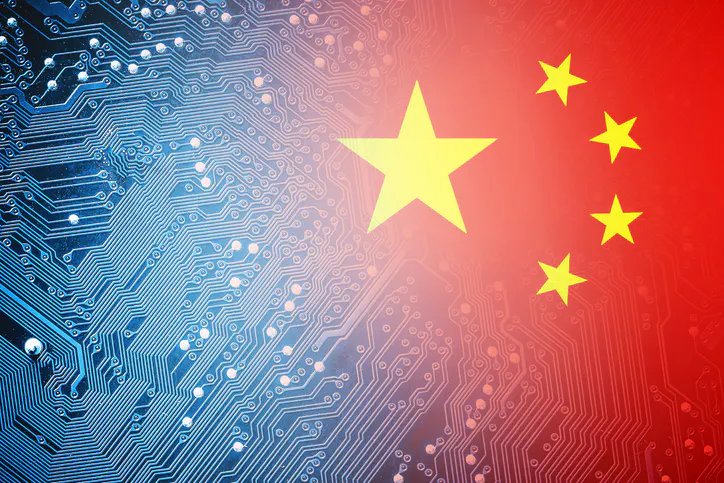
America’s Next China Dependency Could Be Artificial Intelligence
Premium domains for sale
Freedom Is Back In Style
For decades, American companies followed the straightforward rule: if another company can produce goods or services at a lower cost, we should purchase from them.
Freedom Is Back
In Style
Premium domains for sale
We’ve seen this principle applied to rare earths, pharmaceutical supply chains, and steel. As a result, consumers benefited, companies lowered costs, and capital moved toward more profitable industries. Then, years later, we discovered that cheap access to a strategic resource is not the same thing as secure access. We are on the verge of seeing this play out again with AI.
These vulnerabilities became especially apparent during the COVID-19 crisis, when Americans faced shortages of essential goods, widespread delays for commonplace products, and sharply rising costs as supply chains buckled. Our vulnerabilities are in the spotlight again as the U.S. grapples with securing the minerals essential to military systems, automobiles, computers, and other advanced technologies – an issue that will almost certainly be discussed when Chinese President Xi Jinping visits the White House.
Although it may be hard to believe today, the U.S. was once the world’s dominant producer of rare earths, with California’s Mountain Pass at the center of the industry. Beginning in the 1990s, however, inexpensive Chinese production transformed the economics, and American companies decided to simply buy what was needed more cheaply abroad. Mountain Pass’s separation operations closed in 1998 and mining ceased in 2002.
America had gone from being largely self-sufficient to obtaining more than 90% of its separated rare earths from China or countries using Chinese material. American leaders never formally decided that the U.S. should depend on China for materials essential to electronics, weapons, and advanced manufacturing. Instead, thousands of individually rational economic decisions produced that result.
We saw a similar outcome with steel, where China dramatically expanded production under laws that allowed for mass pollution, cheap labor, and currency manipulation to depress global steel prices, leading to greater dependence on China and the downfall of many domestic producers. This is also true for pharmaceuticals where active ingredients and their chemical precursors have increasingly been sourced from China and India.
Which brings us to AI, where much of today’s policy debate treats an AI model as a product, focused on which frontier laboratory is in the lead and which Chinese AI is closing the gap. But that may be the wrong way to look at it.
Increasingly, intelligence is becoming a component. Just as steel isn’t the skyscraper, rare-earth magnets aren’t the vehicle, and an active pharmaceutical ingredient isn’t the pill in your medicine cabinet, AI’s most important role will be as an input you put into a product made by somebody else.
In most cases, the AI model sits invisibly inside the product or service. You don’t see the AI operating behind the scenes of your finance software, navigation system, email inbox, or camera phone. They just work better because of it. For companies building those products, the relevant question could eventually be less about who has the best model and more about finding the cheapest intelligence that can reliably do the job.
That distinction matters enormously for America’s debate over open-weight AI. Companies will want models they can download, customize, fine-tune, run locally, and embed into products without paying a frontier lab. If American companies cannot supply those models, someone else will.
China increasingly appears willing to compete aggressively in this market. Chinese developers have released capable open-weight models while emphasizing efficiency and low prices. They do not need to produce the world’s best model to reshape the market. They only need to produce intelligence that is good enough and cheaper.
Imagine if, in America, we restricted open and affordable AI models and limited ourselves to regulated, closed frontier models. This is how industrial dependencies form. The result would be American products themselves becoming more dependent on Chinese intelligence.
An American company might own the interface, customer relationship, and application while the foundational intelligence underneath it comes from a Chinese model, just as an American pharmaceutical company can sell medicine whose critical chemical inputs originate abroad.
Even regulation banning Chinese AI won’t, by itself, solve this problem. China will still produce and dominate globally if American open-weight companies aren’t encouraged to develop and compete. America should think carefully before creating a world in which its companies can make the most sophisticated intelligence on Earth but regulate themselves out of offering the form of intelligence the rest of the economy actually wants to build with.
The lesson of rare earths, steel, and pharmaceuticals shows us that when we allow China to flood the market with a cheaper product, it leads to China dominating the market. We should be careful not to repeat the mistake with the most consequential input of the 21st century.
***
Mike Martin is a former Senior National Security Official. He served in the National Security Council and the Pentagon during the first Trump administration.
More from this network:
Domains for Sale · GOTPeople.org · TheDSAPlatform · The Truth About Socialism
What's Your Reaction?
 Like
0
Like
0
 Dislike
0
Dislike
0
 Love
0
Love
0
 Funny
0
Funny
0
 Wow
0
Wow
0
 Sad
0
Sad
0
 Angry
0
Angry
0

I am just an average American. My teen years were in the late 70s and I participated in all that that decade offered. Started working young, too young. Then I joined the Army before I graduated High School. I spent 25 years in, mostly in Infantry units. Since then I've worked in information technology positions all at small family owned companies. At this rate I'll never be a tech millionaire. When I was young I rode horses as much as I could. I do believe I should have been a cowboy. I'm getting in the saddle again by taking riding lessons and see where it goes.
Premium domains for sale


















Comments (0)