

Argentina Is Booming—Capitalism Remains Undefeated
Premium domains for sale
Freedom Is Back In Style
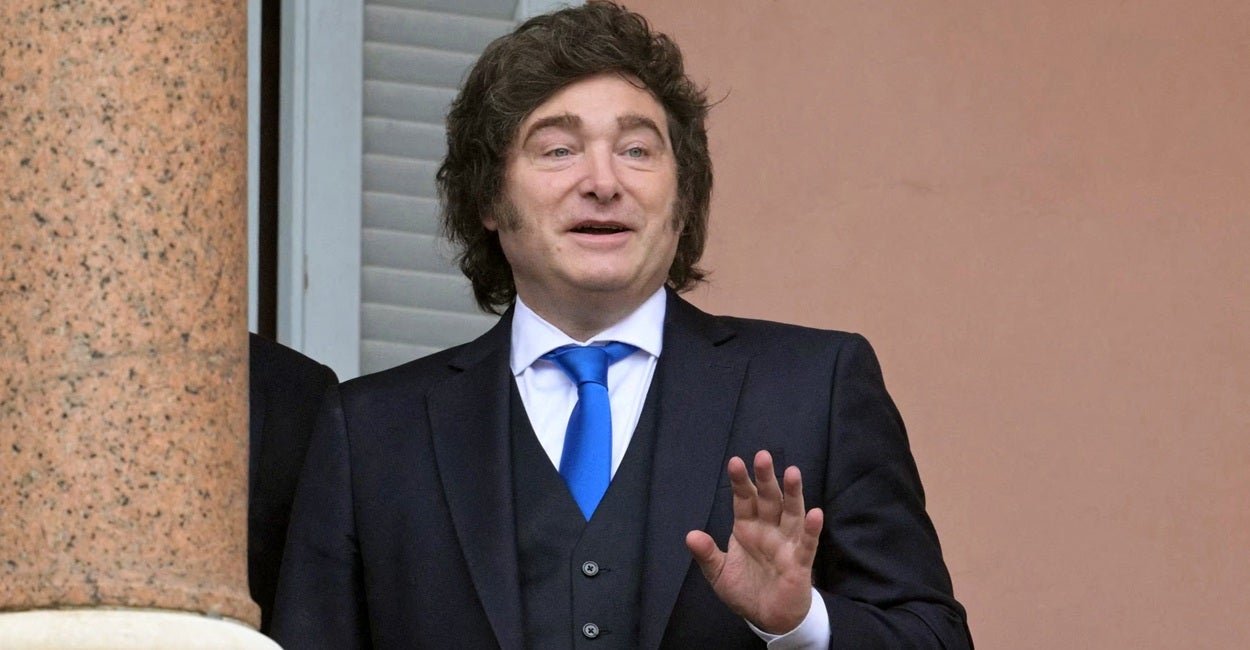
In 2023, over 100 leading economists from around the world, including progressive darling Thomas Piketty, signed a letter warning that “far-right” Argentine presidential candidate Javier Milei’s policies, which were “rooted in laissez-faire economics,” would cause “devastation,” spike inflation, expand poverty, and worsen unemployment.
Freedom Is Back
In Style
Premium domains for sale
Celebrated economists never penned any open letters warning that the preceding Peronists’ or Kirchnerists’ perverse blend of fascism, socialism, and unionism would drive Argentina—once one of the world’s wealthiest nations—into destitution, unemployment, soaring inflation, and bankruptcy.
But that’s how it always goes.
Political scientist Ian Bremmer warned, “Economic collapse is coming imminently.”
Felix Salmon, then chief financial correspondent at Axios (now at Bloomberg), argued that Milei’s “wrecking ball” policies would plunge Argentina into “a deep recession.”
When the U.S. provided Argentina with a $20 billion currency swap line last year, former New York Times columnist and Milei critic Paul Krugman argued that there’s “no plausible scenario in which even $20 billion in U.S. loans will save Javier Milei’s failing economic strategy.”
Argentina only tapped around $2.5 billion of that funding and then fully repaid the loan in January of this year with interest, far ahead of schedule.
Well, Argentina’s 2025 gross domestic product also blew past expectations, growing 4.4%, the highest in years. The International Monetary Fund expects the GDP will grow at similar rates in 2026 and 2027.
When Milei’s socialist predecessor Alberto Fernandez reopened the economy after COVID-19 and saw the entirely predictable rise in GDP, popular Nobel laureate economist and Hugo Chavez fan Joseph Stiglitz called it an “economic miracle.” Over the next year, inflation rose to 97%, while poverty spiked, real wages fell, and GDP stagnated.
Since Milei’s party won power in 2023, inflation has dropped over 200%, plunging to the lowest level in eight years.
Though this is likely the fastest any nation experiencing hyperinflation has improved its position in modern history, Stiglitz still warns that Milei is leading Argentina into “crisis.”
Yet it had a fiscal surplus for the second consecutive year in 2025, marking the first time since 2008 that it accomplished the feat, and the poverty rate dropped significantly in 2025, reaching its lowest level since 2018.
The crisis Milei took on was stark: In the first half of 2024, around 52.9% of the population was living in poverty, with 18% in extreme poverty.
Poverty fell 14 percentage points, to 38%, last year. It is at 31% now.
Milei did all this the old-fashioned way.
He removed price controls, got rid of tariffs and opened trade, privatized a slew of government-run agencies, cut red tape, weakened union monopolies, made major cuts in spending, and eliminated an array of needless state jobs.
In other words, all the usual stuff that free marketers preach will work—and experts warn us will bring on Armageddon.
True capitalism has never been tried. But even partial capitalism works every time.
And we never run out of examples.
After gaining independence and moving away from a planned economy in the 1990s, Estonia was one of the first former communist nations to embrace free-market solutions. It soon became one of the most successful, tech-driven economies in Europe.
The Poles moved slower, but they also shed socialism for capitalistic reforms, abandoning price controls and scaling back state power.
Now they’re one of the few former communist nations economically on par with the West.
In the 1980s Ireland was the poorest nation in Western Europe. After its stagnant economy adopted a slew of laissez-faire reforms, deregulations, and lower taxes, Ireland not only grew to have a higher GDP per capita than Britain but became the third-wealthiest nation in the world.
Singapore, once destitute, transformed into a free-market economy and now edges out Ireland on the world’s-richest list.
South Korea, also once one of the poorest nations, undertook economic liberalization efforts in the 1980s and accelerated them in the 1990s, shedding its top-down government-controlled protectionist economy for a market system.
Now it’s one the world’s most dynamic economies.
For its first decades of existence, Israel was a one-party quasi-socialist state with a union-run economy that was constantly teetering on the edge of economic crisis.
It wasn’t until the 1990s, after an extensive deregulation of Israel’s economy, that the nation experienced an explosion of productivity and quality of life.
Israel’s per-capita GDP now outperforms most European nations, while its tech sector outperforms most of the world.
Yet no matter how many times the technocrats or socialists or progressives are proven (sometimes catastrophically) wrong, they are never treated as the radicals.
No matter how often free-market reforms work to better the lives of millions, they will never be credited.
COPYRIGHT 2026 CREATORS.COM
We publish a variety of perspectives. Nothing written here is to be construed as representing the views of The Daily Signal.
The post Argentina Is Booming—Capitalism Remains Undefeated appeared first on The Daily Signal.
More from this network:
Domains for Sale · GOTPeople.org · TheDSAPlatform · The Truth About Socialism
What's Your Reaction?
 Like
0
Like
0
 Dislike
0
Dislike
0
 Love
0
Love
0
 Funny
0
Funny
0
 Wow
0
Wow
0
 Sad
0
Sad
0
 Angry
0
Angry
0

I am just an average American. My teen years were in the late 70s and I participated in all that that decade offered. Started working young, too young. Then I joined the Army before I graduated High School. I spent 25 years in, mostly in Infantry units. Since then I've worked in information technology positions all at small family owned companies. At this rate I'll never be a tech millionaire. When I was young I rode horses as much as I could. I do believe I should have been a cowboy. I'm getting in the saddle again by taking riding lessons and see where it goes.
Premium domains for sale
















Comments (0)