

Ben Shapiro Talks Truth, Problem-Solving, And True Conservatism On ‘Uncommon Knowledge’
Premium domains for sale
Freedom Is Back In Style
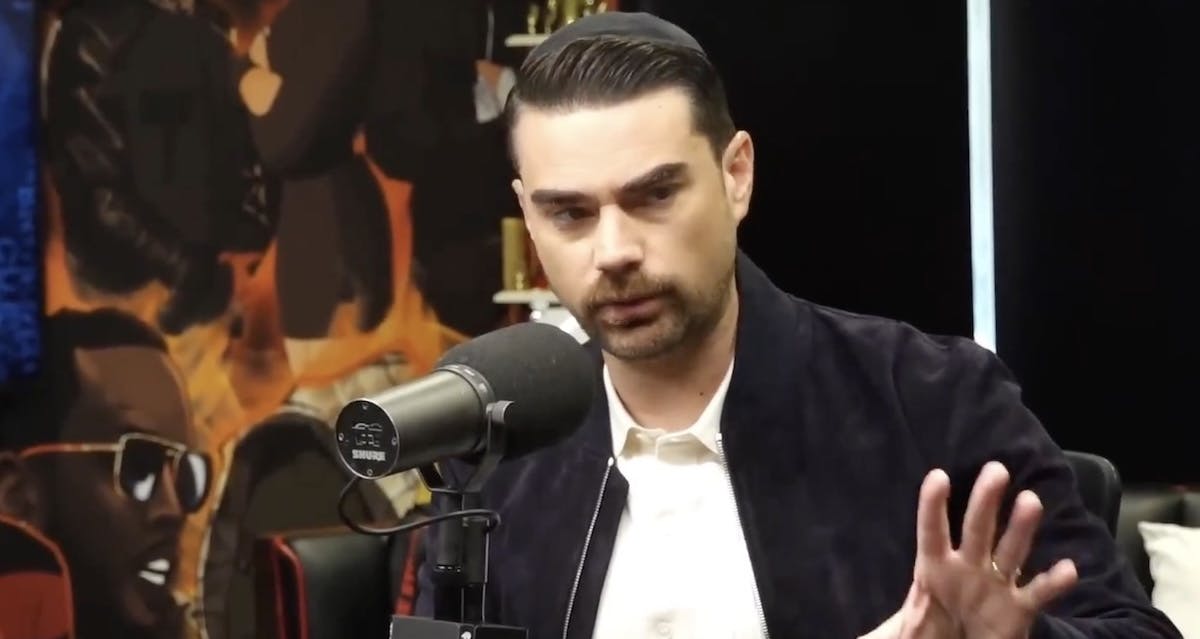
Daily Wire host Ben Shapiro sat down with Peter Robinson on “Uncommon Knowledge” for a conversation that ultimately landed on a single, animating concern: what happens to a political movement, and a country, when it loses its grip on truth.
Freedom Is Back
In Style
Premium domains for sale
“Every proposition, when originally proposed, is nuanced,” he said, “and by the time it is popularized, it becomes a bumper sticker.”
That flattening, he argued, has reshaped American politics on both the Left and the Right, replacing argument with emotion and, increasingly, skepticism with outright conspiracism.
That shift, in his telling, is downstream of collapsing institutional trust. Events like Russiagate, COVID-era policymaking, and the unrest of 2020 each contained “grains of truth,” he said, but those truths were “abstracted into a theory whereby the fundamental institutions of the West are themselves corrupted.” Once that belief sets in, “you’re susceptible to literally anything.”
Nowhere is that dynamic more visible, he argued, than in the rise of grievance politics. On the global stage, Shapiro pointed to Israel as a case study in how success breeds resentment. “There’s only one successful state in the Middle East … a tiny state,” he said, noting its economic and military strength relative to the region. “That country is hated for its success because of that.”
But the same instinct, he warned, is now taking root on the American Right. If people come to believe the United States is in managed decline, they begin searching for someone to blame. “You start to look at who’s had a pretty good 80 years?” he said. “The truth is that Jews in America have had an amazing 80 years … and the state of Israel has had a pretty stellar 80 years.” That line of thinking, he suggested, helps explain the overlap between populist grievance and rising anti-Semitism.
Shapiro has increasingly taken aim at those tendencies within his own coalition. Reflecting on a recent speech at Turning Point USA following the murder of Charlie Kirk, he warned that “the conservative movement is in serious danger … from charlatans who … traffic in conspiracism and dishonesty.” In the interview, he was more blunt: “There is a market for conspiracism.”
He dismissed criticism from figures like Tucker Carlson and Megyn Kelly as beside the point. “They’re not even remotely arguments,” he said, drawing a distinction between censorship and judgment. “Anyone can have anyone on any stage at any time. This is America. If you decide to waste your time listening to the conspiratorial ravings of an incipient madman like Tucker Carlson, you can do that. This is America. But you are also wasting your time and you’re making your brain dumber.”
That raised a deeper question: what actually defines conservatism today? Shapiro drew a sharp distinction between the Republican Party and the conservative movement, arguing the former is “a vehicle for victory,” while the latter has lost touch with its philosophical roots. The principles that once undergirded the right, limited government, federalism, localism, are no longer widely understood. “When you say to people, government should be as small as it can, most people’s reaction is, why?” he said. “Most politicians even have no capacity to explain that.”
The result, he predicts, is fragmentation. The post-Trump coalition contains too many competing strains to hold together long-term. “It will fragment,” he said, pointing to a broader “withering of the ability to explain the philosophy undergirding these policy preferences.”
That same erosion, he argued, is playing out in governance itself. Blue states losing residents to red states are unlikely to correct course anytime soon. “That’s like saying when will East Germany fix itself if they had left an open border,” he said. “It won’t — because everybody who wanted to fix it left.” Real change, he suggested, will only come through crisis: “The only thing that could happen that would prompt it is almost full-scale collapse of some of these states in terms of their financing and fiscal capacity. And I think that will come. I think that you will see bankruptcy of many of these states.”
Still, Shapiro’s most pointed critique was cultural, not political: “One of the great disappointments of my life has been finding out that people follow people, not ideas,” he said. That reality, he argued, fuels everything from audience capture to the spread of bad thinking.
It also undercuts what he sees as the core of the American experiment: the idea that problems are meant to be solved. “If you’ve got a problem in your life, it is solvable by you,” he said. “If you don’t have a solution, if you’re asking questions and you’re not interested in the answers, then as I’ve said before, you’re not really asking questions. You’re fomenting a proposition.”
In Shapiro’s view, that shift, from solving problems to narrating them, is the real fault line in American life. And until it’s reversed, the politics built on top of it will remain unstable.
More from this network:
Domains for Sale · GOTPeople.org · TheDSAPlatform · The Truth About Socialism
What's Your Reaction?
 Like
0
Like
0
 Dislike
0
Dislike
0
 Love
0
Love
0
 Funny
0
Funny
0
 Wow
0
Wow
0
 Sad
0
Sad
0
 Angry
0
Angry
0

I am just an average American. My teen years were in the late 70s and I participated in all that that decade offered. Started working young, too young. Then I joined the Army before I graduated High School. I spent 25 years in, mostly in Infantry units. Since then I've worked in information technology positions all at small family owned companies. At this rate I'll never be a tech millionaire. When I was young I rode horses as much as I could. I do believe I should have been a cowboy. I'm getting in the saddle again by taking riding lessons and see where it goes.
Premium domains for sale














Comments (0)