

Criminals aren't just robbing America's mail carriers. They're recruiting them.
Premium domains for sale
Freedom Is Back In Style
Late last month, one or more suspects attacked a postal worker at the San Bruno Post Office in California. They weren't after the employee's wallet or phone. They wanted the mail.
Freedom Is Back
In Style
Premium domains for sale
The thieves made off with four tubs of it, loading them into a silver Lexus before disappearing. Federal authorities are now offering up to $150,000 for information leading to an arrest and conviction. Postal officials warned customers who had recently used the branch or nearby collection boxes to watch their bank and credit card accounts for suspicious activity.
In Chicago, members of a street gang began recruiting postal workers as early as 2017.
Three days earlier, another postal worker had been punched in the face outside a post office in nearby San Leandro. Federal authorities put another $150,000 reward on that case.
Dog eat dog
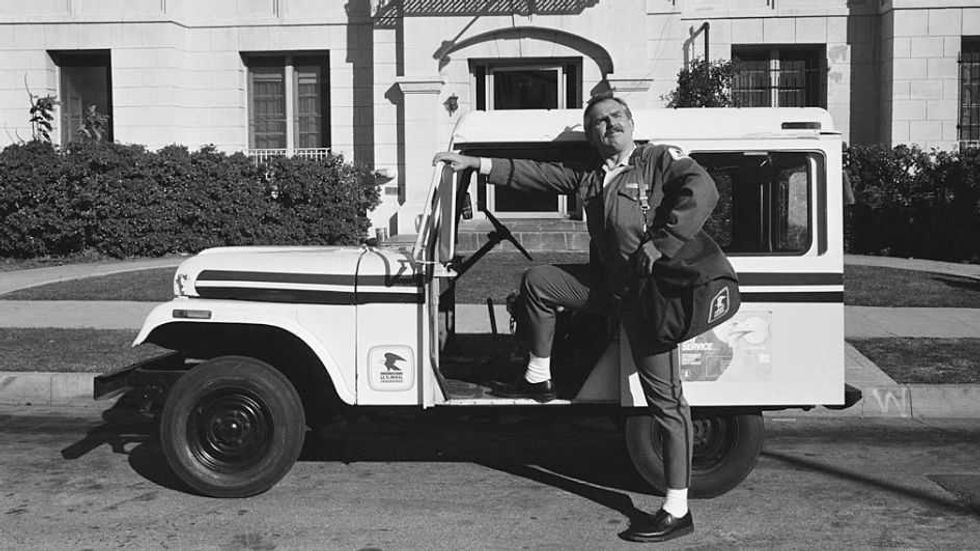
For generations, the occupational menace most closely associated with the American mail carrier has been the dog. That danger remains very real. More than 5,200 Postal Service employees were attacked by dogs last year. Carriers are trained to use their mail satchels as shields and are even equipped with dog repellent.
But lately, some carriers have considerably more to worry about than the neighborhood Rottweiler.
Robberies of postal workers have exploded. In 2019, there were roughly 90 reported nationwide. By 2023, there were about 600 — many involving firearms — a nearly sevenfold increase in four years.
Why would anyone suddenly start mugging the mailman?
Part of the answer is obvious: What he carries is valuable. Personal checks can be altered, cashed, or sold online. Credit cards and financial documents can feed other forms of fraud. Stealing a tub of mail gives a criminal dozens or potentially hundreds of opportunities to find something worth money.
But criminals also discovered that some postal workers carry something even more valuable than the mail itself: an arrow key.
Unsafe deposit
Arrow keys are the master keys many mail carriers use to access collection boxes and other secured mail receptacles along their routes. Stealing one batch of mail gives a thief whatever happens to be inside it. Stealing the right key can provide access to multiple mailboxes, allowing criminals to come back again and again.
The criminal calculus isn't difficult to understand. A mail carrier travels a predictable route, often alone and on foot. He may be carrying checks, credit cards, financial documents, and a key capable of opening numerous secured mailboxes. Compared with robbing a bank or armored truck, attacking a postal worker can look to a criminal like a relatively easy route into somebody else's bank account.
Once criminals obtain the mail, old-fashioned paper becomes raw material for thoroughly modern fraud. Stolen checks can be altered or resold. Credit cards can disappear before their intended recipients even know they have arrived. Personal information extracted from correspondence can be combined with data obtained elsewhere.
The result is that an institution built to move birthday cards, utility bills, tax documents, and catalogs around the country has inadvertently become part of a lucrative criminal supply chain.
Pen pals
But attacking postal workers has an obvious drawback: It attracts federal law enforcement attention, carries serious criminal penalties, and creates witnesses.
So organized criminals eventually discovered another option. Why rob the postal worker when you can recruit him?
The U.S. Postal Service inspector general has warned that criminal organizations are actively targeting postal employees because of their privileged access to the nation's mail network.
In 2022, Missouri mail carrier Cambria Hopkins sold her arrow key to a criminal and told him which collection boxes it opened. She later stole checks from the mail and sold those too, receiving payment in cash, through Cash App, and sometimes in groceries. Earlier this year, she was sentenced to a year and a day in federal prison.
Package deal
The money involved can become enormous. In Mobile, Alabama, postal employee Kalaijha Tomeco Ranier Lewis was recruited by Brian Christopher Williams III as part of a check-fraud scheme that operated from 2021 to 2023. Lewis stole hundreds of high-value business checks destined for P.O. boxes. Investigators later watched her manipulate windowed envelopes as she sorted the mail, checking the dollar amounts inside before deciding which ones to take. Williams paid her between $2,000 and $3,000 for each stack she delivered.
In June 2023, investigators caught Lewis stuffing a stack of stolen checks down her pants. They arrested Williams later that day at a Mobile gas station, where he had arrived to buy the checks. He was carrying $10,000 in cash; authorities also found drugs, a handgun, and stolen checks worth more than $417,000.
Over the course of the scheme, Williams altered stolen checks totaling more than $17 million and sold them to other scammers through an illicit marketplace on Telegram. Lewis was sentenced to five years in federal prison; Williams got eight. The pair were also ordered to pay more than $234,000 in restitution.
Phony express
In Chicago, members of a street gang began recruiting postal workers as early as 2017. One of the first was a young female carrier spotted grocery shopping in her USPS uniform. A gang member approached her with a proposition: Make some money on the side by pulling particular envelopes from the mail and handing them over.
She agreed, smuggling stolen mail out in her uniform and handing it off during her route or after work. At first, she received large amounts of cash and expensive gifts. Then the money dwindled and, according to the Postal Service's inspector general, her recruiter threatened her life when she tried to stop.
The operation eventually grew to include 35 postal employees and 13 outside suspects, compromising more than 200 ZIP codes and at least 10,300 victims. Employees stole checks, credit cards, Treasury checks, cash, and personal information; some workers at processing plants were caught walking out with garbage bags full of mail.
Investigators put actual losses at more than $6 million, with another $46.6 million in intended losses. Twenty-seven defendants were ultimately convicted, and the ringleader received nine years in federal prison.
RELATED: New study: One Chinese cyberattack could make your taps run dry
 Dmytro Buianskyi/Getty Images
Return to sender
The Postal Service has been fighting back: replacing vulnerable locks, installing more secure collection boxes, and moving toward electronic alternatives to traditional arrow keys.
But the basic attraction is difficult to eliminate. Every day, an enormous government delivery network moves checks, credit cards, financial documents, and other valuables directly through American neighborhoods, often entrusted to individual employees working alone.
Although it is not an official motto, generations of Americans know the words carved above the entrance to Manhattan's old General Post Office: “Neither snow nor rain nor heat nor gloom of night stays these couriers from the swift completion of their appointed rounds.”
Perhaps its time for an update: nor the robber who wants the mailbag. Nor the gang member who wants the key.
And now, apparently, nor the criminal recruiter offering enough money to make betraying the public trust look tempting.
More from this network:
Domains for Sale · GOTPeople.org · TheDSAPlatform · The Truth About Socialism
What's Your Reaction?
 Like
0
Like
0
 Dislike
0
Dislike
0
 Love
0
Love
0
 Funny
0
Funny
0
 Wow
0
Wow
0
 Sad
0
Sad
0
 Angry
0
Angry
0

I am just an average American. My teen years were in the late 70s and I participated in all that that decade offered. Started working young, too young. Then I joined the Army before I graduated High School. I spent 25 years in, mostly in Infantry units. Since then I've worked in information technology positions all at small family owned companies. At this rate I'll never be a tech millionaire. When I was young I rode horses as much as I could. I do believe I should have been a cowboy. I'm getting in the saddle again by taking riding lessons and see where it goes.
Premium domains for sale





















Comments (0)