

Gay adoption: The societal experiment nobody is supposed to question
Premium domains for sale
Freedom Is Back In Style
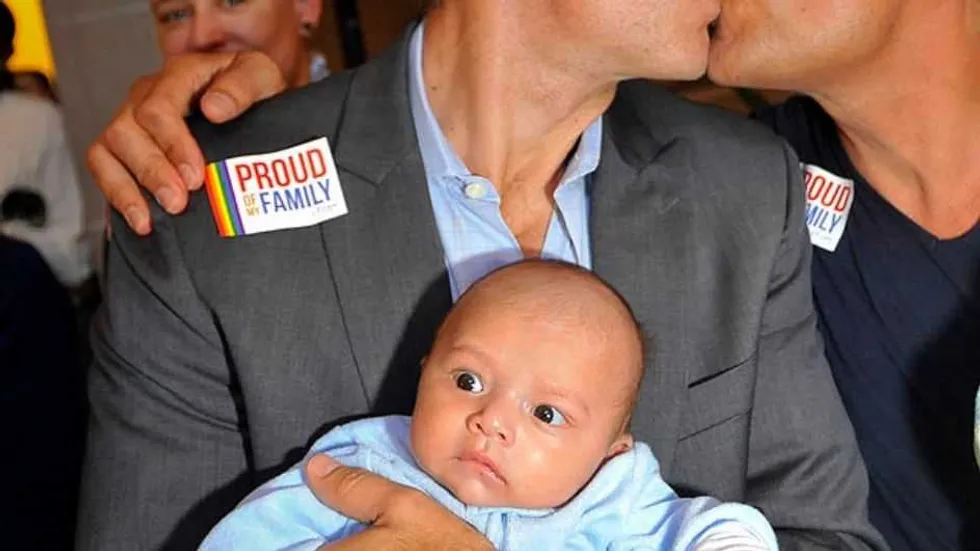
A video recently surfaced online featuring a young American who proudly insisted that same-sex couples make better parents than the boring old bread-and-butter type.
Freedom Is Back
In Style
Premium domains for sale
The ferociously fabulous man then casually revealed that he has three lesbian mothers, two gay fathers, and an array of gay siblings.
For thousands of years, human societies operated on the assumption that mothers and fathers were not interchangeable.
Notice how far the argument has traveled. The cultural case for same-sex parenting once rested largely on tolerance: Gay couples could provide loving homes, and their children should not be stigmatized. Increasingly, the claim is something altogether different — that mothers and fathers are interchangeable, perhaps even that dispensing with one sex represents an improvement.
Luxury beliefs
Right around the time the video started circulating, an interactive global map showing where same-sex adoption enjoys full legal approval and where it remains strictly forbidden caught my eye.
The map is fascinating because it presents a hilarious study in regional priorities. Virtually the entire Western world glows a self-righteous green, while moving eastward reveals solid red. Western progressive elites view that field of green as proof positive that we have ascended to the absolute peak of human enlightenment, having successfully dethroned the ancient, oppressive concept of a mother and a father.
But there's a question buried beneath all the celebration that we're increasingly discouraged from asking: Does family structure actually matter to children?
For thousands of years, human societies operated on the assumption that mothers and fathers were not interchangeable. A child ordinarily entered the world through a mother and father and, absent death, abandonment, abuse, or some other misfortune, was raised by them.
Modern Western culture increasingly treats that arrangement as merely one family configuration among many.
According to modern woke gospel, men are the sole source of domestic chaos and toxic aggression. The cultural narrative assures us almost daily that women are inherently more empathetic and nurturing. They are spiritually elevated beings. Taking that logic to its obvious endpoint, a household featuring two mothers ought to function like a conflict-free utopia of artisanal organic snacks and gentle conflict resolution.
The empirical picture, however, is considerably less settled than activists often pretend.
Widespread transformation
What makes this all the more important is that this is no longer a marginal social development. According to the Williams Institute, approximately 5 million American children are being raised by an LGBTQ parent. That figure includes single LGBTQ parents and shouldn't be confused with the much smaller number living with same-sex couples. But it gives some sense of the scale of the transformation.
Within little more than a generation, same-sex marriage went from legally nonexistent to the law of the land. Gay adoption followed. Reproductive technologies now allow children to be deliberately conceived for families in which either a mother or a father will be absent from the beginning.
We have changed not merely laws but one of society's most basic assumptions about the family: that all things being equal, a child should have a mother and a father.
Given the scale and speed of that change, asking what effects it may have on children should hardly be controversial.
 Pinellas County Sheriff's Office composite
Regnerus redux
In 2012, University of Texas sociologist Mark Regnerus published findings from the New Family Structures Study, which surveyed nearly 3,000 young adults and reported substantial differences between those who grew up continuously with their married biological parents and respondents whose mother or father had engaged in a same-sex relationship. Among the findings, 23% of respondents in Regnerus' "lesbian mother" category reported having been sexually touched by a parent or other adult, compared with roughly 2% of those raised continuously by their married biological parents.
That finding does not mean the lesbian mother or her partner committed the abuse. Indeed, one of the central controversies surrounding the study was how Regnerus constructed the category in the first place.
Critics argued that Regnerus had defined his categories too broadly. Many respondents classified as having a gay or lesbian parent had spent relatively little time living with that parent's same-sex partner, while many had experienced divorce or repeated changes in family structure. Subsequent re-analyses argued that once those factors were handled differently, many of Regnerus' headline findings lost statistical significance.
For years, that critique was treated as essentially the last word.
Then, in 2025, Cornell sociologists Cristobal Young and Erin Cumberworth subjected the Regnerus data to a much more exhaustive test. In their book "Multiverse Analysis," published by Cambridge University Press, they ran roughly 2.6 million alternative model specifications to determine how much Regnerus' results depended on debatable analytical choices.
They expected the exercise to vindicate his critics. It didn't.
Persistent effects
Young and Cumberworth found that the estimated negative association was often smaller under alternative specifications but remained remarkably persistent. Their conclusion was limited but important: There was room to debate the size of the effect and the quality of the underlying data, but within the NFSS dataset, the negative association could not simply be dismissed as an artifact of Regnerus' preferred statistical choices.
That doesn't establish that same-sex parenting caused the negative outcomes Regnerus identified. But it makes it harder to maintain that the evidence is so settled that questioning whether family structure matters amounts to bigotry.
Other research has produced similar disputes.
Methodological muddle
In 2010, Stanford sociologist Michael Rosenfeld analyzed U.S. census data and concluded that the school progress of children living with same-sex couples could not be statistically distinguished from that of children living with married heterosexual couples.
Two years later, Douglas Allen, Catherine Pakaluk, and Joseph Price re-analyzed the same data. Rosenfeld had restricted his main sample to children biologically related to the household head who had lived at the same address for at least five years. Allen and his colleagues argued that those restrictions removed more than half the available children and made differences harder to detect.
Using the larger sample and controlling for those factors instead, they found that children living in married heterosexual households had 35% higher odds of making normal progress through school than children living with same-sex couples. The difference was statistically significant.
The same census data, in other words, produced different results depending on which families researchers included and how they accounted for biological relatedness and stability.
Biological advantage
D. Paul Sullins encountered a related problem using federal health-survey data. His 2015 analysis of more than 200,000 children, including 512 living with same-sex couples, reported higher rates of serious emotional problems, ADHD, and learning disabilities among children in same-sex-parent households.
When Sullins accounted for whether children were living with their biological parents, however, much of the same-sex-parent disadvantage disappeared.
That raises another question about how these studies are constructed. Two men or two women cannot both be the biological parents of the same child. So when researchers "control" for biological relatedness, they may be removing a confounding variable — or they may be controlling for a difference that is inherent in the family structures being compared.
A 2016 Demography study by Corinne Reczek and three colleagues further illustrates the difficulty. Using federal health data on more than 167,000 children, the researchers found that children living with married same-sex parents were similar to those with married opposite-sex parents on most of the outcomes studied. They did, however, find that children with married same-sex parents were more than twice as likely to be reported as having behavioral problems after demographic and socioeconomic controls.
The study had important limitations. The same-sex sample was small, the behavioral measure relied on parental reporting, and the data could not establish causation. The National Center for Health Statistics also later disclosed classification errors affecting the identification of same-sex married couples during several of the survey years. Sullins subsequently argued that excluding those years materially changed some of the results.
Beyond statistics
None of these studies settles the question. Together, they suggest that the research is much less straightforward than the familiar claim that children do equally well in every family structure.
And family structure matters for reasons that extend beyond statistics. A mother and father offer something that two men or two women, however loving and devoted, cannot: a child's daily relationship with both sexes embodied in the two people from whom that child came.
Recognizing this doesn't require believing that every heterosexual marriage is happy, every biological parent is competent, or every alternative family is dysfunctional. Plenty of biological parents are disastrous. Plenty of adoptive parents perform heroic acts of love by giving children stable homes after circumstances have deprived them of their biological families.
But exceptions don't erase ideals.
The distinction becomes especially important when adoption is involved. Adoption has traditionally existed to find families for children who, through some misfortune, cannot be raised by their biological parents. Increasingly, the debate is framed from the opposite direction: around adults' entitlement to form whatever kind of family they desire.
The interests are not necessarily identical.
The question isn't whether gay people can love children. Nor is it whether children raised in unconventional families can grow into happy and successful adults.
The question is whether mothers and fathers provide children with something distinctive enough that society should continue to regard their union as the ideal environment for raising the next generation.
We have changed our answer to that question with extraordinary speed, and millions of children are now growing up on the other side of that change.
Surely we are still allowed to ask whether we got it right.
More from this network:
Domains for Sale · GOTPeople.org · TheDSAPlatform · The Truth About Socialism
What's Your Reaction?
 Like
0
Like
0
 Dislike
0
Dislike
0
 Love
0
Love
0
 Funny
0
Funny
0
 Wow
0
Wow
0
 Sad
0
Sad
0
 Angry
0
Angry
0

I am just an average American. My teen years were in the late 70s and I participated in all that that decade offered. Started working young, too young. Then I joined the Army before I graduated High School. I spent 25 years in, mostly in Infantry units. Since then I've worked in information technology positions all at small family owned companies. At this rate I'll never be a tech millionaire. When I was young I rode horses as much as I could. I do believe I should have been a cowboy. I'm getting in the saddle again by taking riding lessons and see where it goes.
Premium domains for sale
























Comments (0)