

I Looked Into Why Streaming Became Slop. This is How to Fix it.
Premium domains for sale
Freedom Is Back In Style
According to the most recent studies on the subject, the average American now subscribes to four different streaming services. Many subscribe to five or six, or even more. Netflix alone has 325 million subscribers, which almost equals the entire population of the United States, not counting illegal aliens. And yet the surveys, and our own experience, tell us that most people aren’t satisfied with these services, and are only becoming less satisfied every day. We all have the impression that it’s just too much, there are too many of these platforms, and they’re only getting more expensive, as the service declines, and the one major promise of streaming — that we wouldn’t have to deal with ads — has been almost entirely abandoned at this point.
Freedom Is Back
In Style
Premium domains for sale
What’s more, it seems that these services are bad for movies themselves. The art of filmmaking has declined. While streaming services are ubiquitous, the movies and shows themselves feel somehow more marginal, less relevant than ever before. The Oscars happened this past weekend, and nobody noticed or cared because nobody noticed or cared about any of the movies that were nominated. So what’s really happening here, and why? We have done a series of deep dive explorations into various facets of American cultural life, trying to figure out why the quality of everything is on the decline.
In a word, everything kind of sucks now.
Why is that? What’s going wrong? That’s what we’ve been trying to figure out. Well, speaking of things that suck, these streaming services certainly fit the bill, and so do most of the movies and shows they charge us exorbitant fees to access. Why? Let’s explore that question.
Start with the fact that everything is bundled now. Roughly 85% of subscribers to Amazon Prime Video are also subscribers to Amazon Prime, which supposedly gets you faster shipping on some items. Relatively few people subscribe to Prime Video all by itself.
Meanwhile, millions of people have access to Netflix and Hulu through a deal with their cellphone carrier, usually T-Mobile or Verizon. The reason that the streaming services offer these bundles is that they’re worried about “churn,” which means losing customers. Churn is reduced — by a significant margin — when customers have Netflix or Hulu as part of a bundle with their carrier. Bundles are complicated to cancel, for one thing. They might be presented as a “free add-on,” when in reality, you’re definitely paying for it. And maybe most importantly, when you have a Netflix/T-Mobile bundle, you’re likely to be less demanding about the content on Netflix. Over time, you naturally come to see Netflix as a component of a larger, necessary contract with your phone carrier. And that’s exactly how Netflix (and the other streaming services) want you to perceive things. Amazon doesn’t have to justify its cost increases if everyone thinks of “Prime Video Ultra” as a necessary component of “Amazon Prime.”

The other part of the problem — one of the reasons why it’s hard to evaluate the value of the various services — is that they lose the rights to shows and movies all the time. Netflix acquired the rights to “Seinfeld” in 2019, but you have no idea if they’ll have the show in 2027, because the licensing deal expires at the end of this year. On top of that, even when a show is available, you have no idea if it’s going to be the original version. There’s no streaming service that offers “Scrubs” as it originally aired, for example. The licensing rights to the music — which is a big part of the show — were simply too big a hassle to renew.
To give another example — the version of “Seinfeld” that’s on Netflix is widescreen, even though the show was never intended to be widescreen. For the Netflix version, they simply cropped the original image so that it fits widescreen TVs. That means they deleted some of the content on the top and bottom of the image, in every frame. And the result is that the show looks very different from how it originally aired. That may seem like a small issue, and maybe it is in the grand scheme, but it’s more significant than you might think. If we look at films and shows as pieces of art — which they are, or should be — then it’s a problem that these services are making alterations to the art, as they see fit.
The only way to avoid these kinds of changes is to buy physical media that streaming services can’t mess with. You can buy “Seinfeld” on 4K Blu-ray, for example, complete with the original formatting and a bunch of special features and so on (And indeed, a lot of people are doing that now. There’s a whole market for physical media that’s undergoing something of a renaissance at the moment). But as it stands, there’s simply no legal way to stream this show in its original broadcast format.
Unless you’re an extremely devoted “Seinfeld” fan, you probably weren’t aware of this. And you probably aren’t aware of the many, many other ways that streaming services mess with the content you think you’re getting.
On Hulu, you can’t access five episodes of “It’s Always Sunny in Philadelphia,” because they were retroactively “canceled” during the BLM hysteria. Basically, any episode where a character appears in blackface — even if the point of the gag is to mock Danny DeVito for wearing blackface — has been erased from memory. If you subscribe to Hulu, this is never explained to you. They act like you’re getting the whole show. But you aren’t.
Many other shows have similar banned episodes, for similar reasons. NBC removed four episodes of “30 Rock” for depictions of blackface (which, again, weren’t even endorsing the idea of blackface, but whatever). The “Community” episode entitled “Advanced Dungeons & Dragons” was nuked from streaming services as well, because the Asian comedian dressed up as a “Dark Elf.” And Comedy Central/Viacom took five episodes of “South Park” offline because they depicted Mohammed in an unflattering manner, which is a capital offense in the Muslim world (which we’ve now imported to the United States). So they decided to stick to mocking Jesus, Christians, and Trump voters instead. This is one of the reasons comedy is dead, by the way. All of the comedians are cowards.
What’s important to emphasize here is that, while it’s obviously very bad that these streaming services are censoring shows (without even admitting it), this censorship is a symptom of a much larger problem. The problem is not simply that wokeness has run amok, or that Left-wing DEI bureaucrats have taken over the entertainment industry — although that’s all true. The real problem is, in part, that all of this content exists in the ether, and you access it through subscriptions. Even if you “buy” a streaming movie on Amazon, you still only have access to your purchase as long as you have your Amazon subscription. The death of physical media means that nobody owns any particular piece of media anymore.
When I was a kid, we had a physical library of physical copies of our favorite films. We would watch those films over and over again. What this meant was not only that the movies couldn’t be retroactively changed or censored, but also that we got to know these movies; they became a part of our lives in a way that no movie today ever will be, because it always exists in the digital cloud, one bit of content in an endless scroll of other bits.
This is how it works now across the board. In every area of life, we’re confronted with an infinite number of options. This plagues society at every level. You go to the store for ketchup, and there are like 97 different types and brands. The same is true of cars, watches, dating apps, clothing, and so on. It’s too many choices. It’s overwhelming, overstimulating. You commit to one and then worry that maybe that one or that one or the other one would have been better.
And along the same lines, as mentioned, there is no communal experience of film anymore. Everyone’s watching different things. We aren’t experiencing the stuff together. The movies at the Oscars today aren’t necessarily worse than Oscar movies 30 years ago. Sometimes they are. But it’s more that they exist in a fractured cultural landscape, so none of them make any real impact. That’s why it was so weird to see them win awards the other day. Say what you want about a movie like, say, “Titanic” (an example I’ve used in the past), but that was an absolute cultural sensation in a way that no film today is or probably ever could be.
To give you an idea of what I’m talking about: Here are just some of the movies that received Oscar nominations in 2004, more than two decades ago.
See how many of them you’re familiar with: “The Lord of the Rings: The Return of the King,” “Seabiscuit,” “Master and Commander,” “The Last Samurai,” “Mystic River,” “Lost in Translation,” “Finding Nemo,” and “Pirates of the Caribbean.”
Even though these are now relatively old films, there’s a pretty good chance you’ve seen several of those movies, and you’ve probably heard of all of them. Many of them are classics.
Now let’s look at the major Oscar nominees from 2026. Here’s what we have: “Sinners,” “Marty Supreme,” “One Battle After Another,” “Blue Moon,” “The Secret Agent,” “Sentimental Value,” “Bugonia,” “If I had Legs I’d Kick You,” “Zootopia 2,” “Arco,” “Weapons,” and “F1.”
Again, these aren’t all necessarily bad movies. Some of them are. Some of them, like “Weapons,” are actually pretty good. And all of them are technically sophisticated filmmaking. They’re all “well made” from a technical perspective. But most people haven’t heard of about 90% of them. It’s not just that most people haven’t seen them. Most people don’t know they exist. And we certainly won’t be talking about any of these films in 20 years. They’ll be forgotten because we’re all watching different things, and there are so many choices, such an infinite array of options all the time, that no particular piece of content can remain in our consciousness for very long.
That’s why ratings are down, by the way.
This is from The Hollywood Reporter:
Sunday’s 98th Academy Awards drew 17.86 million viewers on ABC and Hulu, based on Nielsen’s big data plus panel ratings. That’s down about 9 percent from last year’s Oscars, which drew 19.69 million viewers for a post-pandemic high, and the smallest audience for the awards since 2022, when 16.68 million people watched. The show delivered a 3.92 rating among adults 18-49 (equivalent to about 5.34 million people in that age group), a 14 percent decline from last year.
So they dropped 14% in the key demographic, and that’s including streaming numbers. They tried to boost the numbers as much as they could, and it’s still a big drop. Unless some kind of stunt is involved — say, someone gets slapped on stage, they announce the wrong “Best Picture” winner — then there’s basically no one who even pretends to care about the Academy Awards anymore.
For comparison, the Oscars had around 45 million views in 1996, the year “Braveheart” won. And they had more than 34 million viewers in 2016, just a decade ago. Now they’re down to 18 million, including a streaming audience, which mostly isn’t paying attention. Is “Braveheart” a better movie than the ones that were nominated this year? I think it certainly was, yes. But this isn’t just about it being a better movie. The point is that “Braveheart” was a cultural phenomenon in a way that no Oscar movie today is, or ever could be. The proliferation of streaming and the internet generally has destroyed the communal experience of movie watching so much that it’s almost impossible for any film to be enjoyed, known, and loved by a majority of Americans. None of them can imprint themselves onto the zeitgeist the way that films of the 90s did.
And yes, it’s easy to point out that the Oscars implemented DEI, and they won’t give awards to productions that aren’t “diverse” in some way. That’s obviously a problem. But even without that handicap, these numbers probably wouldn’t be much better. I’m not going to wax poetic about the Blockbuster days, but the fact is, a lot of people are starting to think about how things were different back then.
I saw a post on X saying that this is a trailer for one of the most popular indie video games right now.
It’s a game where you play as a clerk at a video store like Blockbuster.
Two indie devs made a game where you run your own video store in the early 90s. It’s currently the #5 top-selling game on Steam.
– Rent out VHS tapes & manage customers
– Charge Late & Broken Fees
– Upgrade & customise your storeIt’s called Retro Rewind – Video Store Simulator pic.twitter.com/LIrpX4QI9M
— Indie Game Joe (@IndieGameJoe) March 17, 2026
Source: @IndieGameJoe/X.com
You just stand behind the desk, hand out the movies, make sure people hit the “rewind” button, and so on. That’s what passes for entertainment today, apparently. So the video game industry is in even worse shape than I thought.
But actually, there’s a reason that game is so popular. People are nostalgic for the pre-smartphone, pre-streaming era. It used to be that, if you wanted to watch a movie, you had to make a commitment. You had to plan your night around it. You had to physically drive to a store, scan the shelves, do some research yourself, talk to the clerk, and bring it home. It was an experience. There was a sense of community in it. And then you would take the movie home — just the one, or maybe a couple — and you’d watch the movie you rented. Actually sit and watch it, with no other screens distracting you. If you liked it, maybe you’d watch it again the next night. And then you’d return it. Or you wouldn’t return it, and you’d rack up late fees until you had to go get a membership at the Blockbuster across town under a fake name. But either way, the experience was very different. It was a different experience because watching a film was an experience in a way that it isn’t today.
By contrast, as Matt Damon recently pointed out, modern streaming services have a very different audience. Their audience puts zero effort into finding a show to watch. They just throw it on the screen while they scroll through TikTok on their phones. And the streaming companies realize that. So they have to dumb everything down to the lowest common denominator.
Watch:
Matt Damon and Ben Affleck on Rogan taking about how Netflix has changed filmmaking.
“you re-iterate the plot 3-4x in the dialogue because people are on their phones.”
pic.twitter.com/YxybQJQubE— cinesthetic. (@TheCinesthetic) January 17, 2026
Source: @TheCinesthetic/X.com
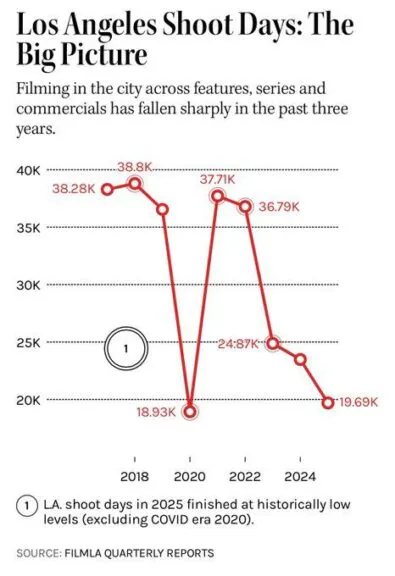
It’s not just that the writing has become more repetitive, formulaic, and dumbed down. The other issue is that, in more and more cases, these shows are basically being generated by a computer. You have AI writing the scripts, and you have computers generating all of the scenery. That’s one reason why, in Los Angeles, the number of film shoots has plummeted to COVID levels.
This is from the Hollywood Reporter, once again:
FilmLA Quarterly Reports
You can see the graph there. It certainly looks like the entertainment industry is in free-fall. And if you watch enough streaming shows, you’ll quickly realize what’s going on. No one’s actually going outside and filming anymore, because computers can do it all by themselves.
Consider this viral scene from the film “Carry-On,” which streams on Netflix. It’s a movie about a TSA agent who’s blackmailed into letting a nerve agent onboard a plane. I actually watched this thing, for some reason, and I can report that it is the dumbest movie ever made. But in any event, here’s the big obligatory action sequence.
Watch:
Source: Computer/YouTube.com
Some people with shockingly low standards praised this scene, because it’s one of those “single take” sequences that isn’t actually a single take. Really, it’s completely unconvincing in every way. You can tell that these people aren’t really in a car. There’s no sense of physics, momentum, or plausibility. They look like they’re in front of green screens, because that’s exactly what’s happening.
They had more convincing, and more authentic, car chases in the 1960s. Films like “Bullitt” were much more interesting and watchable than whatever this is. In 2005, before the streaming era, the budget didn’t go entirely to CGI.
It went to scenes like this one.
Season 1 of Rome (2005) cost $100 million, making it the most expensive show of its time. The crew built a five-acre replica of the Roman Forum at Cinecittà Studios using real marble to ensure the city felt authentic rather than like a movie set.
pic.twitter.com/rDh7HwhdiW— Best Movie Moments ???? (@BestMovieMom) March 16, 2026
Source: @BestMovieMom/X.com
It’s from the first season of the HBO series “Rome.” The crew built a five-acre set, which is part of the reason the production cost over $100 million. The goal was to make everything look as believable as possible. And they succeeded. Now the goal is to make everything look like a video game.
When you watch streaming films and shows, that’s what you get now: A video game. This is what you’re paying an ever-increasing amount of money for, along with your fake “2-day shipping” and your phone bill. Just like your Amazon purchases with 2-day delivery or whatever, streaming shows are now a generic commodity, served up without any artistic vision or integrity whatsoever.
And then to top it off — partially as a consequence of the above — attention spans are shot to hell.
Algorithms know all of this. They feed off of it. The streaming services help to cause the decline in attention spans, and also profit from it. This is a real phenomenon, by the way. A recent report suggests that attention spans have dropped by up to 70% in the last 20 years. This isn’t due to any mysterious epidemic of ADHD. It’s because we have an infinite amount of content streaming into our faces all day, every day. So this has the potential to be a terminal decline, in other words.
It will continue until the moment it stops being profitable. Until there’s a “crash” in the entertainment industry — which could be happening, based on that data from Los Angeles — the amount of “content” will continue to increase exponentially. The monoculture will remain a thing of the past. And one by one, without even telling you, these streaming services will continue to retroactively mess up the shows you like, while flooding you with shows that no sane adult would ever want to watch. Soon — sooner than you think — thanks to AI, the streaming algorithms will be generating entire films, by the thousands every day. It will generate films just for you, kind of like how Spotify will generate a playlist based on the songs you listen to. This will be the moment when popular culture is destroyed forever. We won’t have any kind of shared experience of anything anymore.
On the other hand, in theory, if enough people collect their own physical media and cancel the monthly payments they’ve probably forgotten about, then these streaming services won’t be profitable for long. And eventually, if we maintain that pressure, we could revive an important part of American culture that, for the past few decades, has been vandalized and looted beyond recognition. The people who somehow made “Star Trek” even gayer than before, and the people who butchered “Seinfeld” and everything else are not geniuses. But they aren’t suicidal, either. They respond directly to incentives. The moment we stop paying for their slop, they will relent. The deluge will stop. And eventually, Hollywood will do something it hasn’t done in decades: They’ll produce worthwhile films that people actually want to see, and that millions of people will want to see together, without a cellphone glued to their hand.
We are on a trajectory, heading into the total obliteration of anything that can be properly described as a culture. But we don’t have to stay on it. We do have other options. We can put the phones down. Cancel some of these services. And intentionally choose to reclaim some semblance of a shared culture.
I don’t have a lot of faith that we’ll make that choice. But we can.
In the end, it’s up to us.
More from this network:
Domains for Sale · GOTPeople.org · TheDSAPlatform · The Truth About Socialism
What's Your Reaction?
 Like
0
Like
0
 Dislike
0
Dislike
0
 Love
0
Love
0
 Funny
0
Funny
0
 Wow
0
Wow
0
 Sad
0
Sad
0
 Angry
0
Angry
0

I am just an average American. My teen years were in the late 70s and I participated in all that that decade offered. Started working young, too young. Then I joined the Army before I graduated High School. I spent 25 years in, mostly in Infantry units. Since then I've worked in information technology positions all at small family owned companies. At this rate I'll never be a tech millionaire. When I was young I rode horses as much as I could. I do believe I should have been a cowboy. I'm getting in the saddle again by taking riding lessons and see where it goes.
Premium domains for sale




Comments (0)