

Inside War Secretary Pete Hegseth’s Trip to Singapore
Premium domains for sale
Freedom Is Back In Style
Secretary of War Pete Hegseth said American relations in the Indo-Pacific are stronger than ever after he crossed the ocean to meet with his counterparts in Singapore.
Freedom Is Back
In Style
Premium domains for sale
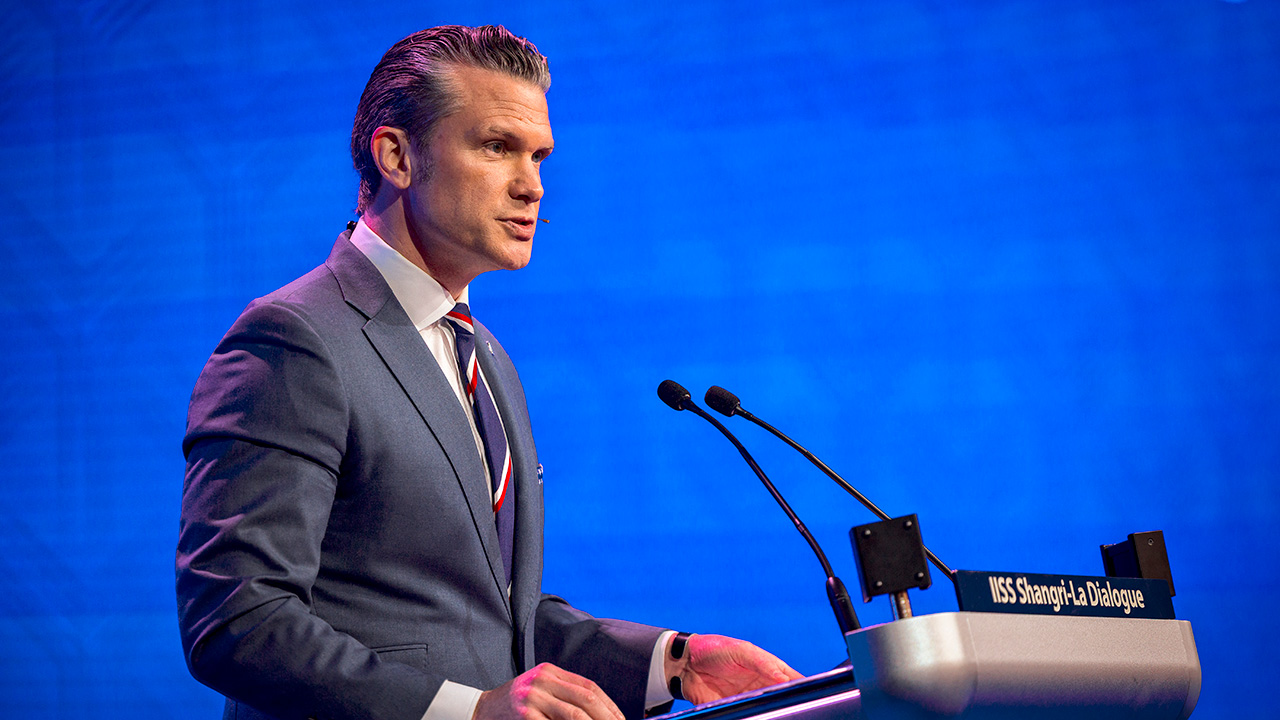
Hegseth spoke at the Shangri-La Dialogue conference, an Asia security summit, in Singapore, and held bilateral meetings with Indo-Pacific leaders on issues facing the region. The Daily Signal joined Hegseth in the press pool.
Hegseth landed in Singapore early Friday morning local time.
— Elizabeth Troutman Mitchell (@TheElizMitchell) May 28, 2026
@SecWar is on the ground in Singapore for the Shangri-la Dialogue conference.
He will be meeting with various Indo-Pacific leaders.
Local time is 3:41 am. @DailySignal pic.twitter.com/I860CU3UO7
Friday
A few hours after landing, he jumped into physical training with American troops on the USS Boxer docked in Singapore.
In the early afternoon, Hegseth met with Singapore’s Prime Minister Lawrence Wong, who welcomed him back to the country and acknowledged the United States has “many preoccupations,” including the situation in the Middle East. He added that the U.S. has “significant interest in this part of the world.”
Hegseth responded that the U.S. is a “country with global obligations, but very much a focus in this region.”
Hegseth then commenced his meetings with regional leaders, starting with a bilateral meeting with Vietnam’s deputy prime minister and minister of national defense, Gen. Phan Van Giang.
They discussed deepening the defense relationship and opportunities to expand cooperation in the maritime domain, including through unmanned capabilities.
Hegseth thanked Vietnam for being a stabilizing force in the region.
“We have a lot of ways we can build upon this partnership, which our defense teams have talked about with your leadership and the leadership of President [Donald] Trump,” Hegseth said, “that I think demonstrates to the world that two countries who just a few decades ago had differences look at the world today with mutual respect and respect for sovereignty and our people and commit to new paths forward in partnership and peace.”
Hegseth had several more meetings with his Malaysian and Thai counterparts before attending the Shangri-La opening dinner, where the president of Vietnam gave a keynote address.
Saturday
Saturday began with Hegseth’s address to Shangri-La. He said Western Europe should learn from the United States’ relationship with Asia.
“We need partners, not protectorates,” he said. “We seek alliances built on shared responsibility, not dependency. This is the maturation of our alliances in a new era.”
Hegseth acknowledged alarm about “China’s historic military buildup and the expansion of its military activities in the region and beyond.” He said the U.S. and Indo-Pacific nations share a “mutual understanding that a Pacific dominated by any hegemon would unwrap the regional balance of power and undermine people that were in it we all seek to preserve.”
“The Department of War is working with the utmost focus to prevent any such unraveling,” he said.
Hegseth said that U.S. relations with China are stronger than they’ve been in years, and Trump’s recent conversations with Chinese leader Xi Jinping in Beijing reinforced this.
But the dialogue between Xi and Trump is not “capitulation,” Hegseth said.
Rather, it’s a “practical guardrail, ensuring the relationship our leaders seek at the top is preserved at every level,” he said.
— Elizabeth Troutman Mitchell (@TheElizMitchell) May 30, 2026
@SecWar said U.S. relations with China are stronger than they've been in years.
Trump’s conversations with President Xi reinforced these goals, per Hegseth.
“They agreed that the United States and China should build a constructive relationship of strategic stability based… pic.twitter.com/0BEwQhisTa
Hegseth then held meetings with his counterpart from the Philippines, Defense Minister Gilberto Teodoro, who praised Hegseth for his “very powerful speech,” which he said “made the intentions of the United States in this region clear.”
“I believe our alliance has never been stronger as we celebrate the 75th anniversary of the mutual defense stream,” Hegseth said.
Hegseth then met with defense chiefs from New Zealand and Japan before heading to the U.S. Embassy in Singapore for meetings with the AUKUS partners, an alliance of Australia, the United Kingdom, and the United States formed in 2021 to counter China’s influence in the region by building up all the military capabilities of all three countries.
Hegseth announced a new AUKUS agreement on unmanned undersea vehicles.
“The signature project will deliver a suite of highly adaptable multi-mission UUV payloads designed to support undersea operations and maintain our collective advantage in the maritime domain,” he said.
The United States “remains committed to the AUKUS partnership and is moving as quickly as possible to enhance our combined submarine presence in the Pacific region,” Hegseth added.
Before heading to the airport for the 20-hour flight back to Washington, D.C., Hegseth gave the Daily Signal an update on the war in Iran.
“Ultimately, like I said, any deal that the president is willing to make, he’s only going to make it if he believes it’s a great deal for our country and the security of the world, and only,” Hegseth said.
“Those goalposts haven’t shifted at all, which is the expectation of the American people, and what we’ve stated to Iran,” he added. “So, in the middle of negotiations, the closer they come to that reality, both now and into the future, the closer we’re going to get to that kind of a deal.”
He also told the Daily Signal the Trump administration’s policy on Taiwan hasn’t changed. After Trump’s Beijing visit, the president said he was undecided on sending arms to Taiwan, leading to speculation about whether the administration was departing from the United States’ historical stance on the country.
“The policy we have on Taiwan is the same as it was at the beginning of this administration,” he said in response to the Daily Signal’s question. “The only change you might see is how we talk about the entirety of it.”
“What I talked about today was strong, quiet, but clear, ensuring our allies know precisely where we stand,” he added, “whether it’s open in public or behind closed doors, and that’s why these meetings have been so important.”
Hegseth also told the Daily Signal that the United States and China agreed in Beijing to keep talking about mutually agreed-upon guardrails on artificial intelligence.
“You’ve got two things: You want to be able to set guardrails, but given the innovation capabilities of the United States of America, we also want to maintain an advantage and ensure that we can utilize that advantage responsibly as well. It’s emblematic of that competing tension,” he said.
“Guardrail conversations are productive between two strong countries, but it’s also our job to run the fastest, and certainly at the War Department,” he said, “we’re trying to do everything we can to maintain that.”
The press pool joined Hegseth on the flight back to Washington, where Hegseth landed at 4 a.m.
More from this network:
Domains for Sale · GOTPeople.org · TheDSAPlatform · The Truth About Socialism
What's Your Reaction?
 Like
0
Like
0
 Dislike
0
Dislike
0
 Love
0
Love
0
 Funny
0
Funny
0
 Wow
0
Wow
0
 Sad
0
Sad
0
 Angry
0
Angry
0

I am just an average American. My teen years were in the late 70s and I participated in all that that decade offered. Started working young, too young. Then I joined the Army before I graduated High School. I spent 25 years in, mostly in Infantry units. Since then I've worked in information technology positions all at small family owned companies. At this rate I'll never be a tech millionaire. When I was young I rode horses as much as I could. I do believe I should have been a cowboy. I'm getting in the saddle again by taking riding lessons and see where it goes.
Premium domains for sale






Comments (0)