

Supreme Court Defends Girls Sports in a Win That Stops Short of the Finish Line
Premium domains for sale
Freedom Is Back In Style
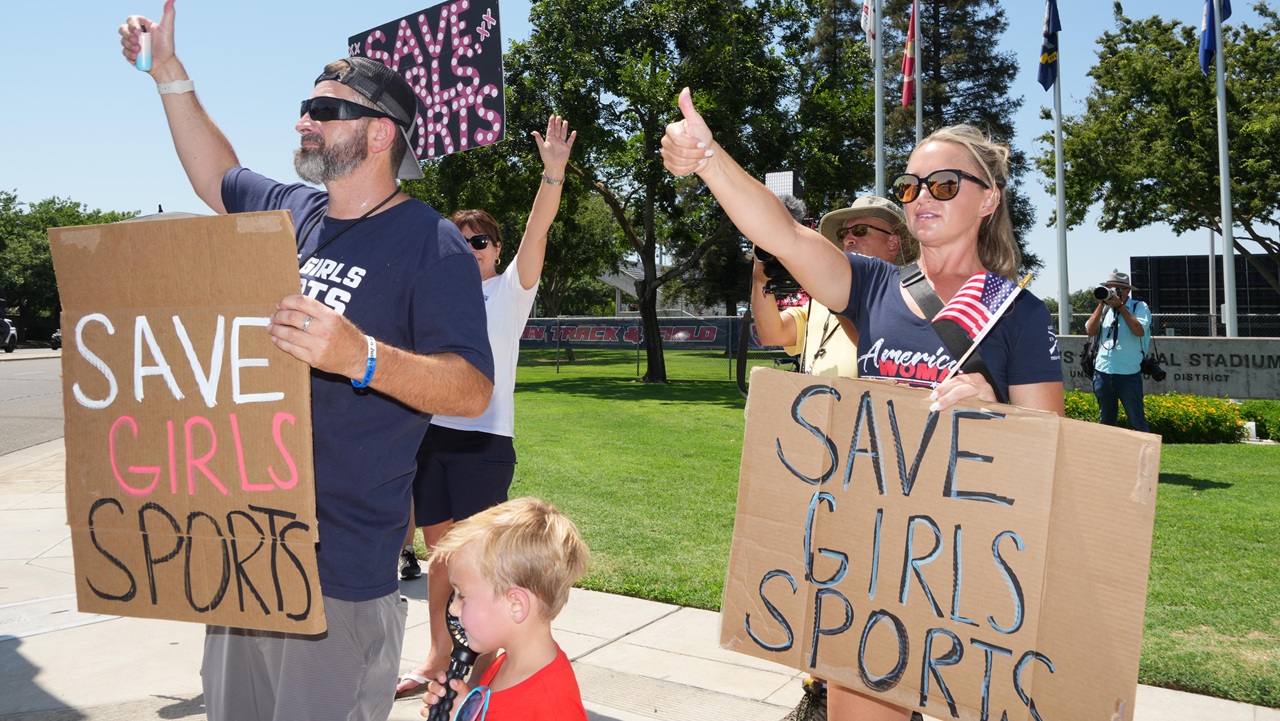
For years, American girls have lined up at the starting blocks only to lose races, scholarships, and records to males who “identify” as females. This morning, the Supreme Court finally said the obvious out loud: Schools can keep girls’ teams for girls.
Freedom Is Back
In Style
Premium domains for sale
In a 6-3 decision in West Virginia v. B.P.J., the court upheld laws in West Virginia and Idaho that reserve female sports for females. The question before the court was whether, under Title IX and the equal protection clause, schools may determine eligibility for female sports based on “biological sex.” On this, the court’s answer, at last, was “yes.”
The ruling rests on two pillars, one statutory and one constitutional.
First, the justices read Title IX to mean what its authors plainly intended. The term “sex” in Title IX cannot plausibly be interpreted to refer to anything other than, well, biological sex. (The phrase itself is redundant.)
This should never have been controversial. The plain meaning of “sex” when Congress passed the law in the early 1970s was sex, not “gender identity.” “Gender identity” was hardly even a concept 50 years ago.
On the narrower question of competitive sports, the court added a point any honest observer already knew: The whole reason we have sex-separate sports teams is the inherent biological differences between men and women.
The plaintiff, a male who “identifies as” female, argued for a carve-out: Schools should be forced to admit males who take puberty blockers or cross-sex hormones. The court rejected this claim. The majority concluded that separate sports teams for males and females are reasonable given the natural physical differences between the sexes. These differences can’t be erased with these drugs.
It also brushed aside the attempt to stretch Bostock v. Clayton County from the workplace into the schoolyard, holding that Title VII and Bostock are not relevant in the context of sports.
Second, the court held that these laws pass constitutional muster. West Virginia and Idaho did not violate the equal protection clause by restricting female sports teams to females. The justices agreed that the interests of safety and competitive fairness are legitimate, and that sex-based policies limiting women’s and girl sports to biological females are “substantially related” to those interests.
Also important: The court refused to bury schools in case-by-case litigation. States don’t have to compare the physical and athletic prowess of every male, case by case, to satisfy intermediate scrutiny. The justices saw the obvious practical problem: It would be well-nigh impossible for a judge to discern the effects of puberty blockers and hormones on every individual male in question and then compare him to the females he would compete against.
For those of us who have fought the long march of gender ideology through our institutions, this ruling is a victory. States can prohibit males, however they “identify,” from competing on female sports teams.
West Virginia and Idaho stood their ground, and the court backed them. So did a broad national consensus. In recent years, 27 states and various sports-governing bodies have all drawn the same line.
This is a real victory for the girls who have been injured or pushed off podiums and out of finals by males pretending to be female. In West Virginia, Idaho, and 25 other states, female athletes can now enjoy fair competition.
The justices affirmed that biology matters for safety and fairness in sports, yet they declined to settle the deeper question hanging over every one of these cases: What is a man, and what is a woman?
The Roberts court tends to decide cases as narrowly as possible. But the dodge has costs. Gender ideology does not confine itself to the track. It marches into locker rooms, bathrooms, prisons, hospitals, and classrooms. And it threatens the physical and emotional health of children.
A ruling rooted in the safety and fairness of sports gives girls a shield on the field, but it leaves the broader fight unresolved. And it leaves female athletes vulnerable in states that have opted for gender fantasy over biological (and moral) reality.
Sooner or later, the court will have to recognize what the laws of West Virginia and Idaho already say: Sex is a biological reality, and reality does not bend to foggy postmodern ephemera like “gender identity.” The sooner our highest court does so, the sooner the law can protect women and girls everywhere, not just at the finish line in some states.
For now, though, we’ll take the win. The court moved in the right direction, even if it stopped a few steps short of the finish line.
More from this network:
Domains for Sale · GOTPeople.org · TheDSAPlatform · The Truth About Socialism
What's Your Reaction?
 Like
0
Like
0
 Dislike
0
Dislike
0
 Love
0
Love
0
 Funny
0
Funny
0
 Wow
0
Wow
0
 Sad
0
Sad
0
 Angry
0
Angry
0

I am just an average American. My teen years were in the late 70s and I participated in all that that decade offered. Started working young, too young. Then I joined the Army before I graduated High School. I spent 25 years in, mostly in Infantry units. Since then I've worked in information technology positions all at small family owned companies. At this rate I'll never be a tech millionaire. When I was young I rode horses as much as I could. I do believe I should have been a cowboy. I'm getting in the saddle again by taking riding lessons and see where it goes.
Premium domains for sale





















Comments (0)