

It's time for a Cyber Monroe Doctrine

Premium domains for sale
Freedom Is Back In Style
When President James Monroe delivered his annual message to Congress in 1823, the United States was young, still fragile, and still finding its place among the great powers. Yet Monroe declared that the Western Hemisphere would no longer be treated as open territory for European colonization, manipulation, or imperial intrigue. Foreign powers would not be permitted to turn neighboring nations into strategic footholds against the United States. The Monroe Doctrine, as it came to be known, warned European powers that America would not tolerate further colonization or puppet monarchs in the Western Hemisphere.
Freedom Is Back
In Style
Premium domains for sale
More than simply setting a foreign policy, Monroe had drawn a line. And as America’s rivals and enemies changed over time, the doctrine rose to the occasion.
During the Cold War, it acquired renewed relevance as the United States confronted Soviet efforts to project power throughout Latin America and the Caribbean. Moscow understood that influence in the Western Hemisphere could give it strategic leverage against the United States without ever having to attack the American mainland directly.
America first, in other words, but not America alone.
Especially through Cuba and Nicaragua, the Soviet Union worked to turn America’s own neighborhood into a theater of anti-American power, fueling revolutionary movements in Central America, waging political warfare, and providing military, intelligence, and ideological support for Marxist insurgencies.
The Cuban Missile Crisis was not the only example of the Soviets’ forward operations, but it was the most dramatic. Moscow’s attempt to place nuclear weapons 90 miles from Florida marked the moment when the logic of the Monroe Doctrine became imperative. Here was an unprecedented fusion of strategic proximity and foreign penetration, in the attempted transformation of the American hemisphere into a platform for outside coercion.
But after the immediate crisis ended, the broader Cold War struggle in Latin America methodically intensified the Monroe Doctrine’s importance. Soviet and Cuban operations exploited instability across the region and pulled vulnerable states into the orbit of America’s geostrategic rivals. The United States did not view these efforts, which extended deep into South America, as distant foreign-policy disputes. It understood the hemispheric scope as a direct challenge to domestic security.
The lesson was simple: Hostile powers do not need to occupy Washington, or even reach American coastlines, to threaten American sovereignty. They only need to embed themselves in the surrounding systems on which American security depends.
Today, the same logic applies. But the hemisphere has changed. For the digital sphere, America needs a Cyber Monroe Doctrine.
The Trump administration’s understanding of cyber
Just as the original Monroe Doctrine recognized that foreign control over nearby territory could pose a direct threat to American security, a Cyber Monroe Doctrine would recognize that foreign control over digital systems could pose a direct threat to national survival. Hostile foreign powers must not be permitted to dominate, manipulate, surveil, or disable the digital infrastructure of the United States or the free world.
For too long, America has treated cybersecurity as a technical issue, as though it were mostly a matter of stronger passwords, better software patches, compliance checklists, and incident-response plans. Those things are important, but they are not enough.
No longer a back-office IT function, cybersecurity is national strategy.
Today, and from now on, a nation is not fully sovereign unless it can secure its ports, pipelines, hospitals, electric grid, military communications, water systems, election systems, law enforcement databases, pharmaceutical supply chains, and financial networks. It may have borders on a map, but if its digital nervous system is owned, surveilled, manipulated, or sabotaged by adversaries, its independence is compromised.
The modern state depends on systems most citizens never see, from food distribution, public health, and emergency services to banking, air travel, and energy production. Not just military readiness but also court systems, public health, and public debate itself depend on networks. But those networks depend on more than a falsely reassuring “cloud.” They rely on hardware, software, data, energy, spectrum, chips, rare-earth minerals, and, ultimately, human trust.
Together, these myriad elements make up a nation’s digital sovereignty, without which national survival cannot long endure.
RELATED: Inside the Pentagon's new high-tech army
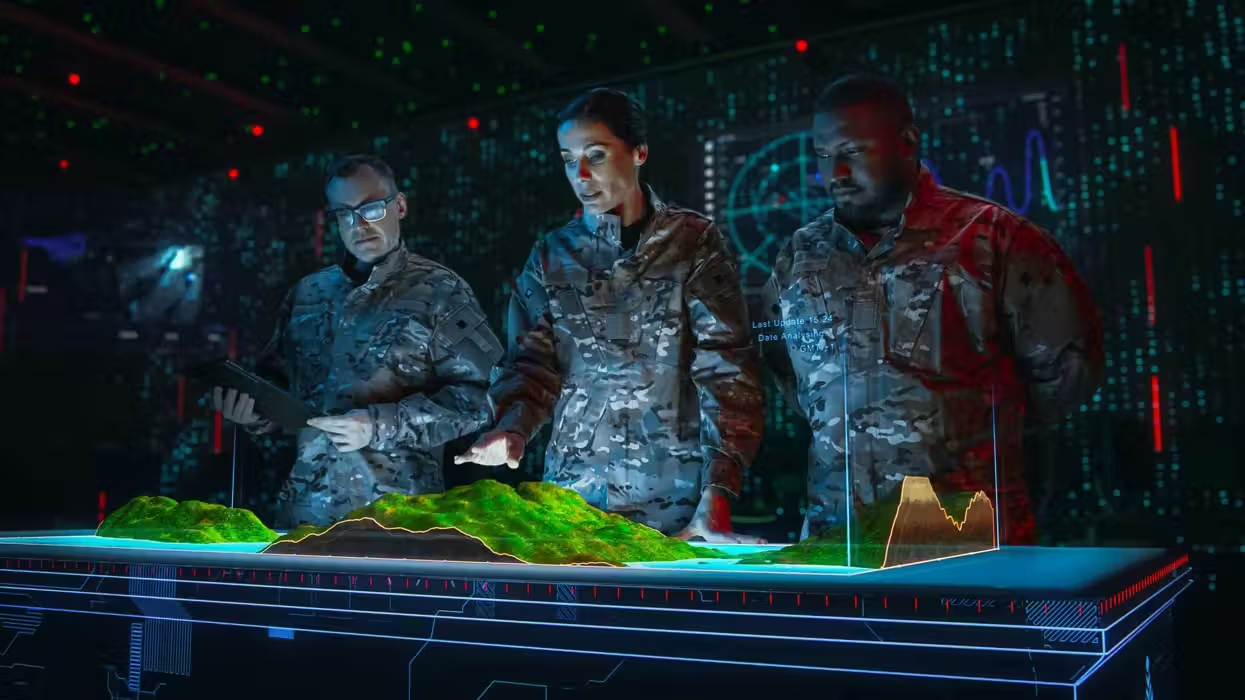 Igorodenkoff/Getty Images
President Trump’s second administration has grasped something that many policy elites spent decades avoiding: For all the digital sphere’s virtuality, digital sovereignty is not an abstraction. It is built, mined, manufactured, coded, powered, defended, and enforced. It requires borders, industry, and secure supply chains. It requires not only technological dominance but the enacted political will to ensure that America’s critical systems serve the American people, not foreign hostiles, whether regimes, cartels, cyber gangs, or shadowy transnational bureaucracies.
The administration understands that cyber, AI, energy, border, and critical minerals policies must be viewed as components of a single strategic project: restoring American control over the systems that make national life possible.
The Trump administration’s June 2025 cybersecurity order focused on defending digital infrastructure, securing vital digital services and capabilities, and improving the nation’s ability to address key cyber threats. Its 2026 action against cybercrime and foreign predatory schemes called for coordinated federal efforts, including private-sector involvement, to detect, disrupt, dismantle, and deter cyber-enabled criminal activity targeting Americans, businesses, critical infrastructure, and public services.
The administration has also moved decisively on the industrial foundation of digital sovereignty. President Trump’s March 2025 order on American mineral production aimed to boost domestic mineral production, streamline permitting, and strengthen national security.
A nation that cannot mine, refine, manufacture, power, and protect the infrastructure of the digital age will not lead that age. It will slavishly trail behind.
The same is true of artificial intelligence.
To ensure America’s decisive and enduring digital-sphere leadership, President Trump’s January 2025 order on AI removed barriers to American AI leadership and stated the goal of retaining global leadership in artificial intelligence. His administration’s July 2025 order promoting the export of the American AI technology stack recognized that the United States must not only develop frontier AI but also ensure that American technologies, standards, and governance models are adopted worldwide. And in March, the administration released a national AI legislative framework focused on winning the AI race to advance human flourishing, economic competitiveness, and national security.
Articulating the doctrine
A Cyber Monroe Doctrine would take these instincts and organize them into a clear national strategy.
It would begin with a declaration that the United States will not accept adversarial control over critical digital infrastructure in the American homeland or among core allies. Hostile state-linked companies must not build, operate, or control the networks on which our military, police, hospitals, utilities, financial institutions, schools, and governments depend.
America cannot allow adverse and incompatible regimes to use telecommunications equipment, cloud services, consumer apps, data brokers, AI platforms, or embedded software as instruments of espionage, influence, coercion, or sabotage. We must stop pretending that every technology product is politically neutral simply because it arrives in a sleek package and is sold at a competitive price.
A Cyber Monroe Doctrine requires a trusted industrial base for the digital age. Chips, hardware, software, telecom, cloud platforms, AI, data infrastructure, and energy itself must all come from trusted sources and be trustworthy right down to bare metal. Cyber policy, in that sense, is industrial policy.
The digital world is physical. It runs on semiconductors, rare-earth minerals, fiber-optic cables, satellites, substations, servers, cooling systems, power plants, and factories. A nation that cannot make, maintain, or secure these inputs is merely renting its future from true sovereigns.
That is why the Trump administration’s emphasis on energy abundance, domestic production, critical minerals, AI leadership, and cyber defense is so important. These are the fused elements of one single foundation of national sovereignty. Our adversaries understand this. They do not separate cyber policy from industrial policy, military policy, intelligence policy, or political warfare. They view technology as state capacity, use companies as instruments of national strategy, and leverage markets to hardwire dependence and submission.
A Cyber Monroe Doctrine would respond with equal seriousness, treating attacks on critical infrastructure as strategic acts more than mere crimes. Ransomware gangs, proxy hackers, and state-sponsored cyber units operate in the gray zone between law enforcement and war, targeting core social infrastructure such as hospitals, schools, police departments, and pipelines, as well as institutional systems across courts, municipalities, small businesses, and local governments.
RELATED: AI bots turn into Marxists — if you make them do this
 L-R: Kirill KUDRYAVTSEV/AFP/Getty Images; Thomas Lohnes/Getty Images
States that shelter, direct, finance, or tolerate these actors must face consequences. The United States should not allow hostile regimes to hide behind criminal proxies while they weaken American society one network at a time.
But America cannot be stuck at the level of reacting to adverse events. The Cyber Monroe Doctrine must frame and animate constructive action: a digital alliance system among free nations.
This is why the Trump administration’s focus on exporting the American AI technology stack is so strategically significant. It recognizes that America cannot merely defend its own networks at home. It must shape the global technology environment abroad. America first, in other words, but not America alone.
The United States, Europe, Israel, Japan, Korea, Australia, India, and other partners should coordinate on secure telecom, cloud infrastructure, AI governance, critical minerals, export controls, semiconductor resilience, cyber defense, and technology standards. The answer to Chinese and Russian cyber power is not isolation. It is trusted interdependence among sovereign nations that share a commitment to freedom, transparency, and the rule of law. If free nations do not build and export the infrastructure of the future, unfree nations will.
A civilization at stake
But governments do not own most of the networks, platforms, data centers, codebases, satellites, logistics systems, and industrial control systems that define modern life. Any serious national cyber strategy must therefore mobilize entrepreneurs, investors, engineers, utilities, banks, defense companies, telecom providers, hospitals, universities, and state and local governments.
We need public-private cooperation that is faster, less bureaucratic, and more operationally serious; procurement systems that reward trusted technology; capital markets aligned with national resilience; and companies cognizant that selling into critical infrastructure is a national responsibility.
The Trump administration’s great contribution is that it has reoriented technology policy around the great national interest of defending our shared civilization’s operating system.
We must be clear-eyed about the inescapable civilizational stakes. Artificial intelligence is already able to control not only infrastructure, but perception itself.
As Martin Heidegger warned, technology does not merely give human beings new tools. It changes the way we encounter reality. His concept of “enframing” described the tendency of technological systems to reveal and order the world and everything in it as a “standing reserve” of raw material to be atomized and reaggregated, measured, optimized, managed, and processed.
In a free society, this is already a profound philosophical problem. In a collectivist society armed with artificial intelligence, it becomes a political weapon.
An authoritarian government using AI does not need to censor every book, arrest every dissident, or burn every newspaper. It can shape what citizens see before they even know they are being governed. It can decide which facts are surfaced, which memories are buried, which videos go viral, which voices are discredited, which narratives are amplified, and which possibilities become literally unthinkable.
Through algorithmic control, predictive surveillance, synthetic media, social-credit systems, biometric tracking, and AI-generated propaganda, a regime can construct a managed reality where citizens or subjects obey power because their very experience of the world around them is designed by power.
The new form of political system unlocked in this way treats human consciousness itself as raw material to be sculpted toward planned ends from a single dashboard.
This is why a Cyber Monroe Doctrine cannot be limited to firewalls, procurement rules, software audits, and sanctions. It must also defend the very conditions of free thought.
A sovereign nation must protect not only its networks, but its people’s ability to perceive reality without foreign manipulation. The battle over artificial intelligence is therefore not only a contest over productivity or military advantage. It is a contest over who gets to define the real.
Fortunately, here, again, the Trump administration is pointing in the right direction, insisting on American AI leadership, rejecting ideological capture of AI systems, promoting the American tech stack, and tying AI development to national security and economic competitiveness.
A Cyber Monroe Doctrine would not mean that every foreign-made product is dangerous or that every cyber incident is an act of war.
The test is straightforward: If a system is essential to American survival — from continuity of government and military readiness to public safety, economic stability, civic trust, and freely formed public opinion — then it must be secure, resilient, and free from adversarial control.
That principle should guide procurement, regulation, investment, diplomacy, military planning, export controls, and alliance strategy. It should shape how we buy software, where we manufacture chips, how we build data centers, how we protect children online, how we defend elections, how we secure hospitals, how we safeguard law enforcement, and how we respond to cyberattacks.
The great strategic contest of our time is not only over territory on the map but the organ systems of the body politic that connect and course deep within it.
The Monroe Doctrine was born in an age of empires. A Cyber Monroe Doctrine is needed in an age of networks.
Monroe rejected foreign empires planting themselves in the physical hemisphere around us. Now his heirs must reject hostile regimes planting themselves inside the digital, industrial, and cognitive hemisphere of free citizens.
More from this network:
Domains for Sale · GOTPeople.org · TheDSAPlatform · The Truth About Socialism
What's Your Reaction?
 Like
0
Like
0
 Dislike
0
Dislike
0
 Love
0
Love
0
 Funny
0
Funny
0
 Wow
0
Wow
0
 Sad
0
Sad
0
 Angry
0
Angry
0

I am just an average American. My teen years were in the late 70s and I participated in all that that decade offered. Started working young, too young. Then I joined the Army before I graduated High School. I spent 25 years in, mostly in Infantry units. Since then I've worked in information technology positions all at small family owned companies. At this rate I'll never be a tech millionaire. When I was young I rode horses as much as I could. I do believe I should have been a cowboy. I'm getting in the saddle again by taking riding lessons and see where it goes.
Premium domains for sale


















Comments (0)