

Musk Says The AI Shaping Your Life Pulled A $800B Bait-And-Switch
Premium domains for sale
Freedom Is Back In Style
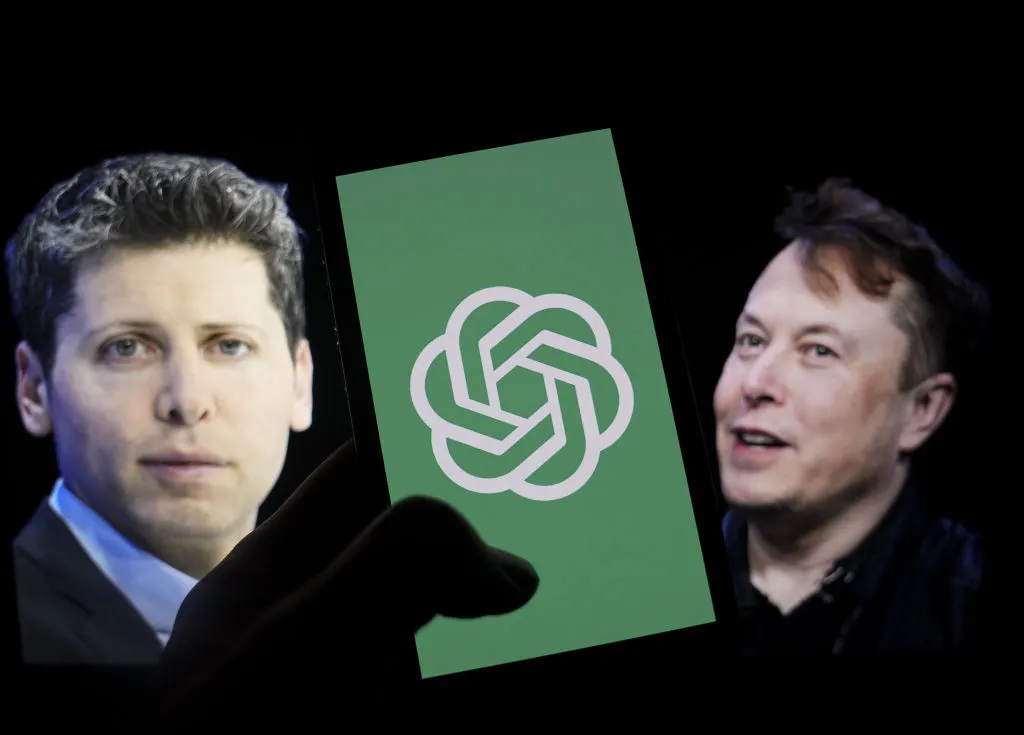
Escalating his legal battle just weeks before a high-stakes federal trial, Elon Musk has amended his lawsuit against OpenAI, demanding the immediate removal of CEO Sam Altman and President Greg Brockman.
Freedom Is Back
In Style
Premium domains for sale
The revised filing, submitted this week, also seeks to force the artificial intelligence giant to abandon its for-profit structure and return to its nonprofit roots.
The case is scheduled to go before a jury on April 27, 2026, in Oakland, California. The outcome could derail OpenAI’s planned initial public offering (IPO) and set a major precedent for how transformative technologies are governed.
In a strategic shift likely intended to neutralize claims that the lawsuit is fueled by personal greed, Musk’s amended complaint clarifies that he is not seeking to personally collect damages, estimated between $134 billion and $150 billion. Instead, Musk has requested that any recovered funds be directed to OpenAI’s nonprofit arm.
“He is asking the court to return everything that was taken from a public charity,” said Musk’s attorney, Marc Toberoff. Musk reinforced this stance publicly on X, suggesting his sole intent is to restore the organization’s founding mission.
Musk has alleged that Altman and Brockman “manipulated and misled” him into providing roughly $38 million in seed funding between 2015 and 2018, based on assurances that OpenAI would remain a non-profit dedicated to open-source artificial general intelligence for the benefit of humanity.
Instead, Musk argues, the leadership engaged in a “wealth machine” scheme, effectively turning OpenAI into a “closed-source de facto subsidiary” of Microsoft. The filing accuses the executives of fraud, breach of fiduciary duty, and racketeering, claiming they leveraged the reputational and tax benefits of a nonprofit to build a private entity now valued at more than $800 billion.
OpenAI has fired back, describing the lawsuit as a “frivolous” campaign driven by “ego, jealousy, and a desire to slow down a competitor.”
Today, at the eleventh hour, Elon lodged a court filing pretending to change his tune about attacking the nonprofit OpenAI Foundation.
The truth is that this case has always been about Elon generating more power and more money for what he wants. Having increasingly realized that…
— OpenAI Newsroom (@OpenAINewsroom) April 7, 2026
The company recently petitioned the attorneys general of California and Delaware to investigate Musk for alleged “anti-competitive behavior,” noting that Musk now operates his own rival AI firm, xAI.
OpenAI’s legal team argues that the pivot to a “capped-profit” model was a matter of survival, citing the astronomical costs of developing advanced AI systems, which it says could reach into the hundreds of billions of dollars. The company has also pointed to internal emails from 2017 suggesting Musk himself once supported a for-profit shift, provided he maintained majority control.
The case gained significant momentum in early 2026 following the discovery of the so-called “Brockman Diaries.” A handwritten 2017 journal entry by Brockman reportedly characterized the nonprofit structure as “a lie,” a piece of evidence U.S. District Judge Yvonne Gonzalez Rogers cited as critical for the upcoming trial.
The court has already confirmed that high-profile figures, including Altman and Microsoft CEO Satya Nadella, are expected to testify.
The conflict is rooted in OpenAI’s 2015 founding. Initially a pure research lab, the organization began shifting its structure shortly after Musk’s departure in 2018:
- 2015: Founded as a nonprofit; Musk provides initial funding.
- 2019: Creates a “capped-profit” subsidiary to attract investment, leading to a multi-billion dollar partnership with Microsoft.
- 2025: Completes a restructuring into a for-profit public benefit corporation.
- Present: Prepares for a potential late-2026 IPO at a valuation exceeding $850 billion.
Legal experts suggest the trial’s implications reach far beyond a personal feud. A victory for Musk could force OpenAI to restructure and raise new questions about nonprofit governance and donor intent. A win for Open AI could affirm the ability of a nonprofit to evolve into profit-generating enterprises despite donor objections.
More from this network:
Domains for Sale · GOTPeople.org · TheDSAPlatform · The Truth About Socialism
What's Your Reaction?
 Like
0
Like
0
 Dislike
0
Dislike
0
 Love
0
Love
0
 Funny
0
Funny
0
 Wow
0
Wow
0
 Sad
0
Sad
0
 Angry
0
Angry
0

I am just an average American. My teen years were in the late 70s and I participated in all that that decade offered. Started working young, too young. Then I joined the Army before I graduated High School. I spent 25 years in, mostly in Infantry units. Since then I've worked in information technology positions all at small family owned companies. At this rate I'll never be a tech millionaire. When I was young I rode horses as much as I could. I do believe I should have been a cowboy. I'm getting in the saddle again by taking riding lessons and see where it goes.
Premium domains for sale





Comments (0)