

New Era For America: First New Reactor Goes Critical Under Trump’s Watch
Premium domains for sale
Freedom Is Back In Style
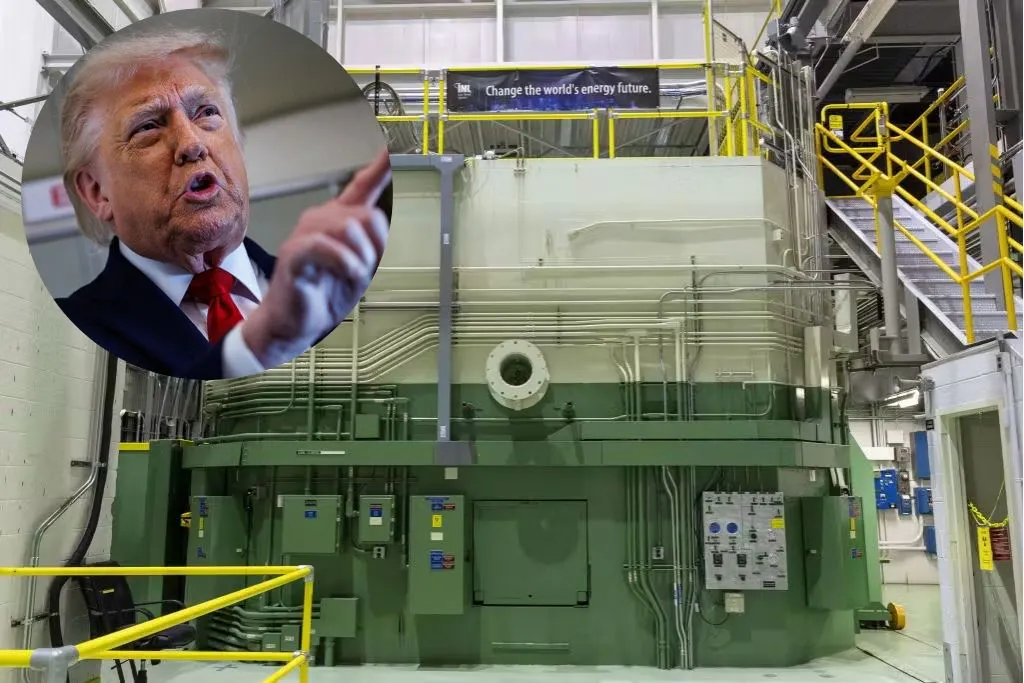
The Department of Energy announced that America’s nuclear rebirth has officially arrived, with Antares Nuclear’s Mark-0 reactor successfully completing a zero-power fueled criticality demonstration at Idaho National Laboratory on June 4 — the first privately developed non-light-water reactor to go critical in the United States in more than 40 years.
Freedom Is Back
In Style
Premium domains for sale
The achievement comes directly as a result of President Donald Trump’s May 2025 executive order setting a July 4 deadline for reactors to reach criticality, a goal many in the energy establishment dismissed as fantasy.
“The skeptics didn’t believe President Trump’s Reactor Pilot Program could achieve criticality in less than a year,” said Assistant Secretary of Nuclear Energy Ted Garrish. “Today, we celebrate the first of the pilot projects to reach criticality.”
Energy Secretary Chris Wright put the moment in its proper historical context. “It is fitting that on the eve of our nation’s 250th anniversary, we are witnessing a historic moment for American energy. For the first time in more than four decades, a new privately developed non-light-water reactor has reached criticality in the United States,” he said.
The Mark-0 is the 53rd reactor built at the Idaho National Laboratory site since 1951 and establishes the basis for subsequent reactors to begin producing electricity in 2027. When commercialized, Antares’ microreactors are expected to power military installations, terrestrial applications, and even space missions.
The announcement marks a stunning reversal of fortune for an industry that was, not long ago, being methodically dismantled.
America’s nuclear story is one of the great self-inflicted wounds in the history of energy policy. The United States pioneered commercial nuclear power — the Shippingport Atomic Power Station lit up Pittsburgh in 1957 under Eisenhower’s “Atoms for Peace” program — and by the 1970s, utilities had ordered over 200 reactors. Nuclear was going to power the American century.
Then came the activists, the lawyers, and the regulators.
The anti-nuclear movement, born in the 1960s out of California environmentalism, spent two decades grinding the industry down. Protest campaigns, lawsuits, and regulatory obstruction drove construction costs through the roof. When Three Mile Island experienced a partial meltdown in 1979 — an accident that killed no one and caused no measurable increase in cancer — the media frenzy finished what the activists started. More than 100 reactor orders were canceled. No new plants were ordered for nearly three decades.
The crowning absurdity came on Long Island, where the completed Shoreham Nuclear Power Plant — built at a cost of $6 billion — was decommissioned in 1994 without ever generating a single watt of public electricity, because local politicians refused to approve an evacuation plan.
The 2000s brought brief hope of a “nuclear renaissance,” but cheap fracking gas and the 2011 Fukushima disaster in Japan killed that momentum. Plants across the country closed. Vermont Yankee, Kewaunee, San Onofre, Indian Point — gone. And perversely, most were replaced not by wind turbines or solar panels, but by natural gas, pumping out the very carbon emissions the plant closures were supposedly meant to prevent.
Meanwhile, American energy demand exploded. The artificial intelligence revolution is leading to a tripling of AI data center electricity consumption by 2030. The grid is straining. And the politicians who spent decades killing nuclear are now scrambling for solutions.
Trump’s executive order seeks to cut through the paralysis, and Antares’ reactor gives the effort a promising development.
The case for nuclear has never been stronger. A uranium fuel pellet the size of a fingertip produces as much energy as a ton of coal. Nuclear plants run at over 90% capacity — rain, shine, or dead calm. They emit no carbon, no sulfur dioxide, no particulate matter. And unlike wind and solar, they work around the clock, providing the stable backbone a modern grid requires.
America built this technology. America pioneered it. America then spent 40 years talking itself out of it.
The new announcement suggests that era is over.
More from this network:
Domains for Sale · GOTPeople.org · TheDSAPlatform · The Truth About Socialism
What's Your Reaction?
 Like
0
Like
0
 Dislike
0
Dislike
0
 Love
0
Love
0
 Funny
0
Funny
0
 Wow
0
Wow
0
 Sad
0
Sad
0
 Angry
0
Angry
0

I am just an average American. My teen years were in the late 70s and I participated in all that that decade offered. Started working young, too young. Then I joined the Army before I graduated High School. I spent 25 years in, mostly in Infantry units. Since then I've worked in information technology positions all at small family owned companies. At this rate I'll never be a tech millionaire. When I was young I rode horses as much as I could. I do believe I should have been a cowboy. I'm getting in the saddle again by taking riding lessons and see where it goes.
Premium domains for sale


















Comments (0)