

Obama’s Telling Phrase After the Correspondents’ Dinner Shooting
Premium domains for sale
Freedom Is Back In Style
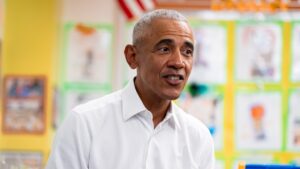
Former President Barack Obama posted on X in response to the attempted shooting of President Donald Trump at the White House Correspondents’ Dinner. The post began with a familiar formula:
Freedom Is Back
In Style
Premium domains for sale
“Although we don’t yet have all the details about the motives behind last night’s shooting…”
And yet—almost instantly—the moral framing is already in place.
It’s a bit like a disciplined defense in football—the left defends every blade of grass.
Nothing is conceded. No ground is given—not even in the first moments, when facts are still emerging. Every inch of interpretation is contested immediately.
This is the toolkit of an elite communicator—skills that helped get him to the top—deployed with the confidence that perception can be shaped at scale. He is using these tools to condition Americans.
Built into the former president’s comments is deflection. He is attempting to sever any link between rhetoric and consequences—because if that link takes hold, it constrains what can be said next.
The potential cause-and-effect is so politically costly that it’s easier to obscure it than to reckon with it.
Scions of the Left like the former president guide perception. They set boundaries. They create permission structures for how events are interpreted.
In modern political communication, uncertainty about facts rarely slows down the narrative. If anything, it accelerates it. A lack of clarity creates space, and that space gets filled quickly, often before the public has time to process what actually happened.
That is clearly a strategic move.
Language like former President Obama’s doesn’t confront emerging conclusions head-on. It redirects them. It encourages hesitation at the precise moment people are forming judgments, subtly shifting the focus from what’s visible to what might still be unknown.
“Don’t jump to conclusions.” “Motives are unclear.” “Let’s see more facts.”
It sounds measured.
But the practical effect is to interrupt momentum—to slow the natural formation of judgment and replace it with uncertainty that can be shaped over time.
And that delay matters. Because once initial reactions are softened, interpretation becomes more fluid—and easier to guide.
This isn’t aimed at people who are already certain. It’s aimed at those who feel tension but aren’t sure how to resolve it. The language offers an escape hatch: a way to stay in that uncertainty without committing one way or the other.
And it doesn’t just influence supporters—it complicates the response from critics.
It forces critics to defend what moments earlier felt obvious—while opening them up to being dismissed as premature or politically motivated.
The field tightens around the interpretation of events. Reality becomes contested terrain.
This broader communication model—narrative first, facts later—is at the core of what’s explored in “You Don’t Know Barack: Exposing Obama.” The myth, the image, the carefully managed story of this man is compared to the underlying record.
First as a candidate and then as president, Obama refined this model of communication, and its influence didn’t end with his presidency.
There’s another layer here that matters just as much: Obama understands his influence.
He knows that when he speaks, millions of people take cues from him. For many, his words still carry real weight.
That brings responsibility. Because when someone with that level of authority emphasizes uncertainty, he isn’t just describing a lack of information. He’s shaping how that lack of information is interpreted. He’s setting the tone for how others respond.
At this point, that pattern is well established. The outcomes are predictable. The effects are known.
We were told his presidency would unify the country.
Instead, the years that followed saw deepening cultural and political fractures that continue to define American life. Whether by design or by effect, the gap between rhetoric and reality widened.
Even his legacy projects reflect that divide. The Obama Presidential Center in Chicago has been praised in elite circles but criticized locally as out of touch, with real concerns about displacement.
Image over impact and narrative over substance. That pattern holds.
And it brings us back to moments like this.
Language at this level isn’t passive. It shapes perception. It defines what people feel permitted to believe—or question.
You don’t get to indulge this kind of framing, normalize it, and elevate those who deploy it and then act surprised when the downstream effects are confusion and distrust.
When clarity is repeatedly softened into ambiguity, people stop trusting their own judgment.
And when truth itself feels negotiable, the consequences are inevitable.
Those paying attention can see it clearly: this is the craft of a master operator—calculated, disciplined, and rooted in a cynical approach that has long disguised division as something else.
Not caution.
Not restraint.
But design.
We publish a variety of perspectives. Nothing written here is to be construed as representing the views of The Daily Signal.
More from this network:
Domains for Sale · GOTPeople.org · TheDSAPlatform · The Truth About Socialism
What's Your Reaction?
 Like
0
Like
0
 Dislike
0
Dislike
0
 Love
0
Love
0
 Funny
0
Funny
0
 Wow
0
Wow
0
 Sad
0
Sad
0
 Angry
0
Angry
0

I am just an average American. My teen years were in the late 70s and I participated in all that that decade offered. Started working young, too young. Then I joined the Army before I graduated High School. I spent 25 years in, mostly in Infantry units. Since then I've worked in information technology positions all at small family owned companies. At this rate I'll never be a tech millionaire. When I was young I rode horses as much as I could. I do believe I should have been a cowboy. I'm getting in the saddle again by taking riding lessons and see where it goes.
Premium domains for sale



Comments (0)