

Remembering Pope Saint John Paul II
Premium domains for sale
Freedom Is Back In Style
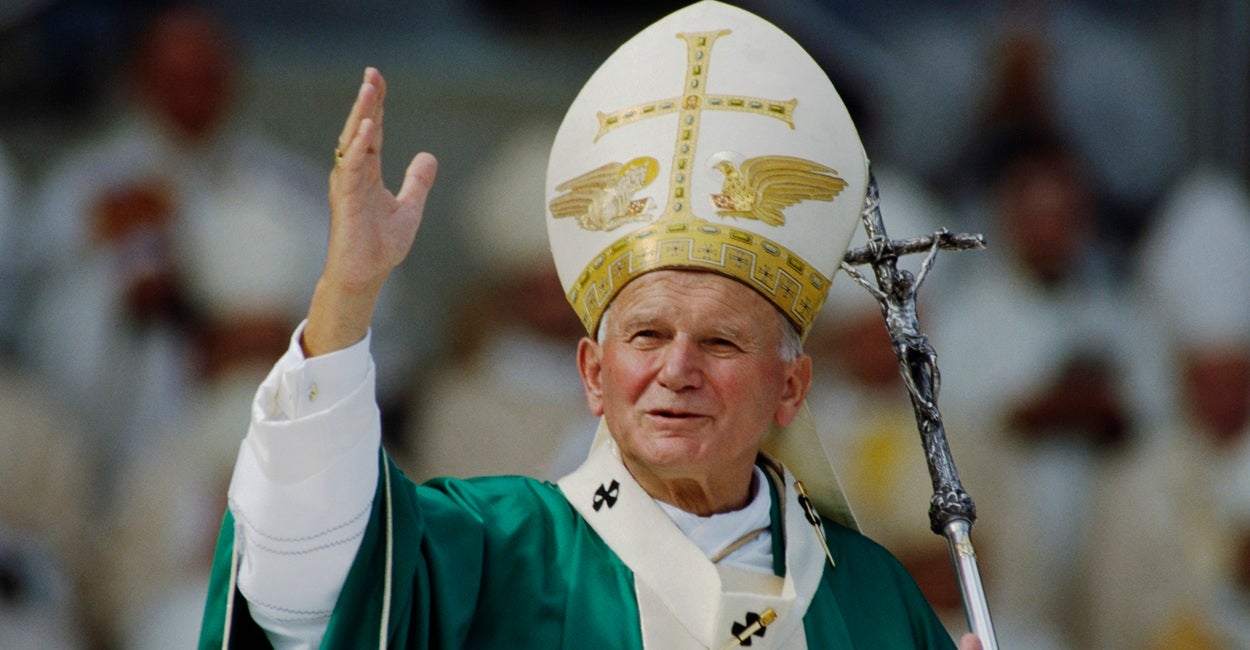
Twenty-one years have passed since that April 2 in 2005 when, at 9:37 p.m., Pope John Paul II returned to the Father’s House. It’s been 21 years since the end of one of the longest pontificates in the history of the church and of the life of a pope who changed the world.
Freedom Is Back
In Style
Premium domains for sale
Today, I am reminded of his unceasing commitment, his powerful gestures, and his words: “Do not be afraid: open, indeed open wide the doors to Christ!”
St. John Paul II was the pontiff of records and the man who led the church into the new millennium. Born Karol Józef Wojtyla in Poland on May 18, 1920, John Paul II was the first non-Italian pope in 455 years and the first Pole ever to ascend to the papal throne. The young Karol was an eclectic personality: philosopher, poet, artist, and priest, continuously engaged in the world and for the world.
For many, the pontificate of St. John Paul II was one of the fundamental elements that led to the end of communist regimes in Eastern Europe, so much so that still today many see him as one of the builders of modern Europe.
His pontificate was also marked by an act of unimaginable violence: on May 13, 1981, in St. Peter’s Square, the pope was hit by some gunshots fired by Ali Agca. Wojtyla collapsed, the image went around the world, and remained impressed in people’s minds as one of the strongest of the 20th century. For a few months, the world’s 1.5 billion Catholics feared for the life of the supreme pontiff, but, miraculously, he survived and continued his tireless apostolate, including by forgiving the man who shot him.
St. John Paul II traveled more than all his predecessors, bringing hope to the most remote corners of the Earth and to destinations marked by historic firsts—such as the trip to Cuba in 1998—making over 100 trips and meeting millions and millions of people.
Among the phenomena that marked the pontificate of St. John Paul II, there was the irresistible adherence to a real youth movement born to follow the Pontiff everywhere. The “Papaboys” became the term used to describe the thousands of young people who met John Paul II during World Youth Days, creating a very strong relationship, so much so that young people were the last thought in the hours of agony before death.
Every time I came in contact with Pope John Paul II, I felt like I was meeting Jesus, whom the pope represented with all of himself: with the words, the silence, the gestures, the way of praying, with all his way of being. I could see immediately that he was a person full of God. And for the world, he had become a visible sign of an invisible reality. Often it was enough to look at him to discover the presence of God and, thus, to begin to pray.
And it was the pontiff’s suffering, shown in the long illness that led to his death, that was one of his last acts while embracing his mission and giving his whole self to the world as Vicar of Peter: “One does not come down from the Cross,” he warned over and over.
John Paul II testified to the world that to make existence and love a coherent whole, the only way is to love unlimitedly, beyond and more than one’s own existence, abandoning oneself completely to the embrace of Christ, who “takes nothing away but gives everything.”
In these times of de-Christianization, there is a pressing need for a living witness by the baptized faithful to the whole message and mission of Jesus, following the footsteps of the Old and New Testament Covenant tradition. Specifically, the baptized members of the lay faithful are called by their “special vocation” to bear witness to the mercy of God.
In the first place, lay people must profess their belief in the basic truth of redemption and salvation achieved by Jesus on a Roman Cross at Mount Calvary. Then, they must transmit that revealed truth of faith, seeking to make it incarnate in their own lives and, as far as it is humanly possible, in the lives of all people of good will.
In other words, we are called by the sacraments of Baptism to participate in the message and mission of Jesus, to profess and proclaim God’s mercy in all of its truth, as it has been transmitted and handed down by Revelation, and as St. Pope John Paul II showed us every day of his pontificate.
The post Remembering Pope Saint John Paul II appeared first on The Daily Signal.
More from this network:
Domains for Sale · GOTPeople.org · TheDSAPlatform · The Truth About Socialism
What's Your Reaction?
 Like
0
Like
0
 Dislike
0
Dislike
0
 Love
0
Love
0
 Funny
0
Funny
0
 Wow
0
Wow
0
 Sad
0
Sad
0
 Angry
0
Angry
0

I am just an average American. My teen years were in the late 70s and I participated in all that that decade offered. Started working young, too young. Then I joined the Army before I graduated High School. I spent 25 years in, mostly in Infantry units. Since then I've worked in information technology positions all at small family owned companies. At this rate I'll never be a tech millionaire. When I was young I rode horses as much as I could. I do believe I should have been a cowboy. I'm getting in the saddle again by taking riding lessons and see where it goes.
Premium domains for sale



Comments (0)