

The Civil Rights Standard Turning Race-Based Employment On Its Head
Premium domains for sale
Freedom Is Back In Style
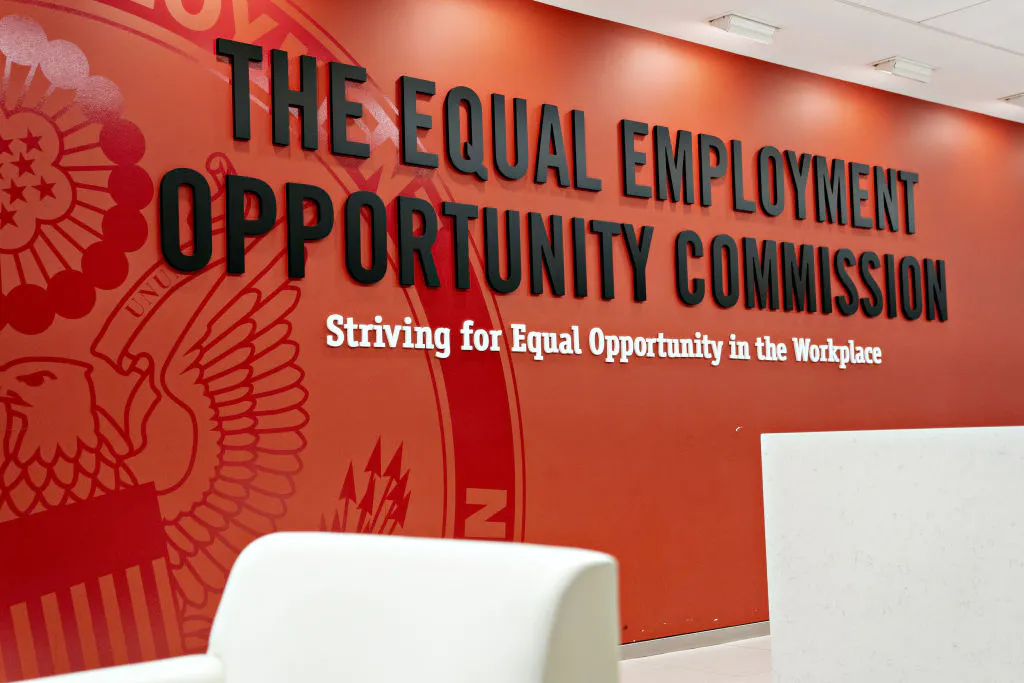
On Tuesday, the U.S. Department of Justice (DOJ) Office of Legal Counsel informed the Equal Employment Opportunity Commission (EEOC) that its guidelines regarding business “disparate-impact” liability under Title VII of the Civil Rights Act of 1964 violate the 14th Amendment of the U.S. Constitution. Quoting Acting Attorney General Todd Blanche, the letter states, “despite trying to promote equality, EEOC’s disparate impact liability interpretation under Title VII actually fosters the very discrimination its guidelines seek to address.”
Freedom Is Back
In Style
Premium domains for sale
To appreciate the significance of this letter and the legal battle to come, one must first understand the revolutionary character of the Trump administration’s civil rights enforcement agenda. Since taking office in January of 2025, the administration has wielded its civil rights authorities to attack racial discrimination in student admissions, faculty hiring and promotion, and workplace training (i.e., DEI). It has also taken action to restore Title IX protections for women and girls. In each case, the administration has asserted the plain meaning of federal civil rights statutes against what I have called “the unwritten constitution” of the modern civil rights state — the notion that textual commitments to equal treatment under the law may legitimately be ignored in pursuit of a higher imperative of leveling group disparities.
This campaign to restore equal treatment under the law is “revolutionary” in the original sense of the term: prior to the French Revolution, a “revolution” denoted a restoration of, or cyclical return to, an earlier, more legitimate social order. In nearly every instance, the Trump administration’s return to the text and intent of civil rights law advances the goal of ensuring equal treatment under the law for all Americans — an element of the American order that traces back to its inception in the Declaration of Independence.
Running contrary to the original intent of “equal treatment under the law” has been the application of the disparate impact doctrine — a creation of the federal courts that was subsequently codified in the Civil Rights Act of 1991. The Trump administration is now challenging the constitutionality of aspects of this law; however, before addressing the administration’s latest action, it is helpful to discuss what the disparate impact doctrine is and how its use harms Americans of every background.
Undermining Equality and Economic Mobility
Conventionally, the term “discrimination” describes treating people differently and, in law, doing so based on one or more legally protected characteristics. However, disparate impact “discrimination” is quite different. Here, neutral policies are treated as “discriminatory” if their use results in unequal outcomes between groups defined along lines of protected characteristics.
On such grounds, courts and federal regulators (such as the EEOC) have forced employers to abandon non-discriminatory policies and lower standards (e.g., written and physical fitness tests, criminal background checks, English proficiency standards, height and weight requirements, and teacher certification standards) to ensure the right proportion of protected groups are present. In some cases, including school discipline policies, the federal government has used the disparate impact doctrine to force schools to racially discriminate against students (disparate treatment) based on protected attributes, in plain defiance of both the spirit and letter of the Civil Rights Act.
Disparate impact doctrine denies Americans equal treatment under law — but the problems don’t end there.
As Frederick Hess and Grant Addison describe, disparate impact also harms workers and families by distorting postsecondary education and labor markets. Employers desire workers who are skilled, trainable, and diligent. Job requirements help employers to sift through applicant pools to find eligible candidates; however, these requirements are often associated with disparate impacts, as noted. The EEOC uses disparate impact to limit the use of many job requirements, but not college degree requirements. This omission fuels the proliferation of unnecessary college degrees, which, in turn, leads to excessive college spending and debt.
Ironically, these distortions likely harm black students and workers the most. I say “ironically” because disparate impact doctrine entered federal civil rights law in response to a suit, Griggs v Duke Power Co., alleging a company’s high school diploma and job test requirements unfairly disadvantaged black applicants. Yet, to attend college, students must also take an aptitude test (e.g., the SAT or ACT) and possess a high school diploma. Moreover, on average, black students are less likely to complete college and they tend to accumulate more student debt.
Restoring Equality Under the Law
Disparate impact claims proceed through a 3-part burden-sharing process as follows:
- A plaintiff identifies an employment practice associated with outcomes disparity.
- The employer demonstrates the practice in question is both job-related and consistent with business necessity.
- A plaintiff successfully asserts an alternative (less disparity-inducing) practice that could serve the employer’s legitimate interests.
At this point, the employer is found liable for “discrimination.”
Fortunately, each step in this process is governed by federal agency guidelines. Those guidelines can be revised. For example, in a recent America First Policy Institute report, my coauthor and I propose several options to strengthen requirements for plaintiffs asserting a disparate impact claim, recognition of aptitude tests, criminal background screens, and merit-based policies as presumptively legitimate business necessities, and clarifying that the burden rests with plaintiffs to propose and defend the viability of alternative policies.
The new DOJ Opinion adopts several of these proposals, including easing restrictions on job tests (e.g., aptitude tests, knowledge tests, criminal background checks) by requiring that employers demonstrate only that such tests are “reasonable,” “useful,” or in service of “a valid business purpose.” In line with our recommendations, it also places the onus on plaintiffs to identify specific disparity-inducing practices and demonstrate that an alternative, workable approach would both serve employers’ legitimate needs equally and reduce disparities.
The DOJ goes further, challenging the constitutionality of existing guidelines, arguing that mandating outcome leveling along racial lines effectively requires employers to treat applicants and employees of different backgrounds differently — that is, to illegally discriminate against them. This argument appears to be well-founded, especially given the Court’s ruling in Rici v. DeStefano that disparate treatment remains prohibited by Title VII of the Civil Rights Act, regardless of employers’ intentions to mitigate disparities.
Perhaps most fundamentally, the Trump administration is on solid footing because its revolutionary return to America’s foundational commitment to equal treatment is reflected in the Constitution itself. The Court has affirmed this principle time and again, including recently by describing the Constitution as “color-blind” and emphasizing that “the way to stop discrimination on the basis of race is to stop discriminating on the basis of race.” The same is true of Title VII of the Civil Rights Act of 1964, which plainly prohibits disparate treatment.
As America approaches its 250th anniversary, Americans should be proud that, under President Trump’s leadership, the nation is returning to its foundational commitment to equality under the law.
***
Christopher Schorr, PhD, directs the Higher Education Reform Initiative at the America First Policy Institute.
More from this network:
Domains for Sale · GOTPeople.org · TheDSAPlatform · The Truth About Socialism
What's Your Reaction?
 Like
0
Like
0
 Dislike
0
Dislike
0
 Love
0
Love
0
 Funny
0
Funny
0
 Wow
0
Wow
0
 Sad
0
Sad
0
 Angry
0
Angry
0

I am just an average American. My teen years were in the late 70s and I participated in all that that decade offered. Started working young, too young. Then I joined the Army before I graduated High School. I spent 25 years in, mostly in Infantry units. Since then I've worked in information technology positions all at small family owned companies. At this rate I'll never be a tech millionaire. When I was young I rode horses as much as I could. I do believe I should have been a cowboy. I'm getting in the saddle again by taking riding lessons and see where it goes.
Premium domains for sale














Comments (0)