

Calvin Coolidge on the Christian Roots of American Liberty
Premium domains for sale
Freedom Is Back In Style
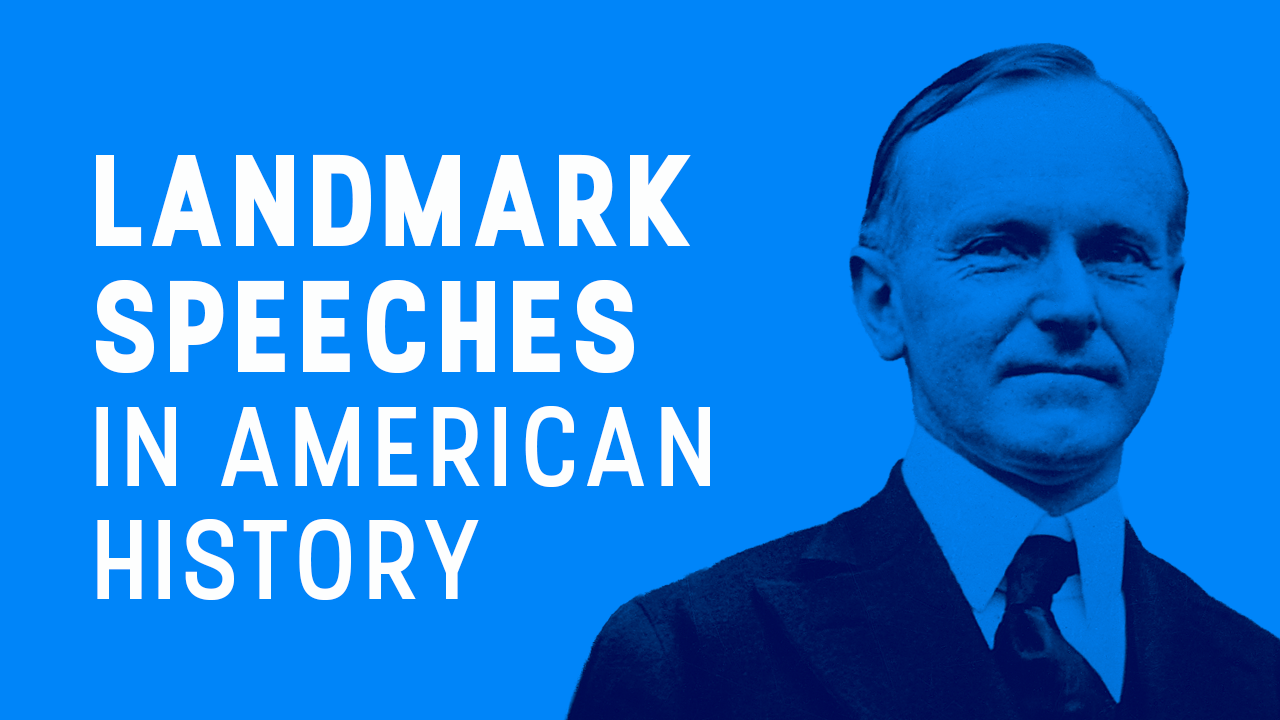
Welcome to the seventh in our series, Landmark Speeches in American History. We are celebrating America’s 250th anniversary with articles by prominent authors about how some of the greatest speeches in our history—by celebrated orators like Ronald Reagan, Abraham Lincoln, and Martin Luther King Jr.—honored the vision of our founding document, the Declaration of Independence.
Freedom Is Back
In Style
Premium domains for sale
America’s 30th president, Calvin Coolidge, was famously so taciturn that he earned the nickname “Silent Cal.” Yet this least talkative of American leaders delivered on July 5, 1926, one of the greatest speeches in our nation’s history—a masterpiece not of high-flown rhetoric but of deep insight into the religious origins and philosophical permanence of the Declaration of Independence.
Coolidge’s speech, delivered in Philadelphia, was part of that year’s celebrations of the 150th anniversary of the declaration and American independence. The president was engaged in a battle: like his immediate predecessor, Warren Harding, Coolidge represented a repudiation of the progressive ideology of the Woodrow Wilson administration.
To read the full speech, click here.
Progressives tended to look upon the Constitution as outdated—an 18th-century charter of government wholly unsuited to the more advanced world of the early 20th-century—and the Declaration of Independence as mere propaganda. Progressives, then as now, thought of themselves as servants of science, while conservatives, they believed, were prisoners of nostalgia and tools of selfish businessmen.
The sesquicentennial of the declaration arrived just a few years after the Bolsheviks had consolidated power in the newly formed Soviet Union. While not all progressives were pro-Communist, the USSR seemed to many to be a model of what modern government should be: It was secular, claimed to be scientific, and understood “democracy” in economic terms, requiring the expropriation of the wealthy (and the middle class, and, really, everyone else) to establish the equality necessary for a truly free political system, one in which highly educated administrators—commissars—would serve the people in a spirit of objectivity, without all the cumbersome checks and balances and partisan distractions of the American system.
What the Soviet Union really was, from its very beginning, was a murderous tyranny ruled by a completely unaccountable elite of Communist Party insiders. But progressives were so disillusioned by what they considered to be the selfishness of capitalism and the irrationality of our antiquated institutions that they looked abroad for models of modernity, and many found what they wanted to see in the Soviet Union and, for that matter, in Benito Mussolini’s Italy.
Coolidge did not pander to progressive opinion; he defied it. He refused to present the Declaration of Independence as a secular creed: in his telling, it had a distinctly Protestant genealogy. Instead of looking to a progressive future, Coolidge emphasized America’s colonial history. And there could be no progress beyond the vision of the Declaration of Independence, he argued, because that vision was forever true. It could not be improved upon.
“It is not so much then for the purpose of undertaking to proclaim new theories and principles that this annual celebration is maintained, but rather to reaffirm and reestablish those old theories and principles which time and the unerring logic of events have demonstrated to be sound,” said Coolidge.
His speech was no exercise in political romanticism. “[T]he causes which led to the American Revolution,” he acknowledged, were “in their immediate occasion … largely economic.” But the economic context—the colonists’ objections to Britain’s navigation laws and taxation without representation—brought much deeper questions to the fore.
“Life in a new and open country had aspirations which could not be realized in any subordinate position. A separate establishment”—a separate nation—was ultimately inevitable. It had been decreed by the very laws of human nature.” History was replete with tales of colonies and provinces that had ceded from kingdoms, empires, and states of every kind. What was remarkable was what Americans would do with their independence.
“[T]he Declaration of Independence represented the movement of a people. It was not, of course, a movement from the top,” Coolidge argued. The colonial elite tended to be lukewarm or hostile to the Revolution.
At the same time, “It was in no sense a rising of the oppressed and downtrodden. It brought no scum to the surface, for the reason that colonial society had developed no scum. The great body of the people were accustomed to privations, but they were free from depravity. If they had poverty, it was not of the hopeless kind that afflicts great cities, but the inspiring kind that marks the spirit of the pioneer.”
The Continental Congress was obedient to its constituents, and Coolidge takes care to note which colonies were earliest in giving instructions to their delegates allowing for—and later demanding—independence. North Carolina, Georgia, South Carolina, Virginia, Rhode Island, and Massachusetts all receive their due.
“This obedience of the delegates to the wishes of their constituents, which in some cases caused them to modify their previous positions, is a matter of great significance. It reveals an orderly process of government in the first place; but more than that, it demonstrates that the Declaration of Independence was the result of the seasoned and deliberate thought of the dominant portion of the people of the Colonies,” Coolidge observed.
This was a popular revolution that nonetheless exhibited the finest attributes of orderly self-government. Issuing the declaration itself was “the political action of a duly authorized and constituted representative public body in its sovereign capacity, supported by the force of general opinion and by the armies of Washington already in the field … ”
Coolidge alludes to other revolutions that vindicated local and popular self-government in varying degrees, such as the Dutch revolt against Philip II of Spain in 1581 and England’s Glorious Revolution of 1688. These earlier episodes supply some precedent for government by consent and even inalienable rights. They do not, however, encompass anything like a doctrine that “all men are created equal.”
The new nation proclaimed by the declaration stood apart from any other in human history in its joint affirmation “that all men are created equal, that they are endowed with certain inalienable rights, and that therefore the source of the just powers of government must be derived from the consent of the governed.”
Where did the emphasis on equality come from?
It did not come from philosophical speculation, according to Coolidge, and it did not come from Europe’s political theorists of the preceding century, however much some of their ideas might coincide with those of the declaration. The true roots of the idea that all men are created equally were to be found in Christianity, particularly as it was preached and practiced in colonial America.
“Rev. Thomas Hooker of Connecticut as early as 1638 … said in a sermon before the General Court that—‘The foundation of authority is laid in the free consent of the people. The choice of public magistrates belongs unto the people by God’s own allowance,’” Coolidge noted.
Political thinkers such as Samuel Pufendorf did inform the views of other clergymen and preachers who promulgated ideas like Hooker’s, such as “Rev. John Wise, of Massachusetts” who “was one of the leaders of the revolt against the royal governor Andros in 1687, for which he suffered imprisonment.”
But Wise went beyond Pufendorf. In Wise’s works, Coolidge contended, we find, “the doctrine of equality, popular sovereignty, and the substance of the theory of inalienable rights clearly asserted … at the opening of the eighteenth century, just as we have the principle of the consent of the governed stated by Hooker as early as 1638.” (It’s worth noting that this not only long precedes John Locke’s “Second Treatise of Civil Government,” published in 1689, but that it’s also more than a decade earlier than the social-contract theory of Thomas Hobbes’s “Leviathan,” which first appeared in 1651.)
“No one can examine this record and escape the conclusion that in the great outline of its principles the declaration was the result of the religious teachings of the preceding period,” Coolidge concluded:
[T]he world is always influenced by all the experience and all the thought of the past. But when we come to a contemplation of the immediate conception of the principles of human relationship which went into the Declaration of Independence we are not required to extend our search beyond our own shores. They are found in the texts, the sermons, and the writings of the early colonial clergy who were earnestly undertaking to instruct their congregations in the great mystery of how to live. They preached equality because they believed in the fatherhood of God and the brotherhood of man.
“Whatever else we may say of it,” Coolidge continued, “the Declaration of Independence was profoundly American.”
Yet he warned, “a tree will wither if its roots be destroyed”: “Unless the faith of the American people in these religious convictions is to endure, the principles of our Declaration will perish. We can not continue to enjoy the result if we neglect and abandon the cause.”
Progressives thought otherwise, as Coolidge acknowledged: “It is often asserted that the world has made a great deal of progress since 1776, that we have had new thoughts and new experiences which have given us a great advance over the people of that day, and that we may therefore very well discard their conclusions for something more modern.”
But he entirely rejected that understanding of “progress”:
If all men are created equal, that is final. If they are endowed with inalienable rights, that is final. If governments derive their just powers from the consent of the governed, that is final. No advance, no progress can be made beyond these propositions. If anyone wishes to deny their truth or their soundness, the only direction in which he can proceed historically is not forward, but backward toward the time when there was no equality, no rights of the individual, no rule of the people.
Coolidge did not invoke the example of the newborn Soviet Union to prove his point, but that secular, scientific experiment in constructing a fully modern centralized state—supposedly on principles more advanced than those of the 18th-century declaration of Independence and United States constitution—demonstrated exactly where the false concept of progress could lead. “There is far more danger of harm than there is hope of good in any radical changes,” the president cautioned.
The progressives fatally misunderstood cause and effect: “We live in an age of science and of abounding accumulation of material things. These did not create our declaration. Our declaration created them. The things of the spirit come first.” America must not “sink into a pagan materialism.”
Calvin Coolidge’s speech in honor of the declaration’s 150th anniversary is no mere specimen of its time. It is a permanent contribution to America’s self-understanding: a complement to the declaration itself.
More from this network:
Domains for Sale · GOTPeople.org · TheDSAPlatform · The Truth About Socialism
What's Your Reaction?
 Like
0
Like
0
 Dislike
0
Dislike
0
 Love
0
Love
0
 Funny
0
Funny
0
 Wow
0
Wow
0
 Sad
0
Sad
0
 Angry
0
Angry
0

I am just an average American. My teen years were in the late 70s and I participated in all that that decade offered. Started working young, too young. Then I joined the Army before I graduated High School. I spent 25 years in, mostly in Infantry units. Since then I've worked in information technology positions all at small family owned companies. At this rate I'll never be a tech millionaire. When I was young I rode horses as much as I could. I do believe I should have been a cowboy. I'm getting in the saddle again by taking riding lessons and see where it goes.
Premium domains for sale
























Comments (0)