

The Foreign Influence Operation Telling Americans To Hate Data Centers
Premium domains for sale
Freedom Is Back In Style
The posts look natural enough, if a little AI-sloppy. Beautiful landscapes with recognizable local landmarks in the distance and a bold message: “It’s not worth giving up an inch of this to a data center.” Your suspicions might be aroused by the fact that the message is so similar, despite the pages in question allegedly being from so many different places. Chicago. Washington. Ohio. Utah. Kentucky
Freedom Is Back
In Style
Premium domains for sale

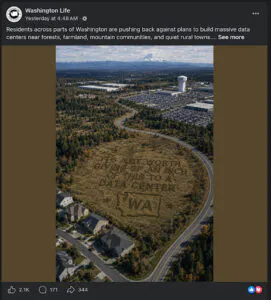

There is a lot of discussion about data centers in America these days. But how much of it is genuine debate about the future of our nation’s digital infrastructure, and how much of it is driven by something else? Something more nefarious? One clue might be in where these pages are managed – almost all of them in Bangladesh.

You might be surprised to see this. I am not. Having closely followed the debate in America over data centers – and the AI technology they help power – it is increasingly obvious that foreign powers are showing a distinct interest in sowing strife and division among the American public for a single purpose: slowing American AI development.
It’s not just posts on social media, either. At a recent event, Interior Secretary Doug Burgum warned that “foreign-sourced, dark money” has been funding anti-data-center advocacy inside America. A recent report in American Intelligence placed these operations in the broader context of long-running efforts by foreign actors to discourage American energy and technological development, using “green” and “environmental” concerns to slow America’s growth. And an expose by the Bitcoin Policy Institute connected the dots between specific Chinese Communist-funded entities and dark-money organizations in the United States that are pushing anti-AI and anti-data-center messaging.
It isn’t even all behind-the-scenes: Senator Bernie Sanders brought two Chinese professors – including an active Counselor of the State Council of the People’s Republic of China – to his recent event on Capitol Hill about how America needs to slow down on AI.
Why would foreign actors and governments care about slowing down American AI development? Because they’re not far behind. Experts estimate that American frontier (latest, most advanced) AI models are around six months ahead of our closest foreign competitors in China. Six months may not sound like a lot of time, but in AI it can be a lifetime. And that six months means that in any adversarial situation (think hacking, cybercrime, etc.), the AI resources available to Americans would be six months ahead of overseas attackers. Our enemies would love for that gap to close.
I want to be clear about what I’m not alleging: I don’t think that the entirety of the discussion around data centers or the AI infrastructure of the future is a foreign creation. There surely are people right here in America with strong views on any new construction anywhere. But it is indisputable that foreign actors are now working to inflame those tensions, and that any slowdown in American AI development only benefits our overseas adversaries.
It would be one thing if China were slowing down its own buildout of electricity or data centers in the same way that these networks of foreign influence peddlers are urging the United States to slow down. They’re not. China already generates more than double the electricity we do in the United States, and it’s expanded its capacity roughly fivefold since 2005, while America’s has remained flat. Reports indicate that China is looking to triple that capacity over the next 25 years. Electricity generation isn’t the only ingredient in the development of advanced AI systems, but it’s a major one – one that China is poised to run away with.
America’s energy needs going forward are great. The All-In Podcast’s David Friedberg broke it down succinctly, tying together America’s need for energy production, how it fuels our economic growth, and how it could even help pay down our national debt. Unlike in China, investment in AI infrastructure is driven almost entirely by the private sector, meaning taxpayers are on the hook for very little. And with President Donald Trump’s Ratepayer Protection Plan, bipartisan efforts in Congress, and commitments from the leading AI companies to cover ratepayer costs, we can expand our capacity with only positive effects on American ratepayers and taxpayers.
All we have to do is let them build. The question is: will we? And who will try to stop us, and with what tactics?
Americans should be wary of who is pushing negative messages about AI and data centers into their feeds and the American media. These negative and inflammatory messages are designed to divide us and should be viewed with heavy suspicion. Ask yourself: who benefits from America losing the AI race?
***
Logan Dobson is a public affairs specialist in Washington, D.C., who serves as an advisor to Build American AI, a pro-American AI advocacy group focused on passing a national regulatory framework for AI.
More from this network:
Domains for Sale · GOTPeople.org · TheDSAPlatform · The Truth About Socialism
What's Your Reaction?
 Like
0
Like
0
 Dislike
0
Dislike
0
 Love
0
Love
0
 Funny
0
Funny
0
 Wow
0
Wow
0
 Sad
0
Sad
0
 Angry
0
Angry
0

I am just an average American. My teen years were in the late 70s and I participated in all that that decade offered. Started working young, too young. Then I joined the Army before I graduated High School. I spent 25 years in, mostly in Infantry units. Since then I've worked in information technology positions all at small family owned companies. At this rate I'll never be a tech millionaire. When I was young I rode horses as much as I could. I do believe I should have been a cowboy. I'm getting in the saddle again by taking riding lessons and see where it goes.
Premium domains for sale














Comments (0)