

The Gordie Howe Bridge Affair And The Costs Of Canada’s Anti-Americanism
Premium domains for sale
Freedom Is Back In Style
Politics, in its original understanding, is the art of securing the happiness of a people through reasoned deliberation about justice and the common good. In modern democracies, however, it is increasingly the art of manipulating passions that obliterate reason and obscure the common good. Canadian Prime Minister Mark Carney is a striking example of this degeneration. He has ascended to power by pandering to his citizenry’s lowest and most convenient resentment: anti-Americanism.
Freedom Is Back
In Style
Premium domains for sale
Nowhere is this more apparent than in the Gordie Howe Bridge affair, which lays bare the contradiction at the heart of his rule. Having ridden this wave to victory last year, Carney now discovers that the very passion he inflamed has become a tyrant over his own judgment. He confronts a hard truth: his personal electoral interest is now at war with the national interest, even the self-preservation, of Canada itself.
To understand the gravity of the problem, one must begin with first principles. No political order can endure if it deliberately miseducates its citizens to hate the very conditions of its existence. Canada’s geography, economy, and security are inseparable from its friendship with the United States. To pretend that Canada can flourish while treating the United States as a permanent enemy, a perpetual object of contempt, is to deny the truths upon which Canadian peace and prosperity rest. Yet Carney’s political genius has been to transform that denial into a badge of national honor.
Any prudent statesman might criticize particular American policies that conflict with Canadian interests. But this is not what transpired. Rather, Carney’s campaign invited Canadians to define themselves against America. He courted and inflamed a virulent anti-Americanism that treats the United States as a principle of corruption: culturally vulgar, economically rapacious, politically decadent. Canada, by contrast, was painted as the purer North American nation, morally superior, more compassionate, more enlightened. It was a flattering tale, and flattery is the great solvent of good judgment in democracies.
The teaching implicit in this rhetoric is simple: whatever comes from the United States is suspect; whatever separates Canada from the United States must be inherently virtuous. Having accepted such a teaching, the electorate is now predisposed to see any close cooperation, any agreement, any “deal” with the United States as a betrayal.
But a nation cannot sustain itself on the proposition, “We are what we are not.” Canada does not become more truly itself by hollowing out its own material foundations in order to maintain a heightened sense of moral indignation. Pride is not a substitute for prosperity, and contempt is not policy.
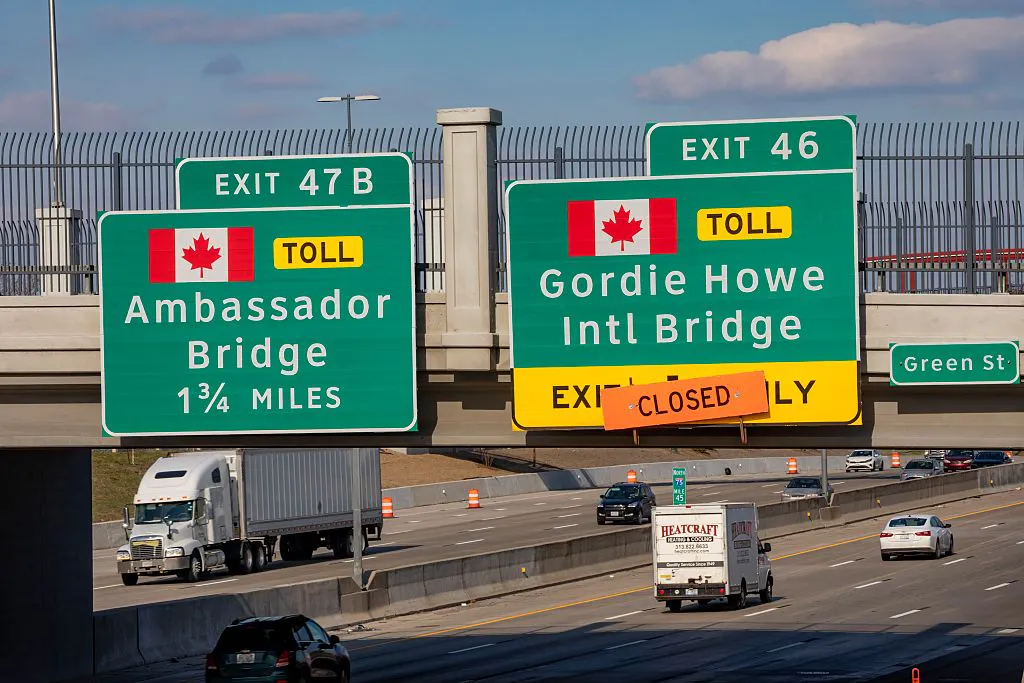
The Gordie Howe Bridge episode crystallizes the danger. The bridge represents a critical artery of trade and supply between Windsor and Detroit: an embodiment of cross-border integration. Millions of jobs, billions of dollars in commerce, and the daily lives of citizens on both sides depend upon it. It is a standing refutation of the delusion that Canada can seal itself off from the United States and flourish in isolation.
But Carney is, by his own design, the tribune of an anti-American demos. He has indoctrinated his supporters to believe that American “demands” are, by their nature, insulting, and that any accommodation is proof of weakness. He has courted commentators and activists who treat every bilateral agreement as another chapter in the supposed story of Canadian victimhood.
Thus, when the bridge crisis emerged, he found himself caught between truth and the passions he had stoked. Business leaders, economists, and provincial officials could see the stakes: disruption of a vital trade corridor, damage to supply chains, risk to investment and employment. Every rational argument pointed toward a negotiated deal. But these considerations had to confront a public teaching: that to bend in any way to American insistence is to forfeit Canadian dignity.
The path he chose was characteristic of a politician who fears the electorate he has miseducated. Outwardly, he postured as the defender of Canadian sovereignty, drawing “red lines,” using the rhetoric of defiance, promising no compromise. Inwardly, his government scrambled to find a formula that would prevent another economic calamity. The eventual resolution gave the United States much of what it had sought from the beginning, but it came late, obscured by semantic evasions and half-acknowledged concessions.
The results satisfied no one. Those Canadians most committed to the anti-American line saw only capitulation under the cloak of empty bravado. More sober observers, who understand that Canada cannot risk a trade war with its indispensable neighbor, saw a prime minister incapable of saying in public what he was compelled to admit in private: that Canadian survival requires cooperation with the American colossus.
The bridge incident, therefore, reveals that Canada is being habituated to a fatal confusion: the belief that to do what is necessary for national self-preservation is somehow ignoble, while to indulge sterile defiance is virtuous. A political order that teaches such a lesson to its citizens corrodes the very faculty of judgment on which self-government depends.
In its classical understanding, prudence is the chief political virtue by which a statesman discerns and pursues the true good. Prudence does not mean timidity or surrender; it means seeing things as they are and acting accordingly. For a Canadian prime minister, prudence must begin with the acknowledgment that Canada’s fate is entwined with that of the United States. Geography and power are not nullified by rhetoric. The question is not whether Canada will deal with the United States, but on what terms, with what clarity, and in what spirit.
Anti-Americanism, as Carney has wielded it, is the enemy of prudence. It does not permit a calm weighing of advantages and risks. It insists that the very act of dealing with the United States is suspect. It inverts the moral order: necessary compromise becomes shameful, and theatrical defiance becomes noble. Under such conditions, the statesman who seeks the true good of his nation must either defy the prejudices he has helped create or surrender to them and preside over a long decline.
The question, then, “Is it in Prime Minister Mark Carney’s interest to secure any deals with the United States?” must be answered on two levels. If by “interest” we mean his interest as a seeker of re-election, then a comprehensive rational agreement with the United States may well be contrary. Every sensible concession will be denounced as treason by those whom he taught to equate dignity with defiance.
But if by “interest” we mean the preservation and flourishing of Canada as a free and prosperous nation, then such a deal is indispensable. To jeopardize crucial economic and security arrangements for the sake of indulging national vanity is to prefer shadow to substance. It is to sacrifice the future for the intoxication of the present moment.
Carney’s predicament is thus emblematic of a deeper crisis in demagogic leadership. The statesman worthy of the name seeks to elevate opinion toward truth, to discipline and educate passion so that the people can recognize their true interests. The demagogue does the opposite: he magnifies passion against reason and then becomes its captive.
Nations can die more subtly than by invasion, bankruptcy, or demographic collapse. That is, by losing the capacity to recognize their own good when it conflicts with their favorite resentments. Canada now stands at such a crossroads. It can have its cathartic anti-Americanism, or it can have a serious future in which its prosperity and security are guarded with adult sobriety. What it cannot have, no matter how skilled its prime minister, is both.
***
Dimpee Brar currently serves as the Director of Engagement for Allies for a Strong Canada. She is a writer whose work can be found in the Federalist, American Spectator, the Western Standard, and the Toronto Sun. She appears frequently on various podcasts and radio shows. You can follow her on X: @isthisdimpeeb
More from this network:
Domains for Sale · GOTPeople.org · TheDSAPlatform · The Truth About Socialism
What's Your Reaction?
 Like
0
Like
0
 Dislike
0
Dislike
0
 Love
0
Love
0
 Funny
0
Funny
0
 Wow
0
Wow
0
 Sad
0
Sad
0
 Angry
0
Angry
0

I am just an average American. My teen years were in the late 70s and I participated in all that that decade offered. Started working young, too young. Then I joined the Army before I graduated High School. I spent 25 years in, mostly in Infantry units. Since then I've worked in information technology positions all at small family owned companies. At this rate I'll never be a tech millionaire. When I was young I rode horses as much as I could. I do believe I should have been a cowboy. I'm getting in the saddle again by taking riding lessons and see where it goes.
Premium domains for sale














Comments (0)