

The Rise And Fall Of The German Battleship Bismarck, Part III
Premium domains for sale
Freedom Is Back In Style
Editor’s note: This is the third in a four-part weekend series on the hunt for the Bismarck, coming up on its 85th anniversary this month.
Freedom Is Back
In Style
Premium domains for sale
On the bridge of King George V, still steaming westward toward the battle area, Adm. Tovey received a staggering message from the captain of Prince of Wales, John Leach. It simply read: HOOD SUNK.
Word of the disaster ricocheted through the fleet. One sailor described the mood aboard his vessel as “a strange mixture of incredulity, anger, and loss.” Royal Navy pilot Alan Swinton’s reaction was blunter: “Well bugger me!” But as the magnitude of what had happened settled in, numbness turned to rage, then iron resolve. The Admiralty now had one mission: avenge Hood. Sink Bismarck.
One British warship was still engaging the lethal German battleship and cruiser. But Prince of Wales was in no condition to continue the fight. During the action her aft Y turret jammed, and she was down to only three operational 14-inch guns, while Hood’s destruction freed both Bismarck and Prinz Eugen to concentrate fire on the lone British battleship. It did not take long for the German gunners to find the range. In the next 10 minutes, the Prince of Wales was struck four times by Bismarck and another three by Prinz Eugen. Outnumbered, with 13 crewmen dead and turrets malfunctioning, Captain Leach broke off the action at 6:10 a.m. Lindemann wanted to pursue and destroy the fleeing battleship, but Lütchens ordered the squadron southward instead.
Now came the damage assessment. Bismarck had blasted her way free, but the victory carried a heavy cost. Prince of Wales, though untested and under intense fire, had scored three hits, including two below the waterline, one at the bow and one amidships. Two thousand tons of seawater flooded Bismarck’s forward compartments, leaving her down three degrees by the bow and listing nine degrees to port before counterflooding corrected the imbalance. Worse still, damage to fuel tanks cut off access to 1,000 tons of precious oil. Lütchens no doubt wished he’d topped off when he had the chance.
Trailing oil and unable to sustain maximum speed, Bismarck needed repairs. Lütchens faced two choices: return north toward Norway and Germany, the closer route, or make for the French coast through the sanctuary of wide-open seas. Lindemann, after initially arguing to repair the ship at sea and continue the mission, favored returning home. Lütchens instead informed Berlin he intended to head for occupied France.
Since Prinz Eugen remained unscathed, Lütchens would detach her for commerce raiding. But the German ships were still shadowed by Suffolk, Norfolk, and the battered Prince of Wales. Then, at 6:00 p.m. on May 24, Lütchens executed a clever maneuver. Bismarck suddenly turned southwest while Prinz Eugen accelerated directly south. The British followed the battleship as she eventually resumed course while the cruiser slipped unseen into the open Atlantic.
Now Bismarck was alone, and her crew understood what Hood’s obliteration meant. Every available Royal Navy warship in the Atlantic would be mobilized with one purpose: hunt down their fugitive battleship and kill her…and them. For Britain, this was no longer merely a military necessity. It had become a matter of national honor.
The Admiralty ordered every ship within reach to converge on Bismarck. While the cruisers and Prince of Wales continued shadowing her, Tovey steamed at 27 knots aboard King George V, accompanied by the carrier Victorious, battlecruiser Repulse, four cruisers, and several destroyers. Also racing toward the scene was the battleship Rodney and three destroyers, diverted while en route to Boston for a refit. From the south came Gibraltar-based Force H built around the carrier Ark Royal, battlecruiser Renown, and cruiser Sheffield. Two cruisers were pulled from convoy duty off West Africa, and one more, Dorsetshire, detached on her own volition. The hunt was on.
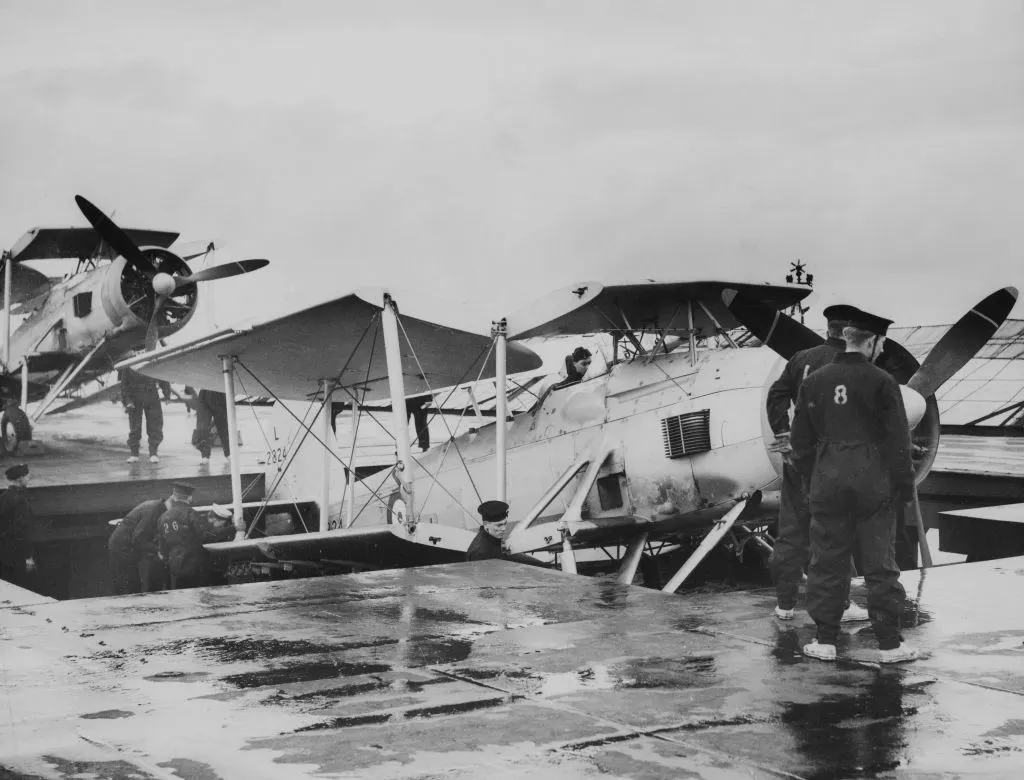
In the spring of 1941 carrier warfare had yet to fully emerge, and most admirals still had little faith in aircrafts’ ability to sink a capital ship at sea. But by the evening of May 24, the British were desperate to stop Bismarck before she reached France, and they resolved to use every arrow in their quiver. One of those arrows was the Fairey Swordfish.
First flown in 1934, the ungainly biplane looked more suited to the trenches of the First World War than modern naval combat. Built of metal framing, canvas, and wire, with a top speed barely above 130 miles per hour, the Swordfish hauled a 1,700-pound torpedo under the belly. With Tovey’s heavy vessels still too far away, these open-cockpit aircraft would launch from Victorious into foul weather to attack the most formidable battleship at sea. It seemed suicidal. One pilot remembered climbing into his cockpit and thinking, “God, I’d get out of this if I could!” But they went.
With the northern sun still lingering above the horizon, the plucky Swordfish lifted off from Victorious’ pitching, rain-swept flight deck and headed into worsening weather. At first, the inexperienced crews emerged from the clouds too early, only to discover an American Coast Guard cutter searching for survivors from a merchant ship sunk earlier by U-boats. Bismarck remained farther away. Surprise was lost, but the Swordfish crews pressed on through heavy anti-aircraft fire. Ironically, the lumbering biplanes’ ostensible weaknesses became strengths. The Swordfish flew so slowly that Bismarck’s advanced fire-control systems struggled to track them properly, especially while the aircraft were buffeted sideways by violent winds. And any shells that did hit passed straight through the canvas skin without detonating.
Skimming the churning sea, the Swordfish released their torpedoes, banked slowly, and crawled away through streams of cold rain and hot tracers. One torpedo struck home. The damage was minor — the warhead detonated against the thickest belt armor — but one sailor was killed, Bismarck’s first fatality. More ominously, the attack demonstrated that aircraft could threaten even the mightiest warship afloat. By 2:00 a.m. on Sunday, May 25, all the biplanes, many riddled with holes, had landed safely aboard Victorious.
May 25 was Admiral Lütchens’s 52nd birthday, but no one aboard Bismarck was celebrating. Fuel had become critical. To conserve oil, he slowed the ship to 22 knots and steered directly for Brest. If Bismarck could get within a few hundred miles of occupied France, Luftwaffe aircraft could shield her final approach. But first he had to shake the British trackers.
Taking advantage of enemy zig-zagging to avoid U-boats, Lütchens executed a brilliant maneuver. At 2:00 a.m., with perfect timing, he ordered Bismarck hard to starboard, swinging the battleship in a broad loop while the British cruisers, having temporarily lost radar contact during a “zag,” continued onward into the darkness. Bismarck then circled back, crossed her own wake behind them, and resumed her easterly heading. At 5:00 a.m. Suffolk reluctantly signaled: HAVE LOST CONTACT WITH ENEMY. The German battleship had vanished into the Atlantic. When word reached Prince of Wales, one crewman recalled, “We all felt utterly depressed.” Bismarck appeared home free.
And then Lütchens made an inexplicable mistake. Unaware how completely he’d escaped, the admiral carelessly broke radio silence to send routine reports to naval headquarters in France. British direction-finding stations intercepted the transmissions and obtained a bearing on the battleship’s location. Lütchens had inadvertently revealed himself.
But the German admiral was not the only one to blunder. Having obtained a rough bearing, Tovey miscalculated Bismarck’s heading and assumed she was steering north. He turned his pursuing force away from the enemy. Only on the evening of May 25 did Tovey realize the mistake. By then, Bismarck had widened the gap still further.
RAF Coastal Command had also joined the search, dispatching reconnaissance aircraft across enormous stretches of ocean in what amounted to scouring for a needle in an Atlantic haystack. Then, at 3:30 a.m. on Monday, 26 May, an American-built Catalina flying boat lifted off to continue the hunt. Although the United States remained officially neutral, the aircraft was co-piloted by an American, L.B. Smith. At 10:30 a.m., to his astonishment, Smith spotted the German battleship below him.
Bismarck had been lost, found, lost again, and found again. But time was rapidly running out. If not stopped soon, the battleship would reach the protective umbrella of German air cover. She still remained roughly 150 miles ahead of her pursuing battleships — well beyond gun range, but not beyond aircraft range.
And so the British turned once more to the Swordfish. This strike would launch from Ark Royal, as Victorious had broken off low on fuel. The raid nearly ended in catastrophe when the attackers mistakenly identified Sheffield as Bismarck and dropped torpedoes against their own cruiser. Fortunately, they missed. As evening approached on May 26, Bismarck drew ever closer to safety.
Then, at 7:00 p.m., with only hours remaining before the German battleship escaped, the intrepid Swordfish again rolled down Ark Royal’s flight deck into foul weather. This time they found their target. Once more the little biplanes crept toward the giant battleship through intense anti-aircraft fire. Towering geysers erupted around them as Bismarck fired her main guns into the sea in an attempt to destroy the fragile aircraft with shell splashes alone. The Swordfish pressed through the chaos and released their torpedoes before turning away into the darkness.
From the aircrews’ perspective, the attack appeared to be another failure. The torpedoes seemed to miss. And with France now dangerously close, time had effectively run out.
Only a miracle could stop Bismarck now.
And that is exactly what happened.
***
Brad Schaeffer is a commodities fund manager, author, and columnist whose articles have appeared on the pages of The Wall Street Journal, NY Post, NY Daily News, The Daily Wire, National Review, The Hill, The Federalist, Zerohedge, and other outlets. He is the author of three books. You can also follow him on Substack and X. His latest book, A War For Half The World: Why the Real Battle for the Future was Fought in the Pacific, will be released in February 2027.
More from this network:
Domains for Sale · GOTPeople.org · TheDSAPlatform · The Truth About Socialism
What's Your Reaction?
 Like
0
Like
0
 Dislike
0
Dislike
0
 Love
0
Love
0
 Funny
0
Funny
0
 Wow
0
Wow
0
 Sad
0
Sad
0
 Angry
0
Angry
0

I am just an average American. My teen years were in the late 70s and I participated in all that that decade offered. Started working young, too young. Then I joined the Army before I graduated High School. I spent 25 years in, mostly in Infantry units. Since then I've worked in information technology positions all at small family owned companies. At this rate I'll never be a tech millionaire. When I was young I rode horses as much as I could. I do believe I should have been a cowboy. I'm getting in the saddle again by taking riding lessons and see where it goes.
Premium domains for sale




















Comments (0)