

The Rise, Fall, And Deportation Of The Original Political Troll
Premium domains for sale
Freedom Is Back In Style
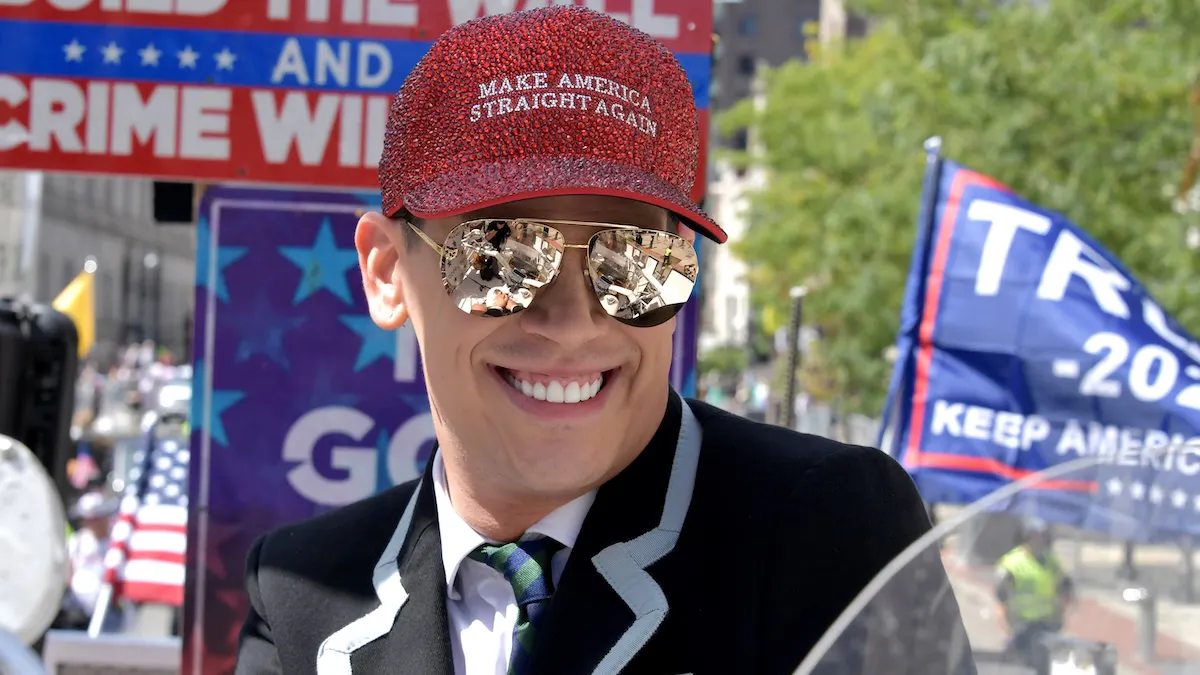
A decade ago, putting Milo Yiannopoulos’ name on a university speaking calendar meant inviting violent student riots and salacious national headlines. Last week, Immigration and Customs Enforcement arrested him at the New Orleans airport and deported him to the U.K. It’s such a perfectly scripted ending to his American career that it almost seems ghostwritten. Which, in Milo’s case, would be appropriate.
Freedom Is Back
In Style
Premium domains for sale
“It was physically degrading. It was frightening. I don’t think I’ve ever been frightened like that before,” Yiannopoulos said in an interview with Piers Morgan, a privilege not bestowed upon the average ICE deportee. In a piece in the Spectator, Yiannopoulos claimed that the ICE facility he was in was empty and that the Trump administration’s deportation policy was akin to a chess board lacking its pieces. But the experience, he said, opened his mind and his heart. “In the past,” he said, “I think I’ve been a little blasé when people talked about their trauma.”
You think? Yiannopoulos dined off trauma for years, which briefly made him one of the most controversial figures in American politics. And now, we live in the world he helped make.
The rise of a provocateur
After dropping out of university, Milo worked at the Catholic Herald, then moved into tech journalism around 2009, writing and blogging for the Daily Telegraph and contributing to TechCrunch. He cultivated a reputation as a nasty theatrical gadfly of the London startup scene. By 2012 Wired UK was literally describing him as a “provocateur” who liked to “provoke and irritate, often for its own sake.”
Then in late 2011 he co-founded The Kernel, a gossip publication whose pitch was basically: British technology journalism is timid and clubby, and we’re going to be meaner and more aggressive. It covered startups, internet culture, and media but also specialized in picking fights with people in the British tech establishment. In a 2012 profile, The Observer called him the “pit bull of tech media.” Forbes, rather grandly, called him “Digital Media’s Citizen Kane.” He enjoyed, he told Forbes, “seeing the wicked suffer.”
Enter Gamergate, an internet pile-on against leftism (and sometimes just women) in the video game industry, which allowed Milo to discover that the same provocateur act had vastly greater commercial and political potential when aimed at feminism, political correctness, and the American culture war. “I’d be lying if I said I didn’t recognize the potential of GamerGate to give the left a bloody nose,” he said in a 2015 interview.
On September 1, 2015 Milo published a Breitbart piece titled “Feminist Bullies Tearing the Video Game Industry Apart.” “It’s easy to mock video gamers as dorky loners in yellowing underpants,” the column went in part. “I enjoy upsetting the right people,” he told the L.A. Times in 2015, adding that he wanted to push the boundaries of permissible online speech.
By 2016 Milo had gone from Gamergate provocateur to an enthusiastic Trump surrogate — not officially, but culturally. He called Trump “Daddy” and himself a “Trump-sexual.” He consciously designed this to irritate people. Asked why he called Trump Daddy, Milo said: “I wasn’t particularly attached to it until I saw how much it wound up liberals. And now I do it all the time.”
In July 2016, he told the Washington Post: “My career has taken off exponentially.” He called Trump “a perfect storm of everything I love in life.” The Washington Post noted that Breitbart Tech was publishing so many stories about Milo himself that it was effectively part news operation, part publicity machine.
Milo’s 2016-2017 “Dangerous Faggot Tour” made various college stops, hosted by groups including College Republicans, Young Americans for Liberty, and Turning Point USA. The presentation was deliberately theatrical. At UC Santa Barbara in May 2016, Milo entered a packed hall on a golden throne, wearing pearls, with a life-size Trump cutout waiting onstage. But there was a real constituency underneath the spectacle. One UCSB student told the campus newspaper: “I stopped being ashamed of my opinions and conservative values, so thank you.”
Campuses became an absurd flashpoint when Yiannopoulos appeared, culminating in a February 1, 2017, riot in Berkeley. About 150 masked agitators set fires, lit fireworks, broke windows, and attacked police. The university evacuated Milo and canceled the event. Trump threatened Berkeley’s federal funding over the canceled speech, leading Bill Maher to say “liberals always take the bait.”
Twitter permanently banned Milo in 2016 for making fun of actress Leslie Jones’ reaction to bad reviews of her all-female “Ghostbusters” reboot. His followers unleashed a fusillade, causing her to leave Twitter with the sad message, “I have been called Apes.” From Milo’s point of view, this was a publicity bonanza. In front of a roaring crowd at an RNC party he was hosting in Cleveland, he said “I just got banned from Twitter.”
By December, Simon & Schuster was offering him a reported $250,000 book deal. Milo’s description of that meeting is almost embarrassingly on-theme: “I thought they were going to have me escorted from the building.” Instead, he said, they offered him “a wheelbarrow full of money.” He added, “I don’t care about politics. I only talk about politics because of Trump.”
But politics was also going to bring on his rapid downfall.
Too much trolling
In 2016, Milo appeared on the Drunken Peasants podcast, discussing relationships between adult men and teenage boys, attacking age-of-consent laws, and speaking about his own sexual experiences with an older Catholic priest. On Sunday, Feb. 19, 2017, the conservative anti-Trump account The Reagan Battalion pushed the old footage back into circulation specifically as Milo was about to appear at CPAC. Milo found himself backed into the tightest of corners, forced to say, “I do not support pedophilia. Period.”
By the next day, CPAC had rescinded his invitation. Chairman Matt Schlapp said: “There is no disagreement among our attendees on the evils of sexual abuse of children.” The day after that, Milo lost his book deal. Then, on Tuesday, Feb. 21, he resigned as Breitbart’s senior editor. He insisted, “This decision is mine alone,” although the Washington Post reported that Breitbart staffers had been discussing leaving if he remained. His public explanation was that his “poor choice of words” was distracting from his colleagues’ work.
Milo still had an audience after the crash. He self-published “Dangerous” in July 2017. Then he sued Simon & Schuster for $10 million for breach of contract. The litigation became embarrassing when the publisher’s editorial notes on his manuscript entered the record; by February 2018, Milo abandoned the suit. He said he didn’t want to spend his book profits and another two years litigating it.
By late 2018, documents assembled by former Australian tour promoters indicated that Milo was more than $2 million in debt. The alleged creditors included $400,000 owed to the Mercer family, $153,215 to former lawyers, $76,574 to longtime ghostwriter Allum Bokhari — and $20,000 to Cartier. Milo disputed the characterization, saying these were “company debts, not personal” and claiming he was earning $40,000 a month.
He pleaded for money on Patreon, saying “I’ve had a miserable year or two, banned and de-platformed and censored and blacklisted.” In 2022, he revealed that he was “ex-gay” after going through Catholic conversion therapy. He became an unpaid intern for Marjorie Taylor-Greene. In 2022, he entered Kanye West’s chaotic political orbit, becoming involved with Ye’s prospective 2024 presidential campaign alongside Nick Fuentes. He was fired, later rehired in 2023 as Ye’s director of political operations, and eventually became Yeezy’s chief of staff.
And now he’s a deportee, who — in his time — was ahead of his time.
The modern political influencer who suddenly changes positions without integrity, manufactures stupid feuds, treats attention as ideological capital, converts cancellation into marketing, and makes his personality more important than his ideas is utterly normal now. Milo looks dated and pathetic in 2026 partly because the culture has thoroughly absorbed the techniques that made him freakishly novel in 2015.
In ICE, the great proto-troll finally encountered an institution that wasn’t arguing with him, quote-tweeting him, protesting him, interviewing him, or buying tickets to hate-watch him. It just put him on an airplane. No one waved goodbye.
***
Neal Pollack, “the greatest living American writer,” is the author of 12 semi-bestselling books of fiction and nonfiction and is a three-time “Jeopardy!” champion.
This article is part of Upstream, The Daily Wire’s new home for culture and lifestyle. Real human insight and human stories — from our featured writers to you.
More from this network:
Domains for Sale · GOTPeople.org · TheDSAPlatform · The Truth About Socialism
What's Your Reaction?
 Like
0
Like
0
 Dislike
0
Dislike
0
 Love
0
Love
0
 Funny
0
Funny
0
 Wow
0
Wow
0
 Sad
0
Sad
0
 Angry
0
Angry
0

I am just an average American. My teen years were in the late 70s and I participated in all that that decade offered. Started working young, too young. Then I joined the Army before I graduated High School. I spent 25 years in, mostly in Infantry units. Since then I've worked in information technology positions all at small family owned companies. At this rate I'll never be a tech millionaire. When I was young I rode horses as much as I could. I do believe I should have been a cowboy. I'm getting in the saddle again by taking riding lessons and see where it goes.
Premium domains for sale






Comments (0)