

This Insane New Therapy Trend Is Destroying Families

Premium domains for sale
Freedom Is Back In Style
We learned late Thursday night that Shiloh Hendrix was convicted of one count of “disorderly conduct” for the crime of being robbed by a Somali child and then saying unkind things to a Somali man who berated her.
Freedom Is Back
In Style
Premium domains for sale
She received a jail sentence of 90 days, which was stayed, along with a $1000 fine and an order to perform 200 hours of community service — all because she used words that offended a Somali invader in her state.
BREAKING: Shiloh Hendrix found guilty by a MN jury for “using the n-word” pic.twitter.com/CDdhhWvbuF
— End Wokeness (@EndWokeness) July 24, 2026
She didn’t hit the man. She didn’t threaten him. She verbalized her frustration with the fact that Somalis have taken over Minnesota, to the point that they’re terrorizing her and her child in public parks. She defended her child from a hostile foreigner who was clearly antagonizing her.
Yes, she used a naughty word, but this isn’t North Korea or Canada. We’re allowed to say naughty words in this country because we understand that words are not tantamount to violence. No harm, of any kind, will befall anyone because they heard someone say a word. Especially a word that the very community claiming to be offended by it uses themselves with significant frequency.

For now, unless this verdict is immediately overturned, we can say definitively that the First Amendment, in every relevant respect, has been suspended in the state of Minnesota.
This case raises many issues that we’ll be delving into later on. I wanted to mention it now because it’s an important story — in many ways, a landmark free speech case — that just broke late Thursday night.
But in a somewhat circuitous way, you could also see a connection to the topic at hand. As it indirectly highlights a broader issue, which is that the Leftist mission of destroying American families — of punishing parents who defend their children — has not gone anywhere since the BLM mania of 2020.
If you remember, in 2020, we heard again and again that the “nuclear family” is a racist vestige of white supremacy, and that students should effectively be raised by the school system, rather than their parents.
This is nothing new for communists, as we discuss in our most recent episode of Real History, but it would be naive to think that the Left has abandoned the same objective in this country. They’re not backing down at all. In all aspects of civil society, their goal is to drive a wedge between parents and their children.
We’re going to focus on one front in this war, which is the field of psychiatry — a discipline that demands to be taken seriously, even though it has achieved precisely nothing.
Think of it this way. Over the past 100 years, cardiologists invented open-heart surgery. Infectious disease doctors started prescribing penicillin. Dentists developed all kinds of new and effective ways to advance dental health and hygiene. Neurologists have come up with new treatments for Alzheimer’s. Dermatologists have made many advances in tackling acne and other skin conditions. Eye doctors learned how to perform surgery on the cornea — mostly by accident.
It’s actually a remarkable story: in the 1970s, a kid in Russia got into a fistfight in which he was punched in the face. Pieces of his glasses ended up in his eye. After removing the glass, the Soviet eye doctor realized that the child’s vision had actually improved. The doctor got the idea of cutting the cornea to improve people’s vision, and a few decades later, LASIK was born.
In short, most of the major medical specialties have done something new and noteworthy within the past century. There are marked improvements in their areas of health, which can be directly tied to these advances. If you asked the typical doctor, “What has your particular branch of medicine accomplished since the early 1900s?” you’d get a laundry list of accomplishments that have impacted millions of lives.
But there is at least one notable exception: The field of psychiatry. Psychiatrists are the only doctors who can’t point to a single quantifiable achievement in their entire field. There has never been a documented, verifiable moment in which psychiatrists have ever made a true, measurable advancement. They haven’t stumbled into any major discoveries.
All of their alleged breakthroughs — particularly the “discovery” of ADHD, the closure of the asylums, all the gender derangement, and the mass-prescription of SSRIs, hormones and speed — have turned out to be counterproductive and dangerous, particularly for children.
They told us that depression was caused by a lack of serotonin in the brain, only to admit decades later that they had no idea what they were talking about.
Their primary achievement is not finding new ways to cure or treat diseases, but inventing new diseases that cannot be cured or treated. Most importantly, as we’ll discuss, by every measure, their area of health — mental health — has declined, rapidly and catastrophically, as the field has become more powerful, more pervasive, and better funded.
As the mental health industry has expanded, mental health in our society has plummeted. And yet the industry is never held accountable for this. These dots are rarely connected.
Certainly, the drugs have been a total bust. And, therefore, the only tool that’s left in their arsenal — the only way for a mental health professional to discover a “breakthrough” in the field, aside from coming up with a new drug for a new fake mental health condition, is to experiment with new methods of talk therapy.
That’s all they can attempt to do: Just talk to people in different ways, and say different things, in the hopes they’ll somehow fix all of their patients’ problems.
In other areas of medicine, finding a major breakthrough means conducting lab experiments and high-stakes procedures. In the field of psychiatry, finding a major breakthrough means having a different kind of conversation with your patient, and hoping for the best. And unlike the legitimate fields of medicine, the breakthrough is not measured in any kind of objective, verifiable way.
There’s no subjectivity to the question of whether or not your heart medication is working. But the success of psychiatric treatments is entirely measured by the subjective judgment of the patient, who is in the treatment in the first place because they are troubled and mentally unwell. And by the psychiatrists or therapists, who are, of course, very incentivized to count their own methods as successful.
If you read The Wall Street Journal recently, you might be aware of the latest “conversation” that therapists are pushing. Increasingly, therapists are telling their patients to cut off contact with their own family members, as a way of “protecting their own health” and “allowing for emotional growth.” The numbers are pretty staggering:
About 25% of the U.S. population is estranged from, or has cut ties with, a close relative at any given time—and 10% is estranged from a parent or child—according to research by Karl Pillemer, a family sociologist and professor of human development at Cornell. … Among some 7,000 estranged parents surveyed in April, a third believed their adult child’s therapist had influenced or recommended the decision to end the relationship.
Yes, one-third of estranged parents believe that a therapist convinced their adult child to cut them off. And a quarter of the population is estranged from someone in their family. This is what they call going “no contact,” and it has become increasingly popular.
I never heard that phrase until a few years ago, and now it’s everywhere, especially on TikTok, among Gen Z and Millennials. A huge number of them, as The Wall Street Journal has found, have decided to go “no contact” from their parents. And we have the mental health industry largely to thank for that.
Obviously, certain situations might justify cutting off a family member. If your parents are actually abusive monsters who are destroying your life in some tangible way, then cutting them off is totally justified. I’m not going to say that people have an obligation to endure relentless abuse just because they’re related to the abuser. But that’s not what we’re talking about here.
We’re not talking about parents who were legitimately abusive and were rightly cut off. What’s happening in these cases, very often, is quite different. Therapists have their clients icing out family members — cutting them off completely, essentially disowning them — for reasons that have nothing to do with actual abuse.
In many cases, therapists are simply affirming whatever their client tells them, without questioning whether the client is telling the truth. In other words, instead of functioning as an independent advisor, therapists are acting like yes-men, which is what they usually do. It’s the “affirmative” model of therapy that has been a catastrophic disaster across the board. So if a client is delusional or self-centered, and wants to cut off his family for a dumb reason, the therapist isn’t going to stand in the way. From the WSJ:
A lot of therapists are taught to believe whatever the client is saying at face value,” says Peter Anderson, a licensed marriage and family therapist in Beverly, Mass., who helps families with estrangements and conducted the surveys. “They’re forming conclusions based on one person’s account. … “People are coming into a therapist’s office and parroting what they hear on social media,” Anderson says. “They’re looking for affirmation for a decision they’ve already made.
There are also many cases in which therapists take a more direct role and try to plant memories of abuse or “trauma” in their client’s head. If that sounds implausible, you should know that there’s a long history of therapists and psychiatrists convincing people they were abused when, in fact, they were not. You might remember the “repressed memory” scam of the 80s and 90s, when it became fashionable for people to concoct narratives long after the fact, often with the help of therapists.
Probably the most famous case involved a woman named Eileen Franklin-Lipsker, who became something of a celebrity. In 1989, Eileen alleged that she had suddenly recovered a repressed memory of seeing her father, 51-year-old retired firefighter George Franklin, sexually assault and murder an eight-year-old girl named Susan who lived next door. The alleged memory was more than 20 years old by that point — the killing happened in 1969 — but the media took Eileen’s claim seriously. So did the prosecutors.
Watch:
One of the details that Eileen provided, as part of her newfound recollection of events, was that a ring had been smashed at the crime scene. The authorities took that claim as proof that Eileen’s memory was accurate, since a ring had indeed been recovered.
Defense lawyers attempted to point out that several media organizations had reported on the ring back in 1969, meaning it’s possible that Eileen was simply remembering news coverage she had seen.
The judge didn’t let the defense lawyers make that argument in front of the jury. Not that it would’ve mattered. By all accounts, the jury had fully bought into the idea of “repressed memories.” As the LA Times reported:
Franklin-Lipsker’s story shifted and changed. In one account, her sister Janice had been in the van; in another, she wasn’t. The murder was in the morning, then in the late afternoon. But the contradictions did not cause jurors to disbelieve her, said Harry MacLean, who wrote about the case in the book “Once Upon a Time: A True Story of Memory, Murder and the Law. “The problem was, the jury sat there and took that as evidence of how damaged she was from having George Franklin as a father,” MacLean said. “It was making her more sympathetic.
The prosecution was also assisted by quack experts who went on national television to push this narrative of repressed memories.
In the end, despite the total lack of physical evidence tying him to the murder, George Franklin was convicted and sentenced to life in prison. The judge said he regretted that he couldn’t hand down a death sentence.
After he served more than six years in prison, Franklin was released. A federal judge overturned his conviction, saying the trial court had made several errors.

Shortly afterwards, Eileen’s sister admitted that Eileen’s repressed memory had been unearthed via hypnosis. It wasn’t really a memory at all. It was suggested to her. Then Eileen torpedoed her credibility further when she announced that she had yet another “repressed memory” of her father committing a separate murder. But that claim didn’t go anywhere, because DNA evidence proved her father was nowhere near the murder scene.
The saga of this particular fake “repressed memory” led a memory scientist named Elizabeth Loftus to conduct an experiment, which was published in 1995 in the journal “Psychiatric Annals.” In this experiment, researchers assembled a pool of test subjects and then interviewed their family members to learn about three real events from their childhoods.
Then, the researchers told the test subjects about four events from their childhood — three real, and one that was made-up. In every case, the made-up event was the same: The subjects were told that they had been lost in the mall when they were young, and were rescued by an elderly woman.
In the experiment, 25% of participants said they developed “partial or complete memories” of the fake event that never took place. In later experiments, test subjects became convinced of other events in their childhood that never took place — from dog attacks to near-drownings.
These are extreme examples, but there’s no reason to believe that the psychiatric industry has changed to any significant degree. These are people who will happily tell children that they’re born in the wrong body, and sign them up for a lifetime of hormones and chemical castration — if not outright mutilation. To this day, all over the internet, you’ll find videos from alleged “experts” about how repressed memories are supposedly real. For example, here’s licensed therapist Elizabeth Cappelletti.
Watch:
You can certainly be reminded of things that you haven’t thought of in a while after encountering some kind of relevant cue. That happens all the time. It’s called “remembering something.” But the idea that you can have a deeply repressed memory of a highly traumatic event, for decades, and then one day it’s “triggered” and comes rushing back, or your therapist figures out the secret key for unlocking this hidden memory, is complete nonsense.
If anything, based on all the people who say they have PTSD, the problem with traumatic memories is that they won’t go away. It’s not that they’re buried for 20 years in some secret compartment in your brain that no one can identify. They stick with you. That’s the whole problem.
The point is, this woman is not an outlier. She is very representative of the therapy industry, in that her job is to mislead her clients with fake science and voodoo. If you go into her office and conjure up a “repressed memory” of your father doing something horrible 30 years ago, she won’t tell you that you’re making it up, or that it seems dubious.
Instead, she’ll affirm it and encourage you to cut your father out of your life. That’s how this works. Even though the “repressed memory” idea has been thoroughly discredited and debunked for years now. This is a theme in the psychiatric industry. The industry invents myths — like repressed memories, like chemical imbalances, like gender identity — and even after those myths are exposed, debunked, proven not only false but disastrously harmful, still the industry will keep peddling them, and millions of hapless people will keep paying thousands of dollars to the purveyors of these discredited myths.
That’s why you can easily find thousands of videos of therapists and “life coaches” informing children that if they don’t want to be associated with their parents, then it’s automatically their parents’ fault. You don’t need to do any kind of analysis, engage in any amount of introspection, or communication. If a child cuts off his parents, then by definition, the child is justified. That’s the message.
Watch:
Yes, God forbid you “force your religious options on your child.” Otherwise known as raising them in your faith, which is what every generation of humans has done since the beginning of human civilization. But by this guy’s telling — and according to many other people, especially therapists — if you were raised in a way that is totally consistent with how billions of other people have been raised, then you are a victim, and are now morally justified in disowning your family. This, again, is a very common idea, and it’s one of the main reasons why so many people have cut off their family members, at the urging of “mental health professionals.”
But a few things are lost in this way of thinking, beyond basic logic and common sense. First of all, if you are an adult — again putting aside cases of actual, real abuse — it’s time for you to grow the hell up and get over whatever complaints you have about the way you were raised. Maybe your dad didn’t attend your dance recital. Maybe your mom had a bit of a temper. Maybe your parents made a whole laundry list of mistakes. Maybe, horror of horrors, they forced you to go to church with them. Maybe they even made you do chores. Maybe they didn’t take you to Disney World.
Whatever your complaints are, now you’re an adult. It’s time to move on. It’s time to get over it. The fact that there are people in their 30s and 40s — grown-ups with kids of their own — still obsessing over minor offenses committed by their parents when they were 11 is pathetic and insane.
Yes, your parents made mistakes. You don’t need a therapist to tell you that. Your parents were human beings. They were stumbling along, fumbling around, trying to figure things out as they go, just like you are. Age and perspective should make you more understanding and forgiving of your parent’s faults, not less.
Second, your family is your family. You have an obligation to them. Any “mental health professional” who encourages you to “go no contact” from your parents is encouraging you to shirk one of your most fundamental responsibilities as a human being. That’s why cutting off your parents should be an extreme measure and a last resort. But that’s not what’s happening.
If you think I’m cherry-picking here — if you’re under the impression that most therapists are actually useful — then you have to zoom out a little bit.
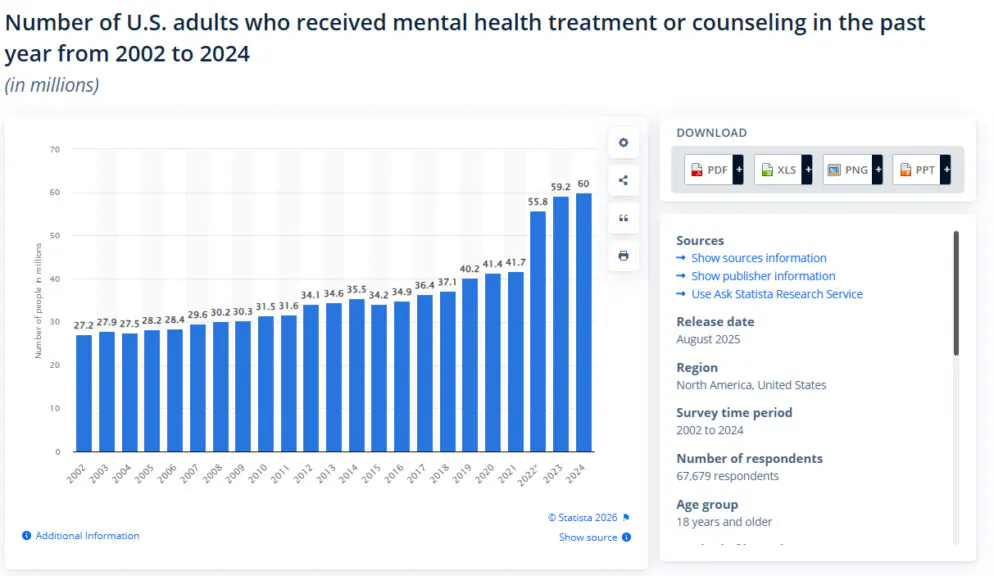
This chart shows the number of adults in the United States who receive mental health treatment of some kind, whether it’s therapy, medications, or both. As you can see, as of 2024, the number is around 60 million people, or roughly one in five adults. In 2002, the number was just 27 million. You can see there was a massive spike during the COVID lockdowns, for obvious reasons, and it’s been increasing ever since.
If we look at talk therapy alone, the numbers are still hard to believe. From 2018 to 2021, the number of American adults receiving outpatient talk therapy alone grew from 6.5% to 8.5%, according to a study from Columbia University. That’s a jump from 16 million people to nearly 22 million.
More recent data from 2024 shows that at least 14% of Americans had received counseling or therapy in the past year. And when you look closely at the demographics, as you’d expect, the vast majority of these patients are young people. Something like 42% of Gen Z is currently in therapy, which marks a 22% increase in just the past four years. So talk therapy is becoming significantly more common, and people who start talk therapy are more likely to continue for a long time. They’re also younger than ever.
These are staggering numbers. They mean that virtually every American is either in therapy or knows someone who is. And yet, despite all of this therapy, there’s no evidence that mental health is improving in this country. In fact, it’s getting worse by every available metric.

The CDC found that the prevalence of depression rose by roughly 60% — from 8% in 2013 to 13% in 2022 — among Americans age 12 and older. Gallup surveys found that 29% of Americans report that they’ve been diagnosed with depression at some point in their life, which is a significant increase from 2015, when only 20% of adults made that claim.
Nearly 48 million Americans — 18% of the adult population — claim that they’re being treated for depression. And depression among young adults aged 18-29 more than doubled, from 13% in 2017 to 27% in 2025. As the therapist Jonathan Alpert writes, “Today, 30% of people between eighteen and twenty-nine and 24% of those aged thirty to thirty-nine are affected by anxiety or depression — statistics that are nothing short of alarming.”
So the problem is pretty clear: We have more therapy than ever, but people are more depressed and anxious than ever. If therapy worked, you’d think the lines would be moving in opposite directions. If therapy generally helps people to become less depressed and anxious, then as therapy becomes more mainstream and commonplace, we should see the depression and anxiety line trending in the opposite direction.
Instead, the depression and anxiety line is shooting up, at the same pace as the therapy line. Something is seriously wrong here. An obvious question is raised: Are these two facts related and, if so, how exactly are they related? Are people seeking out therapy because they’re more depressed and anxious? Or is the psychiatric industry — which is very well-funded, if you haven’t noticed — convincing people that they’re suffering from some kind of mental distress, as a way of securing lifelong patients who can be medicated and billed out for life?
The therapist I just mentioned, Jonathan Alpert, became something of a pariah in the industry for sharing his thoughts on this question. He was essentially banished from the industry for writing a New York Times op-ed in 2012, which admitted that people are spending too much time in therapy, which isn’t helping them. And he pointed out that therapists have a perverse incentive in this relationship.
He wrote:
Research shows that, in many cases, the longer therapy lasts the less likely it is to be effective. Still, therapists are often reluctant to admit defeat … According to research conducted at the University of Pennsylvania, therapists who practice more traditional psychotherapy treat patients for an average of 22 sessions before concluding that progress isn’t being made. Just 12 percent of those therapists choose to refer their stagnant patients to another practitioner. The bottom line: Even though extended therapy is not always beneficial, many therapists persist in leading patients on an open-ended, potentially endless, therapeutic course.
Think of what this means about the industry as a whole. Only 12% of therapists, having realized that therapy isn’t working, would tell their patients to go somewhere else. Just 12%. They can see a patient 22 times with no progress, and after all that, they still don’t want to admit defeat because, in doing so, they’d have to sacrifice a regular payout. This is why psychiatry is the least-regarded, least-competitive medical specialty. It’s a very cynical business — and a cyclical business. Its patients get trapped in a recurring cycle and never escape. That’s all by design.
In cases like this, the therapist is more like a friend who’s being paid to talk to you. And he has no reason to end the relationship because, as long as you keep showing up, he’s making money. In other words, the relationship between a patient and a therapist is a lot like the relationship between you and the local termite guy. You might not have a termite problem at all. But if you ask the termite guy, he’s going to tell you that you should sign up for his termite protection plan, just in case. And then he’ll stop by your house at some regular interval, collecting a paycheck every time.
The same idea applies when it comes to antivirus software on your computer. Your antivirus company has a clear incentive to make you terrified of computer viruses. They’ll never tell you that, actually, their software is unnecessary. They want you afraid and, to that end, they’ll bombard you with pop-ups and emails about cybersecurity threats that don’t actually amount to anything. They’ll do whatever it takes to keep you from unsubscribing.
Part of the problem here is that therapists themselves are often — not always, but often — incompetent, dysfunctional, mentally unwell women with degrees in social work and other fields that do not actually give them any relevant expertise at all. The gender dynamics are very important.
According to the Bureau of Labor Statistics, roughly 75 to 80% of therapists are women. Even if you just look at psychiatrists, who have MDs, you’re still over 55% female. Women regularly comprise more than 80% of the graduates in counseling and clinical psychology programs. And these women, generally speaking, are not remotely impressive or qualified to give anyone advice about anything.
If you’re a man seeking therapy — which is likely a huge mistake on your part — there’s something quite absurd about this situation. How can a grown adult man — with his grown adult man problems and anxieties — sit in a room with a 29-year-old female with a social work degree and expect to get any advice useful or relevant to his life? For that matter, how can a grown adult woman expect that?
To give just one example of the sorts of people who are populating this industry, here’s a morbidly obese, tattooed pink-haired therapist with a nose ring who posted a video attacking me for a previous monologue I did on therapy. She posted it a couple of years ago, but I just came across it the other day. Listen to her argument, but also, just look at this remarkable specimen, and take it all in.
Watch:
There’s no “conspiracy,” she says. There’s no one “cooking the books.” That’s all crazy, she says. “It’s the kind of thing that idiots like Matt Walsh believe, because they don’t have college degrees. The real reason that autism diagnoses are skyrocketing,” she says, “is because there’s a lot of ‘femme-presenting people’ these days who are ‘receiving misogyny.’”
She goes on to beat this point into the ground, saying that I’m crazy for implying that there’s a “deep state” that’s submitting fake autism claims or whatever.
This is a take that, suffice it to say, has not aged particularly well, particularly after Nick Shirley’s videos from Little Somalia in Minneapolis. Everyone now realizes, beyond the shadow of a doubt, that indeed, the therapists are cooking the books. This is reporting from the Cato Institute:
Across eight states with publicly available data, combined Medicaid spending on autism therapy grew from $347 million to over $2.2 billion in recent years. The national total is certainly much larger. … Minnesota’s spending alone went from $671,000 in 2018 to $342 million by 2024. During those years, the number of Minnesota Medicaid autism-therapy recipients rose from 400 to more than 5,700, but per-recipient spending rose even more dramatically, from less than $1,700 to more than $60,000 annually. .. The federal inspector general has now audited Medicaid ABA payments in Colorado, Indiana, Maine, and Wisconsin. In each state, 100 percent of sampled claims contained at least one improper or potentially improper payment. Confirmed improper payments totaled $198 million, or 31 percent, of the $638 million reviewed. … One Colorado recipient was reimbursed for 200 hours of therapy in a single month, or more than eight hours per day, assuming a five-day workweek, the vast majority of which were undocumented. In some facilities, notes were signed before the session had even concluded. Session notes were photocopied across dates with identical text and signatures, and some files contained the wrong child’s name.
So this is obvious, flagrant, malicious fraud. These are numerical increases that, on their face, cannot be explained by a surge in “femme-presenting people receiving misogyny,” whatever that gibberish is supposed to mean.
What’s happening is that autism treatment centers and daycares hire therapists who look like this revolting woman. These therapists don’t need any credentials whatsoever. The therapists then sit in a room eating pizza and billing Medicaid all day. Are they actually talking to any children at any point? Who knows.
Even if there are children in the center, they’re often part of the scheme because the parents are getting kickbacks from the autism treatment center for enrolling them. And to make matters worse, as we’ve discussed before, the insurance companies are often party to the scam as well.
Insurance companies often manage Medicaid programs on behalf of the state (that’s how it works in Minnesota). The insurance companies get reimbursed by the state for any claims they pay out, plus a premium for their services. So the insurance companies have no reason to complain here. They want to keep paying out claims, without any concern for fraud, because they know that the state will eventually make them whole — with interest.
All this to say, the obese woman was wrong. I was right. But I wasn’t just right about this one point. I was right about all of my points.
Before we get to the substance, such as it is, just look at this person. Listen to her. The tone of voice. The TikTok lingo. This is a deeply unimpressive, not particularly bright, and obviously unwell human being — someone who can’t get a handle on her own diet, much less anything else in her life — and yet she is a therapist. She sits in rooms with other unwell people and offers them guidance.
How could a person who is unhappy and dysfunctional possibly help anyone be happy and functional? It’s like hiring a scuba diving instructor who can’t swim. All that will happen is you’ll both end up helplessly sinking into the depths of the sea. Or you’ll sink, and she’ll stay up on the boat, eating a snack and waving to you as you descend, never to be seen again.
This is essentially how therapy works, much of the time, because a huge number of therapists are only in the field to begin with because they’re trying to figure out how to understand and grapple with their own mental problems.
The other major problem with therapy is that it encourages people to spend even more time thinking and talking about themselves, which is the whole appeal of therapy in many cases. This is more likely to breed narcissism than it is to cure it. The truth is that most of your complaints — just like most of my complaints — are petty, not interesting, and not important.
There’s a reason you can’t find anyone in your real life who will sit down and listen to you drone on about them for an hour. It’s not because everyone is being mean to you. It’s because nobody wants to be a sounding board for your navel-gazing monologues about yourself.
Therapy provides such a sounding board, which is exactly the problem. There is a thrill certain people — a lot of people — get from talking about themselves. That’s why they go to therapy. A good therapist would identify that their client is engaged in a pointless narcissistic exercise of self-obsessive monologuing and cut them off, tell them to get over themselves, and inform them that therapy is actually the last thing they need right now.
But very few therapists would ever do such a thing. In my life, I’ve heard stories of a few therapists who maybe would tell a client to shut up, get over themselves, get a hobby, or go for a walk instead of sitting in their office whining about petty bull crap. I’m willing to concede that those would be the good therapists. But they are increasingly few and far between. And wildly out of step in a good way with the mainstream of their profession.
In that video, the therapist, who is in step with the mainstream of her profession, praises this woman for saying that nothing is her fault, and that all of her frustrations are the result of things that “happened to her.” This is called having an “external locus of control,” and it’s one of the worst attitudes you can have.
The fact that she’s going out and doing all of these things — like listening to podcasts and going to therapy — does not change the fact that she fundamentally believes that all of her problems are the fault of other people, especially since, as we all know, the role of podcasts and therapy is to affirm her narcissism even more.
Most of the time, the actual way to overcome your depression, anxieties, insecurities, “traumas,” etc., is to stop obsessing over it, stop thinking about it, and live your life. The chances are very high that you’re better off going to the gym or going for a jog than talking to a therapist. There may be exceptions in extreme cases, but most people are not extreme cases.
I know this is hard for people in our culture to understand, but “talking it out” is actually not the way to solve your problems most of the time. There’s a reason why most people in therapy stay in it forever.
Therapy creates repeat customers. This is intentional. It’s a symbiotic relationship. The therapist needs her clients to come back so the business is viable. The clients want to come back because they have a narcissistic desire to talk about themselves and navel gaze in lieu of actually doing anything to take charge of their own lives.
Unless we break this cycle, the Leftist machine will achieve what it’s sought for a very long time. Families will be torn apart, local communities will collapse, and the state will inevitably become more powerful as a result.
They want nothing more than to turn as many people as possible into resentful, overweight, narcissistic slobs — and to imprison anyone like Shiloh Hendrix who resists. No matter what issues you may have with your own family, ignore the paid activists and fake therapists who insist that you can’t fix those issues.
Look after your own life, take personal responsibility, and make your own decisions. You’ll find that nothing enrages a bad therapist more than telling her you’ve resolved your problem on your own — which of course is pretty good evidence that you never needed her in the first place.
More from this network:
Domains for Sale · GOTPeople.org · TheDSAPlatform · The Truth About Socialism
What's Your Reaction?
 Like
0
Like
0
 Dislike
0
Dislike
0
 Love
0
Love
0
 Funny
0
Funny
0
 Wow
0
Wow
0
 Sad
0
Sad
0
 Angry
0
Angry
0

I am just an average American. My teen years were in the late 70s and I participated in all that that decade offered. Started working young, too young. Then I joined the Army before I graduated High School. I spent 25 years in, mostly in Infantry units. Since then I've worked in information technology positions all at small family owned companies. At this rate I'll never be a tech millionaire. When I was young I rode horses as much as I could. I do believe I should have been a cowboy. I'm getting in the saddle again by taking riding lessons and see where it goes.
Premium domains for sale



















Comments (0)