

Tom DeLay: I Helped Create The FCC’s Ownership Cap. Here’s How We Did It.
Premium domains for sale
Freedom Is Back In Style
Over two decades ago, Republicans were divided over a proposed change to a federal rule that governed television networks’ market reach. It was a revolutionary time for the industry, with cable channels like Fox News and MSNBC forcing the Big Three networks to rethink their business models.
Freedom Is Back
In Style
Premium domains for sale
Today, as the media landscape undergoes another shift, that rule is once again in the spotlight. On August 6th, the Federal Communications Commission will vote to lift an affiliate ownership cap that has been in place since 2004. Former House Majority Leader Tom DeLay was instrumental in imposing that cap. Today, he brings us inside story of how he ended the intra-party skirmish over the FCC cap, and reflects on how the stakes have changed over the past 20 years. We hope you enjoy. — Tim Rice
***
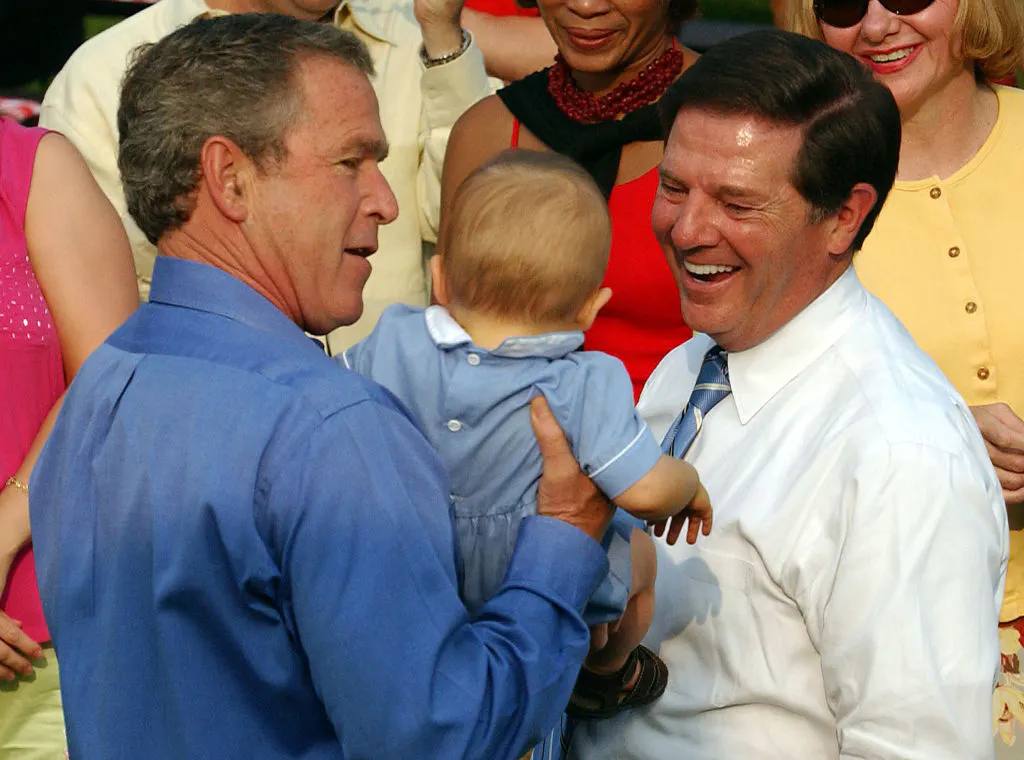
In the fall of 2003, Republicans controlled the House, Senate, and the White House. But Congress was at an impasse over an appropriations bill. We couldn’t fund the federal government until House and Senate leadership came to an agreement over a certain provision.
At issue was a Senate proposal to codify in law the Federal Communications Commission’s rule that no broadcast group could reach more than 35% of American households.
The summer before, the FCC, under Chairman Michael Powell, voted to raise the cap to 45%. Networks supported the move. The trend at the time was for networks to acquire local affiliates, so-called owned-and-operated stations. Fox and CBS were nearing the 35% cap, but didn’t want to slow their growth. But affiliate groups opposed the change, fearing that, without the cap, networks would consistently outbid them as station groups came up for sale.
The late Senator Ted Stevens (R-AK) chaired the Senate Appropriations Committee that summer. He was an ally of the broadcast affiliates and included in a Senate Appropriations bill a provision that would have statutorily set the cap at 35%.
Ted was a friend, and he and I were often allies. But on this issue we were opposed. House Republicans opposed the FCC’s move. As House Majority Leader, it was my responsibility to carry those objections, which I also shared. I supported the Bush administration’s deregulatory efforts at the FCC, and refused to bring up any appropriations bill that included a provision like Stevens’s.
In the time between the FCC action and the legislative standoff, both CBS and Fox had acquired stations that had them reaching nearly 39% of the nation’s households. As it became clear that both Sen. Stevens and I needed an off-ramp, I wanted to make sure that any compromise did not require those networks to divest stations they had lawfully acquired.
In the end, Stevens and I agreed to legislation that set the cap at 39% and prohibited the FCC from changing the cap in its biennial review of media ownership rules. The FCC was not allowed to waive the requirement, except to help companies come into compliance.
The agreement was included in the Fiscal Year 2004 Consolidated Appropriations Act and was signed into law by President George W. Bush.
As is often the case on Capitol Hill, history is repeating itself. Today, FCC Chairman Brendan Carr has sought to waive the cap with respect to one merger and now plans to use regulatory means to abolish the cap altogether.
My policy principles today are no different than they were in 2004, and I have some sympathy for Carr’s objectives. In fact, I would have happily given the FCC authority to review the cap in 2004, but Stevens would never have gone along with that. It was his intention to rein in the FCC. My end of the deal was that the cap would be raised to 39%, and in return, Stevens received certainty that the FCC wouldn’t and couldn’t raise it higher.
If you had told me in 2004 that I would one day find myself defending Stevens’s side of the argument, I would have found it ironic. But I was in the room when the deal was struck, and today, I feel compelled to uphold my end of the bargain after Ted’s passing.
I am a Republican. I support deregulation and the Trump administration. But my ultimate loyalty rests with the Constitution, which gives certain prerogatives to Congress. Regulatory agencies cannot defy or modify laws enacted by Congress. If Chairman Carr wants to raise the statutory cap, he should ask Congress to pass a law giving him authority to do that.
As former Republican FCC Chairman Mike O’Rielly put it, the 39% cap is “a statute, not a suggestion.” As someone who helped create that statute, I agree.
Tom DeLay represented Texas’s 22nd congressional district from 1985 until 2006 and served as House Majority Leader from 2003 to 2005.
More from this network:
Domains for Sale · GOTPeople.org · TheDSAPlatform · The Truth About Socialism
What's Your Reaction?
 Like
0
Like
0
 Dislike
0
Dislike
0
 Love
0
Love
0
 Funny
0
Funny
0
 Wow
0
Wow
0
 Sad
0
Sad
0
 Angry
0
Angry
0

I am just an average American. My teen years were in the late 70s and I participated in all that that decade offered. Started working young, too young. Then I joined the Army before I graduated High School. I spent 25 years in, mostly in Infantry units. Since then I've worked in information technology positions all at small family owned companies. At this rate I'll never be a tech millionaire. When I was young I rode horses as much as I could. I do believe I should have been a cowboy. I'm getting in the saddle again by taking riding lessons and see where it goes.
Premium domains for sale













Comments (0)