

Trump Holds The Future Of Taiwan In His Hands
Premium domains for sale
Freedom Is Back In Style
In a very literal sense, Taiwan is moving westward toward China, and there’s nothing that can be done about it. The tectonic plates that have shifted over millions of years, creating the island’s mountain terrain, are also driving it slowly and irrevocably toward the mainland. That notoriously craggy terrain is expected to act as a deterrent to any attack from the People’s Liberation Army from across the Taiwan Strait, a lane of the Pacific which runs as narrow as 100 miles and for the most part shallower than 100 meters. For the People’s Republic of China, Taiwan lies just out of reach. It is the military equivalent of skipping a smooth rock.
Freedom Is Back
In Style
Premium domains for sale
Taiwan’s position as a locus of China’s ambitions go beyond the temptation of seizing hold of the island’s burgeoning chip industry. It is the path to becoming a true ocean-ruling power, breaking out of the chain of Western-allied archipelagos that run along the Pacific Ring of Fire. To extend the PLA’s untested forces and grasp Taiwan isn’t just a matter of national pride to further the One China policy. It is a giant step toward the global dominance China’s leader, Xi Jinping, wants to transform into an inevitability — his lifetime’s legacy for the PRC.
For critics who have questioned the interests of the United States in its military support for Taiwan, the explosion of the semiconductor industry came at an unfortunate time. Beyond the obvious American interest in defending against the expansion of China’s brutal communist regime, Taiwan is now dominating the global foundry of chips — including more than 60 percent of the market overall, and 90 percent of the most advanced versions, central to the pursuit of artificial intelligence dominance. Taiwan’s innovations made their independence essential at exactly the same time protectionists and isolationists wanted to press the case the island is utterly dispensible.
How very inconvenient.
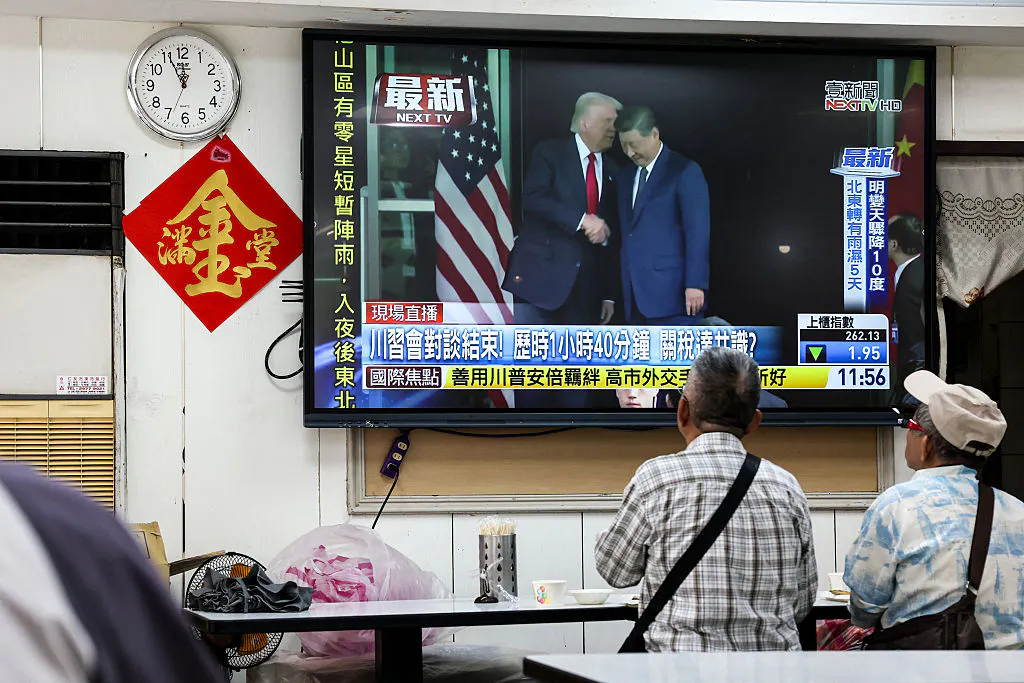
The question that confronts Donald Trump now as he wings his way to the long-anticipated meeting with Xi Jinping is how clearly he will make that importance known. There is no security, market, or historical incentive at this point to concede the long-held position of the United States toward Taiwan — bolstered most recently in a December package that included $11 billion in weapons for the island. But there is the question of how dedicated the Taiwanese are to their own defense, after the opposition to Taiwan’s president — who holds the largest portion of legislative seats — nixed a major package that would’ve significantly increased their defense spending, opting for a half measure that cut back on domestic drone production and their air defense systems. The opposition’s leader, Cheng Li-wun, has courted accusations that she’s working to diminish the island’s deterrence capability — a storyline that only grew after she chose to meet with Xi Jinping in person last month.
For the people of Taiwan, there is also the question of time. Opposition to the acceptance of China taking over their republic is largely the view of older members of society, and the youngest people on the island seem increasingly open to the idea. The constant influence of PRC-backed social media campaigns and outreach efforts to exert soft power over the minds of youths absolutely has something to do with this. For a population that is facing a gargantuan decline — their fertility rate fell to the lowest in the world last year at 0.7 — perhaps all China will have to do is wait them out.
The PRC has telegraphed its Taiwan-related intent for this meeting all along. It wants to tempt Donald Trump by appealing to his personal vision as a peacemaker — particularly in the context of the Iran conflict — by asking for an alteration to stated U.S. policy, or just to have the president declare publicly that he opposes Taiwan’s independence. The propaganda victory alone would send a shudder through the island’s political leadership and would be a coup for Xi Jinping, even if it may seem like a low-cost offering from President Trump for potential economic gain.
In this context, the meeting this week takes on a whole new importance when it comes to dictating the future — not just for AI in the West, but for Donald Trump’s legacy as a world leader. He has restored a hardened focus on America’s interests, particularly in the Western Hemisphere. As dedicated as he is to ending Iran’s chances at becoming a nuclear power, some of his advisors might use that effort’s uncertainty as a justification for sacrificing America’s interests in Taiwan.
If there’s one thing we know about this president, it’s that, as much as he listens to those around him, he keeps his own counsel on the right path forward. There is no wisdom in being remembered as the president who gave China what it craves most. And in a brutal sense, so long as the PRC’s energy is directed at this one infuriatingly productive mountainous island the size of West Virginia, it is spending less time on everything else it would like to do to become the global superpower of Xi Jinping’s dreams. Trump is a gambler, wagering the cost of breaking norms and diplomatic rituals on his, and America’s, strength. Today, that is a cost worth paying.
More from this network:
Domains for Sale · GOTPeople.org · TheDSAPlatform · The Truth About Socialism
What's Your Reaction?
 Like
0
Like
0
 Dislike
0
Dislike
0
 Love
0
Love
0
 Funny
0
Funny
0
 Wow
0
Wow
0
 Sad
0
Sad
0
 Angry
0
Angry
0

I am just an average American. My teen years were in the late 70s and I participated in all that that decade offered. Started working young, too young. Then I joined the Army before I graduated High School. I spent 25 years in, mostly in Infantry units. Since then I've worked in information technology positions all at small family owned companies. At this rate I'll never be a tech millionaire. When I was young I rode horses as much as I could. I do believe I should have been a cowboy. I'm getting in the saddle again by taking riding lessons and see where it goes.
Premium domains for sale













Comments (0)