

Victor Davis Hanson: What Is Actually Happening in Iran
Premium domains for sale
Freedom Is Back In Style
Editor’s note: This is a lightly edited transcript of today’s video from Daily Signal senior contributor Victor Davis Hanson. Subscribe to our YouTube channel to see more of his videos.
Hello, this is Victor Davis Hanson for The Daily Signal.
Freedom Is Back
In Style
Premium domains for sale
What’s going on with Iran, or rather, what’s next with Iran? We’ve gone through six or seven iterations of we’re at war, we’re negotiating, we’re at war, we’re negotiating, we’re at war. So about 75% of the so-called war that began on Feb. 28 of this year has been negotiations.
About 25% has actually been kinetic action. And I think that’s obscured a little bit what we’re doing in Iran. We’re not passive when we’re negotiating. What Trump is doing right now, the Trump administration, is very similar to what the North did as it started the Civil War. They were not sure how to deal with the South because they’d have to invade it, and it was the size of Europe.
So Winfield Scott came up with the idea of an Anaconda Plan, named after the snake, a python-like snake of Latin America, that would squeeze the South.
In other words, they would occupy the Mississippi River and cut off their western approaches to trade and commerce. The battlefront in the North would cut them off from the industrial cities of the North, and then they would blockade Charleston, Savannah, Mobile, Alabama, and New Orleans, and they would not be able to export cotton nor import manufactured goods, especially weaponry.
Now, it was very slow because in those days there was not an international banking system that you could freeze accounts, or you could isolate a whole area or region economically, or I should say financially.
But it did work.
And one of the reasons that [Gen. William Tecumseh] Sherman was successful in 1864 in the March through Georgia and [Gen. Ulysses S.] Grant was successful in his siege of Richmond, although he never took the city, was that the South had run out of weapons that were commensurate with the Northern armories.
And they did not have the industrial capacity that the North did, and they couldn’t import sophisticated weaponry from Europe, especially Britain.
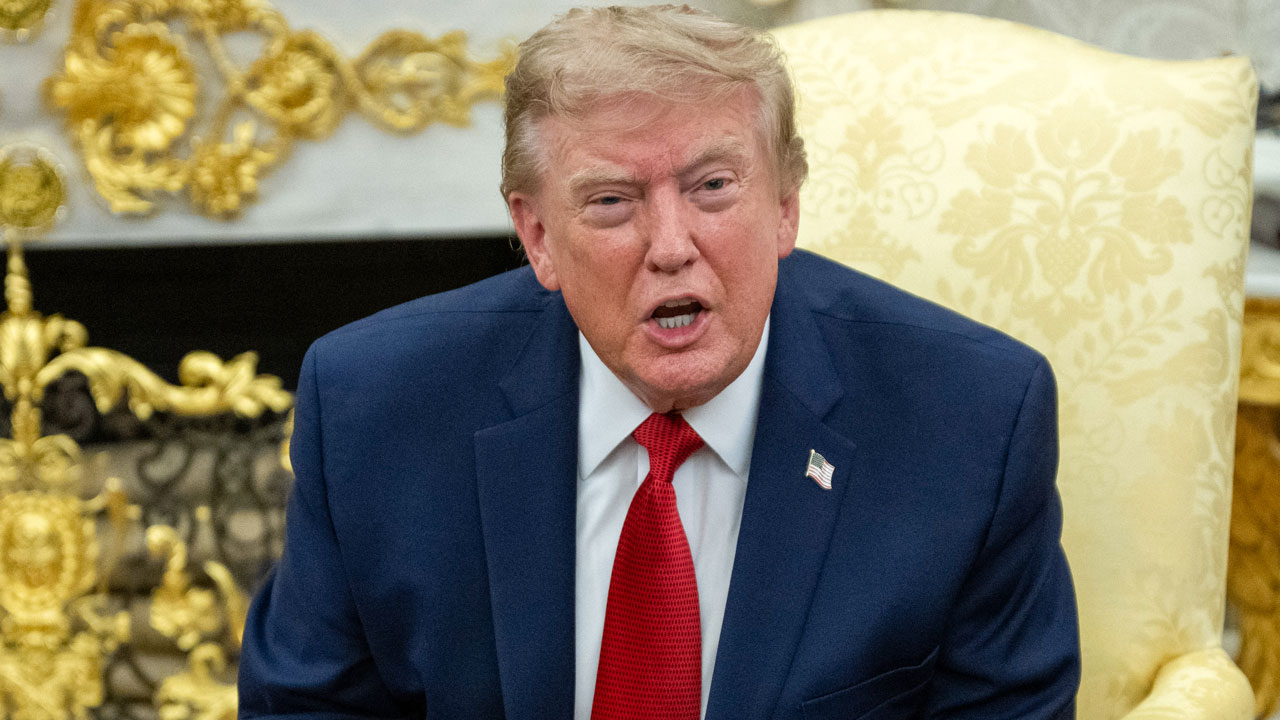
So what we’re doing right now as we talk, fight, talk, fight, is we’re in a battle of wills. Iran thinks they have the cards because Donald Trump is down to less than 80 days before the midterms, the war is unpopular.
They expect, as they have now explicitly said, that the Democrats will take power and maybe cut off funding for the war, or they can wait it out until they have a Democratic presidency.
Donald Trump, though, has the cards that Iran doesn’t. What do I mean by that? We are witnessing really the most successful blockade, embargo, freeze, sanctioning, and debanking of any modern nation.
I can’t think of any other examples, with the exception maybe of North Korea during some periods of hostilities. But Iran cannot export oil. It cannot import through rail or by sea, and increasingly not through the air, material goods, industrial parts, replacement weaponry from abroad. It has no financial access to the world’s economy or to the world’s currency.
It can’t convert its domestic currency into dollars or euros and buy things on the open market. You can’t get out of Iran and travel. You can’t have your bank accounts in Bank of America or Citibank open for check writing. You can’t bring in any foreign currency.
So it’s estimated they’re losing $400 million or $500 million a day, a half-billion dollars a day, in economic output revenue.
And this is in addition to the enormous half-century, one-half-trillion-dollar military-industrial nuclear complex they’ve lost.
So they are being squeezed in an anaconda-like plan that we’ve never seen before. And so when we talk about who’s going to win this war of nerves, the Iranians, as the midterms come closer, think they’re going to force Trump to let up so he can keep the House, or us, who are going to make Iran bankrupt.
It doesn’t really matter because if Trump loses the House, they are not going to cut off aid to… They won’t have enough votes to cut off aid to the American military, nor would they do that.
If Trump were to win the midterms, he would still be as free as he would be to lose them. If he loses the midterms, if he wins them, it doesn’t matter after the midterms are over.
He can do whatever he wants, but he feels he does not want to harm the infrastructure and the livelihood of the Iranian people.
So he’s squeezing, squeezing, squeezing and making them almost irrelevant.
Now, a final thought is they believe long term the future is theirs because they keep bragging that they’re going to control the Strait of Hormuz.
They don’t really control it now. Ships are going in and out against their will. They’re not getting ships in to import goods, nor are they exporting oil out of it. But they feel they’ve achieved such a level of harassment and mine-laying that you can’t fully use it.
But here’s the problem with that.
Their military is shrinking as we speak. It doesn’t have parts. It can’t get fuel, and it doesn’t have an air force to provide air cover. Anytime almost any of the Gulf States or the United States wants to take out facilities in Iran, they can do so, and they have done so. And they’ve done so to uch a degree that it doesn’t really have a maritime component in their military.
But more importantly, Donald Trump announced he would like to internationalize or even claim the Straits of Hormuz as U.S. territory.
I don’t think that the American people want that. I don’t think he wants it. I think he’s trolling the Iranians because very soon the Straits of Hormuz are not going to be relevant to the global economy.
Of its 20-some million barrels of exported oil that leave the Strait, already somewhere between six and eight million barrels have bypassed it through pipelines to the Gulf of Oman outside the Strait, or through the Red Sea, where ships can come through the Suez Canal or up through the Indian Ocean and into the Red Sea and get oil without Iran having any ability to intercede or to stop that.
And now we’re hearing that both the Gulf of Oman and the Red Sea pipelines will be increased, either with a parallel line or they will be enhanced.
And then, in addition to that, there may be Mediterranean exporting ports of Gulf oil, particularly Saudi oil, that will go across Jordan into Israel and maybe at a port somewhere near or at Haifa and then on the Syrian coast vis-a-vis Turkey.
So what I’m saying is that rather than ships, forget about the war, rather than ships having to go into that narrow strait all the way into the Gulf, depending on their location, a much more ideal system to export oil from Middle East countries is not to have tankers go through that narrow strait and go all the way into the Gulf, but simply dock at the Mediterranean or dock at the Red Sea or dock at the Gulf of Oman, and that’s going to happen.
And so, they may be lords of a strait that is particularly not relevant to the world economy in general and to their revenue crisis in particular. Bottom line, look what’s going on on the ground and not what people are saying or screaming about or hysterical about.
Each day that we are engaged, Iran is getting poorer and poorer and poorer, and that is a fact that transcends the importance of the midterm elections or the Gulf of Hormuz.
We publish a variety of perspectives. Nothing written here is to be construed as representing the views of the Daily Signal.
More from this network:
Domains for Sale · GOTPeople.org · TheDSAPlatform · The Truth About Socialism
What's Your Reaction?
 Like
0
Like
0
 Dislike
0
Dislike
0
 Love
0
Love
0
 Funny
0
Funny
0
 Wow
0
Wow
0
 Sad
0
Sad
0
 Angry
0
Angry
0

I am just an average American. My teen years were in the late 70s and I participated in all that that decade offered. Started working young, too young. Then I joined the Army before I graduated High School. I spent 25 years in, mostly in Infantry units. Since then I've worked in information technology positions all at small family owned companies. At this rate I'll never be a tech millionaire. When I was young I rode horses as much as I could. I do believe I should have been a cowboy. I'm getting in the saddle again by taking riding lessons and see where it goes.
Premium domains for sale





Comments (0)