

What The 50-Year Legacy Of The Hyde Amendment Means For The Future
Premium domains for sale
Freedom Is Back In Style
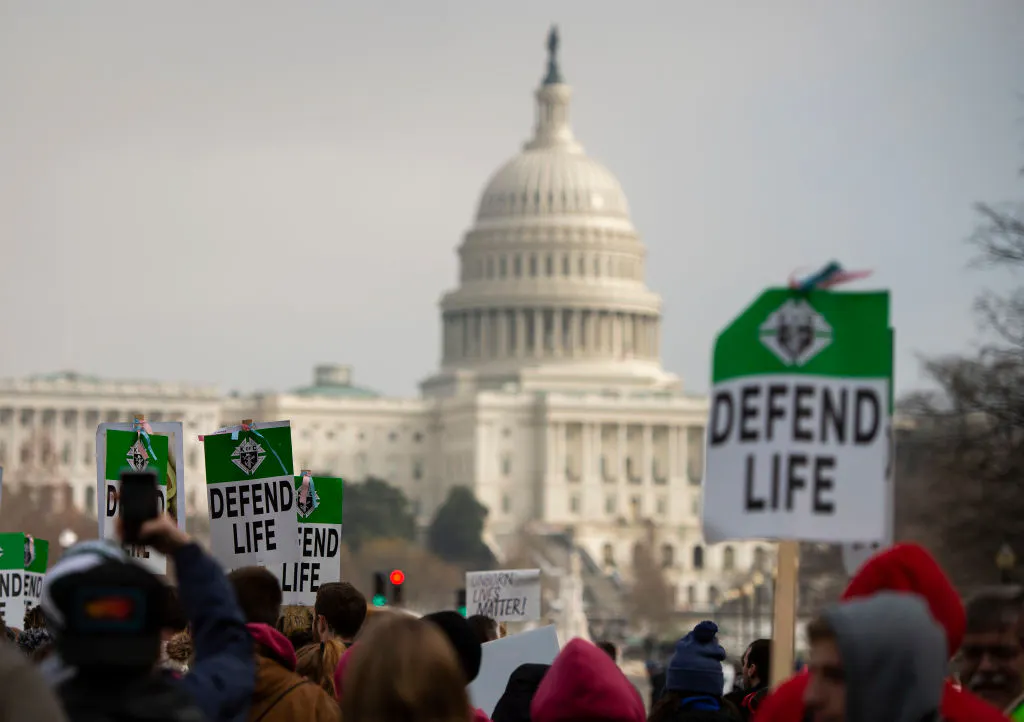
Fifty years ago today, Congress put a straightforward principle into federal law: Americans who oppose abortion should not be compelled to finance it through their federal tax dollars.
Freedom Is Back
In Style
Premium domains for sale
With widespread bipartisan support, Congress attached this restriction, named for its sponsor, Rep. Henry Hyde (R-IL), to the appropriations bill for the Departments of Labor and what was then called Health, Education, and Welfare on September 30, 1976. It has been included in that appropriations bill every year since, prohibiting federal funds from paying for abortions except in instances of rape, incest, or if the mother’s life is at risk.
Our new report, “The Hyde Amendment at 50,” shows that the Hyde Amendment has had a profound effect that is difficult to overstate. We estimate, for example, that Hyde has prevented $2.1 billion in federal Medicaid funds from financing abortions.
But Hyde’s fiscal impact pales in comparison to its effect on human lives.
The Charlotte Lozier Institute estimates that the Hyde Amendment has saved 2,646,474 lives since 1976. That translates to one out of every 72 children born in the United States since Hyde took effect — or, in a striking historical comparison, roughly the entire U.S. population at its founding in 1776.
These estimates highlight not just the magnitude of Hyde, but the importance of protecting its integrity amid the federal government’s vastly expanded role in financing Americans’ health care.
In 1978, Medicaid covered fewer than one in 10 Americans. Today, it covers more than one in four. This trend was propelled by Medicaid’s expansion through Obamacare, which substantially increased the number of women of reproductive age on the program. In 2024, Obamacare expansion enrollees accounted for 38% of all women of reproductive age on Medicaid.
At the same time, Hyde’s practical reach has diminished in states that use their own funds to pay for abortions excluded from federal funding. When Hyde was first enacted, most states also matched its restrictions and did not provide state funds for Medicaid abortions not covered by the federal government; today, 21 states use their own funds to pay for elective abortions not covered by Hyde.
While only a few states consistently track and report abortion data, California reported 142,019 abortions through Medi-Cal in 2023, and Maryland reported 12,858 Medicaid abortions at a cost of $11.3 million in fiscal year 2025.
Even when federal funds don’t pay for abortion procedures themselves, federal funds do pay for post-abortion care and complications. A study that examined nearly 40,000 abortions paid for by California’s Medicaid program between 2011 and 2012 found that 3% of women subsequently visited the emergency department and 25% subsequently returned to the abortion site. The cost of those post-abortion visits averaged $941 and $536, respectively.
Massive growth in Medicaid alongside increasing accounts of fraud and abuse underscore significant gaps in oversight that could compromise the integrity of Hyde protections.
For example, Medicaid’s reporting infrastructure does not track abortions paid through managed care organizations, even though managed care organizations administer Medicaid benefits for more than two-thirds of Medicaid recipients.
Moreover, when Medicaid checks for improper payments through its payment error rate measurement process, it doesn’t check provider payments made by managed care organizations.
Those gaps open the door to misuse and abuse. A federal review found that New York improperly received $3.2 million in federal Medicaid funds for abortion-related claims that were incorrectly classified as federally reimbursable family-planning services.
In addition to maintaining Hyde’s core protection from coerced abortion subsidies, Congress should close existing gaps that threaten Hyde’s effectiveness and integrity. Lawmakers should require the Centers for Medicare and Medicaid Services to: collect data on every Medicaid abortion, including whether it falls within a Hyde exception and the federal and state amounts paid; incorporate Hyde compliance checks into Medicaid’s payment integrity reviews; and recover federal funds improperly spent in violation of Hyde.
The Hyde Amendment has saved millions of lives and prevented federal taxpayers from having to pay for abortions that violate their moral or religious beliefs. After 50 years, Congress should ensure that Hyde’s protections remain as meaningful in practice as they are on paper.
***
Rachel Greszler is a Senior Research Fellow in the Plymouth Institute for Free Enterprise at Advancing American Freedom Foundation.
Thomas Jipping is a Senior Legal Fellow in the Edwin Meese III Institute for the Rule of Law at Advancing American Freedom Foundation.
More from this network:
Domains for Sale · GOTPeople.org · TheDSAPlatform · The Truth About Socialism
Originally Published at Daily Wire, Daily Signal, The Blaze, or Fox News
What's Your Reaction?
 Like
0
Like
0
 Dislike
0
Dislike
0
 Love
0
Love
0
 Funny
0
Funny
0
 Wow
0
Wow
0
 Sad
0
Sad
0
 Angry
0
Angry
0

I am just an average American. My teen years were in the late 70s and I participated in all that that decade offered. Started working young, too young. Then I joined the Army before I graduated High School. I spent 25 years in, mostly in Infantry units. Since then I've worked in information technology positions all at small family owned companies. At this rate I'll never be a tech millionaire. When I was young I rode horses as much as I could. I do believe I should have been a cowboy. I'm getting in the saddle again by taking riding lessons and see where it goes.
Premium domains for sale





















Comments (0)