

What The New He-Man Movie Gets Wrong About Heroes
Premium domains for sale
Freedom Is Back In Style
This article is part of Upstream, The Daily Wire’s new home for culture and lifestyle. Real human insight and human stories — from our featured writers to you.
Freedom Is Back
In Style
Premium domains for sale
***
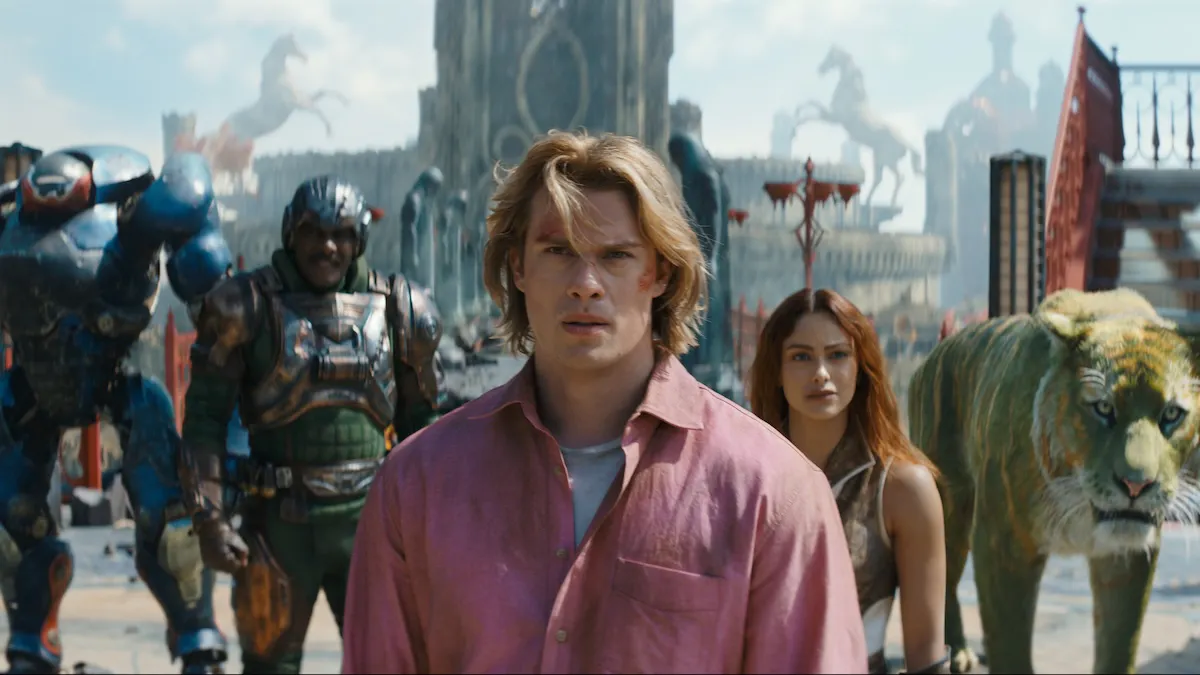
For decades, He-Man occupied a bizarre corner of pop culture. Eternia wasn’t just fantasy, nor was it just science fiction. It was an unapologetically expansive fusion of barbarian heroes, laser rifles, ancient castles, flying vehicles, monsters, robots, and cosmic magic. It looked unlike anything else and was incredibly popular for it. Unfortunately, “Masters of the Universe” sands off most of those rough edges.
The biggest problem with the movie isn’t that it’s bad. Instead, it’s frustratingly average, due to an aversion to making strong stylistic decisions.
As a standalone action-adventure film, the movie is perfectly serviceable. The fight scenes are entertaining, the performances are generally solid, and there are enough nostalgic callbacks to keep longtime fans engaged. As a little kid, my Dad put on He-Man cartoons when he got fed up with watching whatever was on Nick Jr. with me, so I have a lot more nostalgia for the iconic 80s franchise than most people my age.
But as an adaptation of one of the strangest and most visually distinctive toy properties of its era, “Masters of the Universe” never figures out what it wants to be. The result is a film caught between reverence and embarrassment.
Rather than embracing the eccentricity of the source material, the filmmakers largely transform Eternia into a familiar modern blockbuster setting. The world often resembles a generic fantasy kingdom with slick science-fiction elements sprinkled on top. Outside of a few standout designs, much of the visual identity that made the 1987 “Masters of the Universe” memorable is absent.
That lack of commitment extends beyond the production design. The film never decides whether it wants to celebrate the original cartoon or parody it. Either answer would’ve been more acceptable, and certainly more interesting, than what we got.
Serious emotional moments are frequently interrupted by jokes, nostalgic scenes are undercut by irony, and designed comedic interactions (that are frequently quite funny) feel out of place during major narrative beats when the serious story is being advanced. Worst of all, characters are rarely allowed to sit in heroic moments before the script feels obligated to remind the audience not to take any of it too seriously.
Modern blockbusters have developed a habit of apologizing for their own premises, and “Masters of the Universe” certainly falls into that trap. Which is particularly noticeable in its treatment of the heroes.
In the original cartoon, Prince Adam’s secret wasn’t that he became a hero when he transformed into He-Man. He was already a hero. The transformation simply gave him greater physical strength. Adam had the courage, wisdom, and self-sacrifice that make a good hero even when he couldn’t rely on the Sword of Power.
The movie reverses that equation. He-Man often feels like an extension of Adam rather than the culmination of Adam’s character. It makes the hero more relatable, perhaps, but also less aspirational. He-Man should feel larger than life, instead, he frequently feels like a generic Marvel-esque protagonist wearing He-Man’s armor.
Nicholas Galitzine does admirable work with the material he’s given. This is a demanding role for an actor making his debut as a major action lead, and he generally succeeds. Camila Mendes also delivers a solid performance as Teela, though the script doesn’t give her enough meaningful interactions with her father, Man-At-Arms, to fully sell their familial relationship.
The standout performance belongs to Idris Elba. Initially, Elba’s Man-At-Arms appears destined to become a one-note tough-guy authority figure. Instead, he develops into one of the film’s most human characters. Since he is not given much screen time with just his daughter, Man-At-Arms’ scenes mentoring Adam are among the movie’s strongest emotional moments and provide a glimpse of the richer character work the film occasionally hints at.
Jared Leto’s Skeletor is less successful; most of that stems from inconsistent characterization. The original Skeletor worked because he was simultaneously threatening and ridiculous. He was often the comic relief while the heroes remained earnest. Here, Skeletor becomes the primary source of dramatic tension while many of the heroes are tasked with delivering jokes. That may make sense according to modern blockbuster logic, but it misses something essential about the source material. The change strips away part of what made the character memorable.
Longtime fans may also be disappointed by how many supporting characters receive minimal attention. Beast Man barely speaks, Trap Jaw functions only as a mini-boss, Tri-Klops effectively disappears, and Battle Cat is sidelined until the last 20 minutes of the film. Several fan favorites are absent altogether. While no adaptation can include everyone, Eternia loses a lot of its personality when so many colorful characters are reduced to background decoration or silent antagonists with no actual character.
The movie is at its best whenever it fully embraces style. The Snake Mountain sequences are excellent: bathed in torchlight, deep reds, blue shadows, carved serpentine architecture, and dramatic color contrasts, they finally feel like the world of Eternia. The action choreography throughout the film is similarly impressive. Rather than relying entirely on standard blockbuster brawling, many fights embrace the exaggerated, almost cartoonish physicality that the source material demands. Those moments stand out because they reveal what the movie could have been.
The soundtrack follows a similar pattern. The original cartoon’s iconic theme is absent until the end in favor of new material that works well enough but lacks the same emotional impact. A few synth-heavy moments hint at the glam-metal energy that could’ve defined a modern Eternia’s soundscape, but the film never fully commits to the earnest ’80s vibe. Several licensed song choices are distractingly on-the-nose, undercutting scenes that might have landed more effectively with a lighter touch.
Ultimately, “Masters of the Universe” suffers from a lack of conviction. Whenever the film makes a bold stylistic choice, it works. Whenever it fully embraces the bizarre world that made He-Man famous, it works. Whenever it trusts the audience to take its heroes seriously, it works.
The problem is that those moments are constantly competing with safer, corporate, more familiar blockbuster instincts. The result is a movie that is better than the infamous 1987 live-action adaptation but still falls short of becoming the definitive modern He-Man story fans have waited decades to see.
As an action movie, it’s enjoyable enough. As a He-Man movie, it’s harder to recommend without reservations. Fans of the franchise will likely find enough here to justify a trip to the theater. There are genuine crowd-pleasing moments and several sequences that capture the spirit of Eternia. Casual audiences, however, may be better served waiting for streaming.
Grade: C+
More from this network:
Domains for Sale · GOTPeople.org · TheDSAPlatform · The Truth About Socialism
What's Your Reaction?
 Like
0
Like
0
 Dislike
0
Dislike
0
 Love
0
Love
0
 Funny
0
Funny
0
 Wow
0
Wow
0
 Sad
0
Sad
0
 Angry
0
Angry
0

I am just an average American. My teen years were in the late 70s and I participated in all that that decade offered. Started working young, too young. Then I joined the Army before I graduated High School. I spent 25 years in, mostly in Infantry units. Since then I've worked in information technology positions all at small family owned companies. At this rate I'll never be a tech millionaire. When I was young I rode horses as much as I could. I do believe I should have been a cowboy. I'm getting in the saddle again by taking riding lessons and see where it goes.
Premium domains for sale




















Comments (0)