

Will Nigel Farage Call British Parliament’s Bluff?
Premium domains for sale
Freedom Is Back In Style
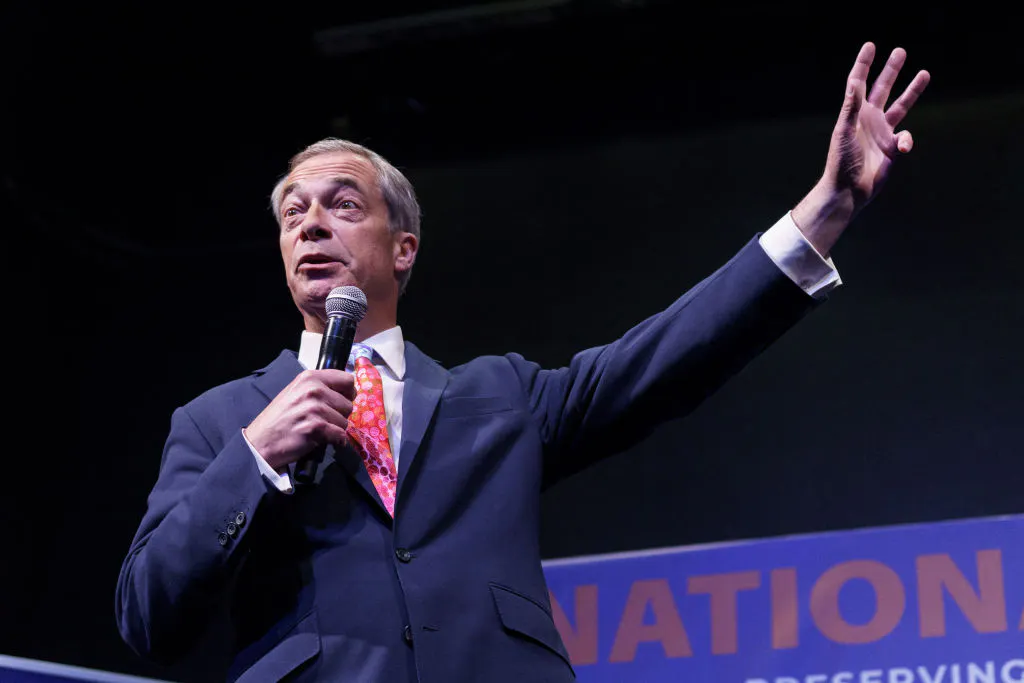
Nigel Farage, leader of the insurgent right party Reform UK, could never be mistaken for a shrinking violet. With 25 years in the political spotlight, he has a litany of controversies, stunts, and comebacks already to his name. On Tuesday, he rolled the dice again.
Freedom Is Back
In Style
Premium domains for sale
Caught in a storm over a £5 million personal gift shortly before he entered Parliament, and over whether it was properly declared to the parliamentary authorities, Farage was facing more negative attention than he had in a long time. Whether the criticisms are fair or the result of his party being ahead in the polls for so long, will likely now be forgotten, however.
That is because he resigned his seat in Parliament to fight a by-election, a one-off election just for his constituency of Clacton-on-Sea. The logic is that he will let his voters judge whether he has done anything wrong and seize the initiative from his critics.
But he also accused the TV channel Sky News (owned by the U.S. company Comcast) of harassing his daughter by turning up at her house after the Times had printed her address. Farage has already had many legitimate security concerns against his person, but the British Labour government refuses to accord him any personal protection on the taxpayers’ dime. This has led President Donald Trump to post on Truth Social this week that the British establishment is playing the “Trump 2024” playbook in order to stop him.
This is not just bluster; rules keep changing in order to specifically target Farage’s party. When rich Brits, invested in crypto and living overseas, started donating to Reform, bans were brought in against Brits donating whilst living abroad. When some of them re-domiciled in Britain to continue donating, a 12-month residency requirement was introduced. The million-plus foreigners in Britain (from the Commonwealth) who are entitled to vote (and overwhelmingly vote for left-wing parties) have not been stopped.
Why are such extreme measures being pursued to stop this party, then? Part of it is policy; Reform has pledged to do away with the whole Cabinet Office, the beating heart of the British administrative (read, if you want, deep) state. Their pledge to take Britain out of the European Convention on Human Rights (ECHR) is another policy that is loathed in Westminster, but wildly popular as the way we can finally stop illegal immigrants crossing over from France on small dinghies.
But much of it, inevitably, is vibes. When polled, every party in Britain says they want immigration reduced, but to many, Farage’s blokey, pints down the pub style rubs them up the wrong way. Some call him a “spiv” an anachronistic pejorative term for someone who dresses too flashily to conceal their inherent shiftiness.
This prevents Reform from cannibalizing more of the traditional Conservative Party voter base; people from the leafy Cotswolds sometimes think of Reform as being too uncouth and brash. In return, Reform supporters think of the Tories as being wets, sellouts who opened the floodgates on migration and allowed woke to conquer common sense. To compare these MAGA insurgents in the GOP is too simplistic, but directionally, it is not far off.
Reforms’ attempts to broaden its appeal have caused an issue in the other direction as well. Rupert Lowe, a former Reform MP and country squire (all ruddy red cheeks and even more tweed), split and founded yet another right-of-center party, Restore Britain. They accuse Reform of being Tories in disguise, pointing to the defections of many high-profile Tories to their ranks.
If this is sounding a bit like the Peoples’ Front of Judea vs the Judean Peoples’ Front from Monty Python’s The Life of Brian, then you’ve understood the situation perfectly.
And so Reform UK leads the national polls at around 25%. Kemi Badenoch’s Conservatives follow them at 21%, with Restore (backed by Elon Musk) splitting the vote in enough cases to deny Reform electoral victories. This creates a wonderful amount of creativity and competition on the Right. Each party is pushing the others on their specialist subjects of civil service renewal, economics, culture wars, and immigration.
But it could also spell ruin for the country.
We do not elect a parliament by national vote share. We fill the 650 seats one at a time, and in each of them, the plurality takes everything. Forty beats three rivals on 20. A candidate the whole country cannot stand still wins on a third of the vote, provided the people who cannot stand him fail to agree on which of his opponents to back instead. The “first past the post” does not reward the best argument or the biggest crowd; it rewards whoever turns up least divided on the only piece of paper that counts.
It is hard to see, therefore, what will happen at the next general election. Tactical voting could produce all sorts of strange results and strange bedfellows, and by the time the votes have been cast, European “coalitions” might just prove impossible to assemble.
This is so frustrating for the Right because whilst the party leaders clearly despise each other, the voters are already there when it comes to a pact. Nine in 10 Reform members say they would sooner share power with the Conservatives than let Labour back in. But the personalities have too much pride and past recrimination to dare to strike an electoral pact.
This coming by-election in Farage’s seat of Clacton will settle none of it. Farage will almost certainly win, not least because the other major parties have declared the election a farce and are refusing to cooperate. And so, whilst the need for a radical right-wing government has never been more needed in Britain, we wait to see whether the right will be able to get it together, or if Britain will collapse under yet another socialist regime.
***
James Price is a former Chief of Staff to the Chancellor of the Exchequer and a senior fellow at the Adam Smith Institute.
More from this network:
Domains for Sale · GOTPeople.org · TheDSAPlatform · The Truth About Socialism
What's Your Reaction?
 Like
0
Like
0
 Dislike
0
Dislike
0
 Love
0
Love
0
 Funny
0
Funny
0
 Wow
0
Wow
0
 Sad
0
Sad
0
 Angry
0
Angry
0

I am just an average American. My teen years were in the late 70s and I participated in all that that decade offered. Started working young, too young. Then I joined the Army before I graduated High School. I spent 25 years in, mostly in Infantry units. Since then I've worked in information technology positions all at small family owned companies. At this rate I'll never be a tech millionaire. When I was young I rode horses as much as I could. I do believe I should have been a cowboy. I'm getting in the saddle again by taking riding lessons and see where it goes.
Premium domains for sale




















Comments (0)