

An Activist Witch Hunt Is Threatening Britain’s Elite Fighting Force
Premium domains for sale
Freedom Is Back In Style
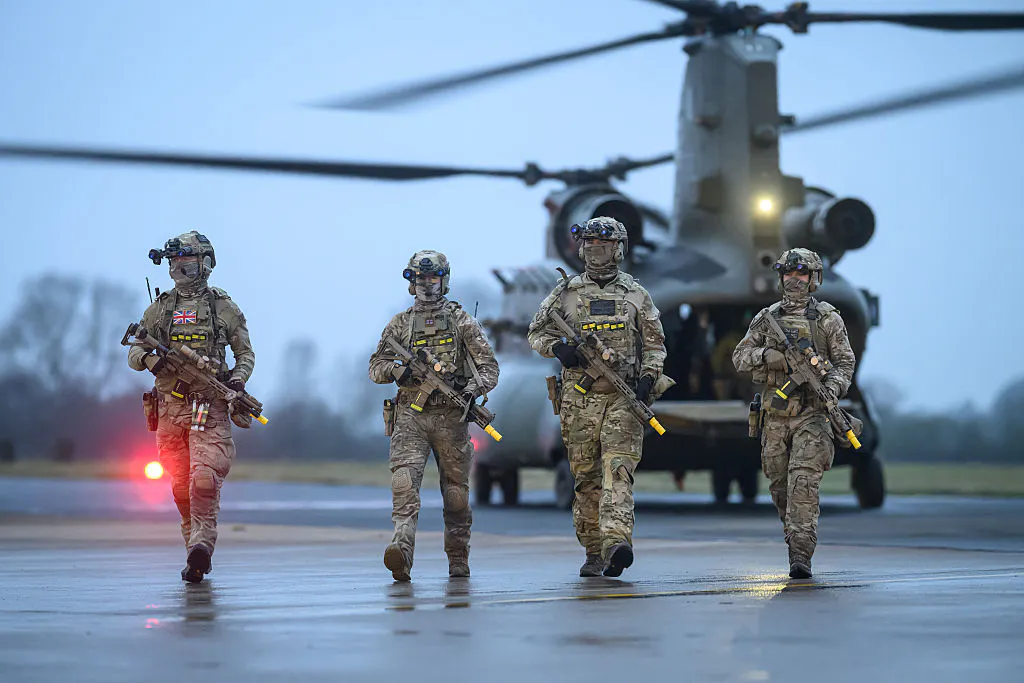
The SAS (Special Air Service), Britain’s most elite fighting force, is used to fighting in the shadows. It is world-renowned, most famously for the London Iranian Embassy siege in 1980, which boosted Britain’s confidence and reputation after Margaret Thatcher’s difficult first year in government. Now, however, it finds itself under threat, not from the enemies of King and Country against whom they have battled over the years, but from those nominally on their own side: activist lawyers in Britain and a government that is failing to protect them.
Freedom Is Back
In Style
Premium domains for sale
Sources have claimed that “witch hunts” by human rights lawyers have led to men in D and G Squadrons SAS applying for premature voluntary release. Although the number has been withheld by journalists for security reasons, some SAS sources described the scale of losses as “a threat to national security.”
These resignations are a result of war crime investigations into recent SAS actions in Syria and Afghanistan, as well as historic actions in Northern Ireland. These are often viewed as a vexatious hounding through the courts, with one case described as “ludicrous” by the judge who heard it, but not before it cost the former soldier four years of legal battles.
Last month, a memo was shared with the Special Air Service and Special Reconnaissance Regiment associations, which showed that 242 special forces soldiers — including 120 who are still serving—are under investigation as part of human rights inquiries which are costing £1 million a month.
Former regimental sergeant major George Simm has said that troops are increasingly afraid of a “knock on the door” from human rights lawyers, and feel betrayed that the government isn’t standing up for them.
Several of those resigning are believed to be senior warrant officers, the backbone of the SAS. Usually, these are the men who stay with the Regiment, as it is sometimes called, for most of their career. They provide a crucial combination of combat experience and cultural continuity. Yet, just before Christmas, a number applied to leave. Morale, unsurprisingly, is said to be extremely bad among those who remain.
At a time when Britain’s armed forces are in a weakened state, losing experienced special forces is a serious issue. British special forces are also integrated with American special forces, having worked closely together for decades. Any diminishment in British capabilities, therefore, has knock-on effects on U.S. security.
This is a depressingly familiar pattern. Over a decade ago, the lawyer Phil Shiner alleged that British troops in Iraq had committed systematic war crimes, leading to the five-year, £24 million Al-Sweady Inquiry. It concluded that the allegations were “wholly without foundation and entirely the product of deliberate lies.” Shiner’s firm, Public Interest Lawyers, was struck off. But the underlying laws remain.
One major issue is the European Convention on Human Rights (ECHR). Ratified in 1951, it was intended to prevent a repeat of the human rights atrocities which occurred in the Second World War, as well as to safeguard European democracies from the Stalinist totalitarianism which then threatened them.
Over the years, however, the ECHR has expanded its powers, especially under the “living instrument” doctrine, which holds that the European Court of Human Rights, which adjudicates cases under the ECHR, can reinterpret the original text in light of changing attitudes. The result has been the Court inventing radical new interpretations. In addition, in 1998, the Court’s rulings became mandatory, meaning that human rights judges could tell nations like Britain what to do without any democratic mandate or challenge.
Crucially, the doctrine of “extraterritoriality” expanded the ECHR’s authority to any territory where a signatory had control, including warzones. Suddenly, SAS operations overseas were at the mercy of human rights lawyers, requiring soldiers to think about how they could justify split-second combat decisions for decades afterward.
The current Labor government has done little to protect the SAS. Keir Starmer, the Prime Minister, is a former human rights lawyer, as is his Attorney General, Richard Hermer. They are currently trying to pass a new law which will remove the immunity introduced by the last government for veterans who served in Northern Ireland, leading to nine former military chiefs claiming that soldiers’ trust in the legal system had collapsed.
While British soldiers face being chased through the courts for the rest of their lives, a former terrorist who tried to blow up a church is standing for office. Shahid Butt can’t be barred from running, as his offense was so long ago. The same human rights laws also protect terrorists, such as Shah Rahman, who tried to blow up the London Stock Exchange as part of an Al Qaeda plot. He cannot be deported back to Bangladesh because the ECHR protects him.
Although there are plausible allegations that some British special forces committed crimes and that there were attempts to cover this up, human rights law is being used to go far beyond that. Soldiers face persecution for doing their duty, while terrorists can use it for protection. No nation can demand that its soldiers defend it if it won’t defend its soldiers.
***
Guy Dampier is a senior researcher on Nationhood at the Prosperity Institute.
More from this network:
Domains for Sale · GOTPeople.org · TheDSAPlatform · The Truth About Socialism
What's Your Reaction?
 Like
0
Like
0
 Dislike
0
Dislike
0
 Love
0
Love
0
 Funny
0
Funny
0
 Wow
0
Wow
0
 Sad
0
Sad
0
 Angry
0
Angry
0

I am just an average American. My teen years were in the late 70s and I participated in all that that decade offered. Started working young, too young. Then I joined the Army before I graduated High School. I spent 25 years in, mostly in Infantry units. Since then I've worked in information technology positions all at small family owned companies. At this rate I'll never be a tech millionaire. When I was young I rode horses as much as I could. I do believe I should have been a cowboy. I'm getting in the saddle again by taking riding lessons and see where it goes.
Premium domains for sale






Comments (0)