

At 250, America’s fate is wonderfully unwritten
Premium domains for sale
Freedom Is Back In Style
America has a habit of bringing ideas — sometimes others’ ideas — to life. This habit breeds a certain culture of meritocratic, independent superiority, understood by self-made elites and commoners alike, that ideas are a dime a dozen: If you don’t get out there and actually do it, you’re just another dreamer.
Freedom Is Back
In Style
Premium domains for sale
I think the most powerful example of this dynamic, and its enduring resonance today, is found in a single line from a single film. In the smash hit 1962 epic “Lawrence of Arabia,” our hero sums up the Western ethos of the ennobled individual will by refusing to let his Arab ally die. Confronted with the dismissive, fatalistic belief that the man’s seemingly inevitable death in the desert is foreordained by God, Lawrence famously snaps back that “nothing is written!” Sure enough, he saves the man, through sheer force of personal grit.
The only true choice is one of freely willed action.
The line was written by British playwright Robert Bolt for British director David Lean in a British production of a British tale of a British officer. Yet, casting our eye across the pond on this landmark national anniversary, we are struck by how lonely America seems today in its insistence on not only the Western principle that a man can, through goodness and greatness, personally break the iron grip of circumstances, but on the proactive living-out of that principle, without which it is but a hollow aspiration.
Our uniquely aggressive, defiant, and self-justifying sense of optimism can, of course, be taken too far; at the extremes, it can lead us to deny that God is always in control and to accept the deaths of millions as a price worth paying for greater power, riches, or renown.
Fate, however, is a pagan concept that can fraudulently enchain a whole people; even a whole world. And the power of even the most ordinary and obscure of men to shatter prideful prognostication through freely willed spiritual sacrifice is richly rooted in great godly obedience.
The paradox of these two ways — that our love of enacted independence can either fulfill or default on our relationship with God — weighs extra heavy upon the soul this 250th year of our land. The chaotic circumstances of our fast-accelerating technologies have opened doors to new expressions of both the healing and damaging versions of our national will to do, not just to think, feel, or be.
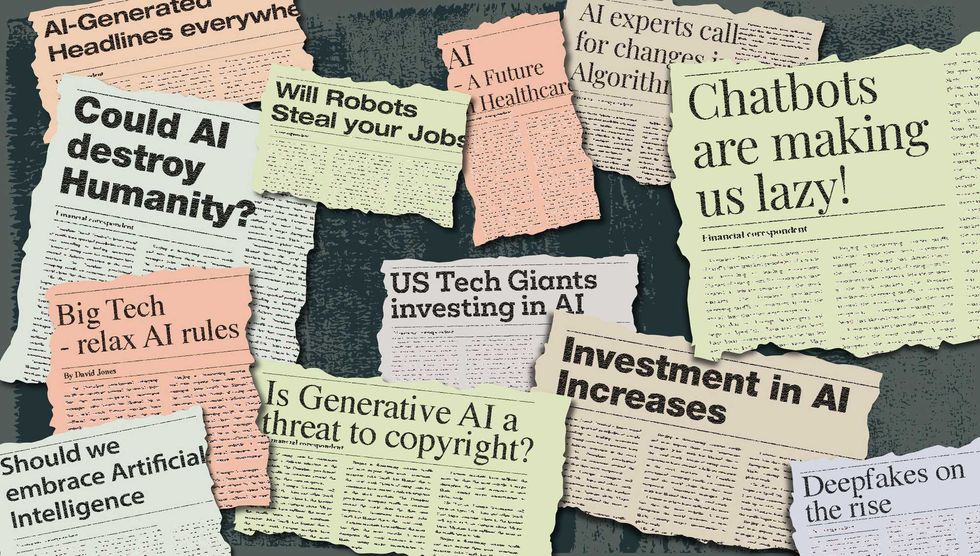
For many, simply trying to stay abreast of these developments in the field of AI alone is too bewildering, frustrating, and frightening an effort to maintain. Many who manage to keep roughly current are themselves increasingly pushed for the sake of cognitive stability toward one of the two extreme positions — deifying or demonizing the thing.
Yet the actual state of play is not, in fact, reflective of the urge to feel willfully in control by choosing sides in a crisp, clean, complete, and comprehensive war for all the marbles, then determine the fate of America, the world, and humankind.
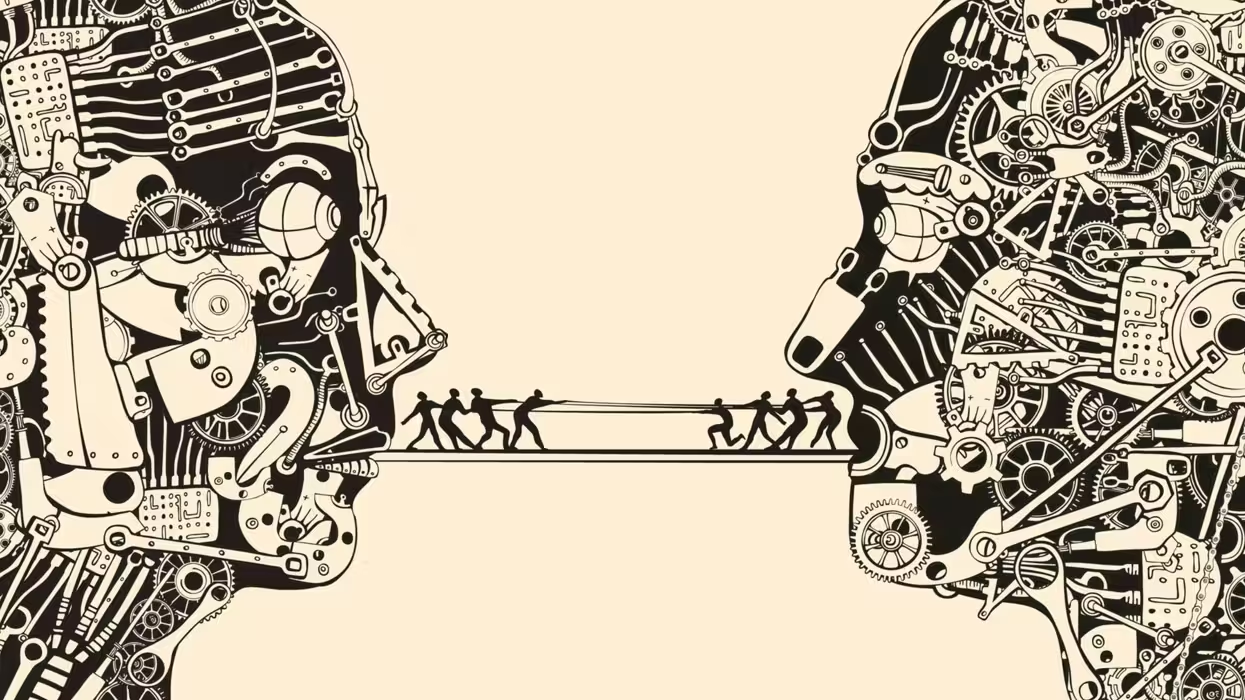
As disorienting and destabilizing as it may be, the state of the AI art in America is a riot of competing and conflicting trajectories and tendencies. Between the deifiers and the demonizers is a roiling stew of wildly different factions: open-sourcers, both for and against Chinese tech; closed-sourcers, some pragmatic, some principled; groups in favor of nationalization; groups opposed; groups opposed depending on how much nationalization is on the table; groups opposed depending on who is doing the nationalizing. There are interests pushing for federal preemption of the states, others hammering away at state-level laws either to restrict or enshrine the right to compute, and still others focused simply on playing politics with the issues in the most effective and enriching ways.
RELATED: The backlash against AI reveals it’s a terrible scapegoat
 RYGERSZEM/Getty Images
A farrago of federal bills jostles together with a flotilla of regulatory efforts, some but not all flowing from the administration’s executive orders and broader agenda. The Supreme Court is now in the mix. Foreign countries and administrative bodies are striking at American companies, imposing fines and rules of their own. The list goes on.
No single political authority is in control of our national technological situation. No one spiritual authority is recognized as our shared guide. We exist in a moment indescribable as simply democratic, oligarchic, technocratic, fascist, communist, socialist, capitalist, nationalist, populist, anarchic, despotic, or, frankly, anything else. We have the Declaration, we have the Constitution, we have federalism, and we have each other. The rest is remarkably, almost stunningly, up in the air.
We can all sit around and wait for the shoes to drop, and for many, beset by the universal cares of life and the hypnotic glare of tech’s pulsing power, paralysis can seem the only sustainable option. But for many more, even those inclined to choose silence and self-exile over wading into the melee, the only true choice is one of freely willed action. Interpreting technological acceleration as the unfolding of fate itself is a choice, not a cosmic requirement, one that is often made reactively, as cope, rather than proactively, as will to power. What presents as prediction is often actually a bet on the overwhelming power of the past, one that denies human agency and life-bringing newness more than it enables people with skin in the game to manifest their plans.
Rather than freaking out over the AI chaos, we ought to take this memorable opportunity to put our actions where our principles purport to be. Don’t try to game out the scramble of the factions. Don’t try to win prediction roulette, scrying, soothsaying, and scheming a way to strength or safety. Decide with discernment where you can forge a path in a manner that allows you to meet your own gaze in the mirror in the morning. And trust that what is written about us is written on the heart, where we still may pledge our honor, and all that is sacred within, to freely make good on who we have been given to be.
More from this network:
Domains for Sale · GOTPeople.org · TheDSAPlatform · The Truth About Socialism
What's Your Reaction?
 Like
0
Like
0
 Dislike
0
Dislike
0
 Love
0
Love
0
 Funny
0
Funny
0
 Wow
0
Wow
0
 Sad
0
Sad
0
 Angry
0
Angry
0

I am just an average American. My teen years were in the late 70s and I participated in all that that decade offered. Started working young, too young. Then I joined the Army before I graduated High School. I spent 25 years in, mostly in Infantry units. Since then I've worked in information technology positions all at small family owned companies. At this rate I'll never be a tech millionaire. When I was young I rode horses as much as I could. I do believe I should have been a cowboy. I'm getting in the saddle again by taking riding lessons and see where it goes.
Premium domains for sale













Comments (0)