

Big Tech Is Making Its Play And Your Kids Could Be Caught In The Middle
Premium domains for sale
Freedom Is Back In Style
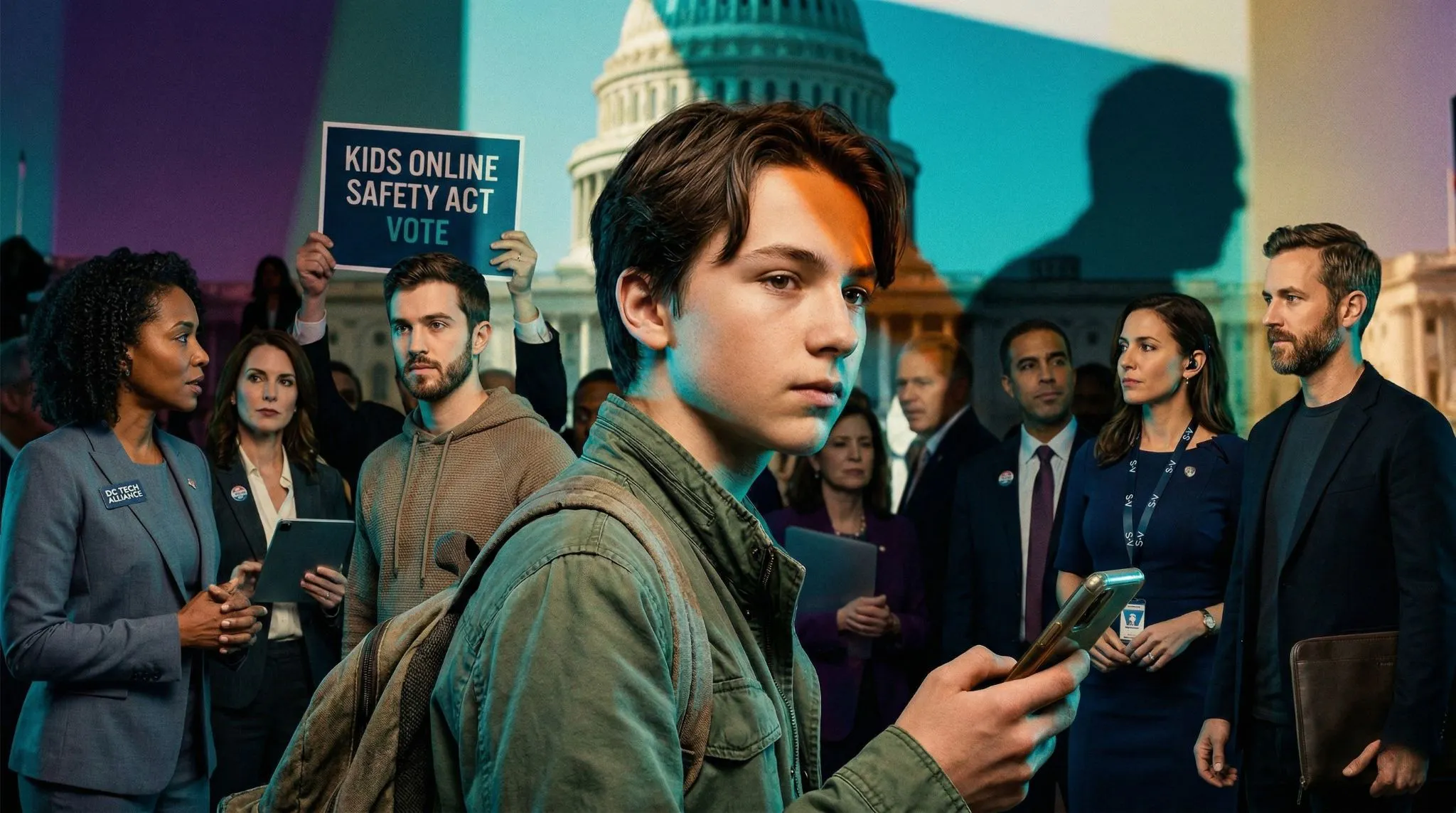
A legislative package that promises to be the largest overhaul of kids’ online safety regulation in decades was advanced last month by the House Energy & Commerce Committee. A good sign of a bill’s efficacy, however, is how strongly the industry it aims to regulate opposes it.
Freedom Is Back
In Style
Premium domains for sale
So far, most of the package — including the Kids Internet and Digital Safety (KIDS) Act and the Children’s Online Privacy Protection (COPPA 2.0) Act — has not drawn serious opposition from Big Tech. What gives?
On balance, Silicon Valley has much to gain if these laws pass as drafted.
For starters, the Senate version of COPPA 2.0 doubles down on the existing age of internet adulthood being 13, thus maintaining the industry-preferred status quo. This ignores the harms social media can cause teens well after 13, such as fueling depression, social isolation, or worse. David Molak, to offer just one heartbreaking example, was driven by online cyberbullying to commit suicide at 16 years old. That’s why eminent figures like Jean Twenge and Jonathan Haidt call for raising the age of social media eligibility to 16, and others call for 18.
This is bad, but perhaps the legislation’s biggest gift to Big Tech is its numerous provisions to preempt or block a growing crop of state laws designed to hold these companies accountable. A look at the finer details of the legislation reveal that Congress would replace robust state regulation with a far lighter “federal standard,” setting a very low ceiling for kids’ online safety at the state level.
Republican sponsors, of course, frame things differently.
In the Washington Post, Rep. Brett Guthrie (R-KY), E&C Committee Chair and lead sponsor of the KIDS Act, described the package in adversarial terms, as Congress moving to correct Big Tech’s egregious failure to “self-regulate.” Guthrie is doubtless correct about Big Tech’s shortcomings. But this only makes it more noteworthy that the tech industry does not oppose this legislation.
Big Tech hasn’t been silent about every bill in the package. The App Store Accountability Act, which has been enacted in four states (thus far), has received significant pushback. The Apple-backed App Association decried the bill as a “poison pill” that would stifle “innovation,” explicitly calling it a “fly in the AI package ointment.”
By openly referring to the child safety package as “the AI package,” the App Association gives away the game. Insiders in Washington regularly admit that they are using the child safety package to mollify the concerns of parents and child safety advocates to pave the way for Congress to pass — what the White House calls — a “minimally burdensome” federal AI standard. In an unguarded interview, Amy Bos, vice president of governmental affairs for industry group NetChoice, speaks of “leveraging, or using, possibly, a kid’s package … to get AI across the finish line.”
Big Tech is only interested in kids’ safety if it comes with a much bigger payoff: a federal law that would stop states from enforcing tougher AI regulations. In fact, with help from Republican leadership, Big Tech has already tried twice — and failed twice — to get Congress to do exactly that.
According to a recent announcement by Senator Ted Cruz, one of Big Tech’s key Congressional allies, it looks like Silicon Valley is gearing up for a third attempt. And it seems they’ll have the buy-in to try again. As Politico recently reported, Senate Majority Leader John Thune said that a federal AI standard is “a ‘big priority’ for the Trump administration, and [he] said a potential bill could be folded into a larger package with other proposals like a kids’ online safety bill.”
But the American people see things differently. Weakening kids’ online safety legislation by tying it to a sweeping “AI package” is a non-starter for American families. Parents nationwide have heard the terrifying story of Adam Raine, a 16-year-old boy who was goaded into taking his own life by ChatGPT. They fear that their child might be next. It’s no surprise, then, why, according to a national poll by the Institute for Family Studies, American voters want Congress to prioritize kids’ online safety over industry carveouts by a margin of nine to one.
Robust online safety for kids is a winning electoral strategy, but tying it to deregulation of AI is a political loser. As a second national Institute for Family Studies poll found, Republican voters in red states support Congressional candidates who protect children from AI harms and oppose those who push preemption. For a party expected to face serious challenges during midterms, it would seem that Republican leadership would be eager to champion the desires of its voters.
Congress should, like countless state legislatures, side with voters and not protect Big Tech companies from responsibility. We have had enough of that.
Ultimately, Rep. Guthrie is right: American families “deserve more than gestures and idle promises. They deserve laws that work.” That includes his.
* * *
Jared Hayden is a policy analyst at the Institute for Family Studies’ Family First Technology Initiative.
Michael Toscano is the director of the Family First Technology Initiative at the Institute for Family Studies.
More from this network:
Domains for Sale · GOTPeople.org · TheDSAPlatform · The Truth About Socialism
What's Your Reaction?
 Like
0
Like
0
 Dislike
0
Dislike
0
 Love
0
Love
0
 Funny
0
Funny
0
 Wow
0
Wow
0
 Sad
0
Sad
0
 Angry
0
Angry
0

I am just an average American. My teen years were in the late 70s and I participated in all that that decade offered. Started working young, too young. Then I joined the Army before I graduated High School. I spent 25 years in, mostly in Infantry units. Since then I've worked in information technology positions all at small family owned companies. At this rate I'll never be a tech millionaire. When I was young I rode horses as much as I could. I do believe I should have been a cowboy. I'm getting in the saddle again by taking riding lessons and see where it goes.
Premium domains for sale














Comments (0)