

Burned And Disfigured: Iran’s Nepo Supreme Leader Needs Plastic Surgery
Premium domains for sale
Freedom Is Back In Style
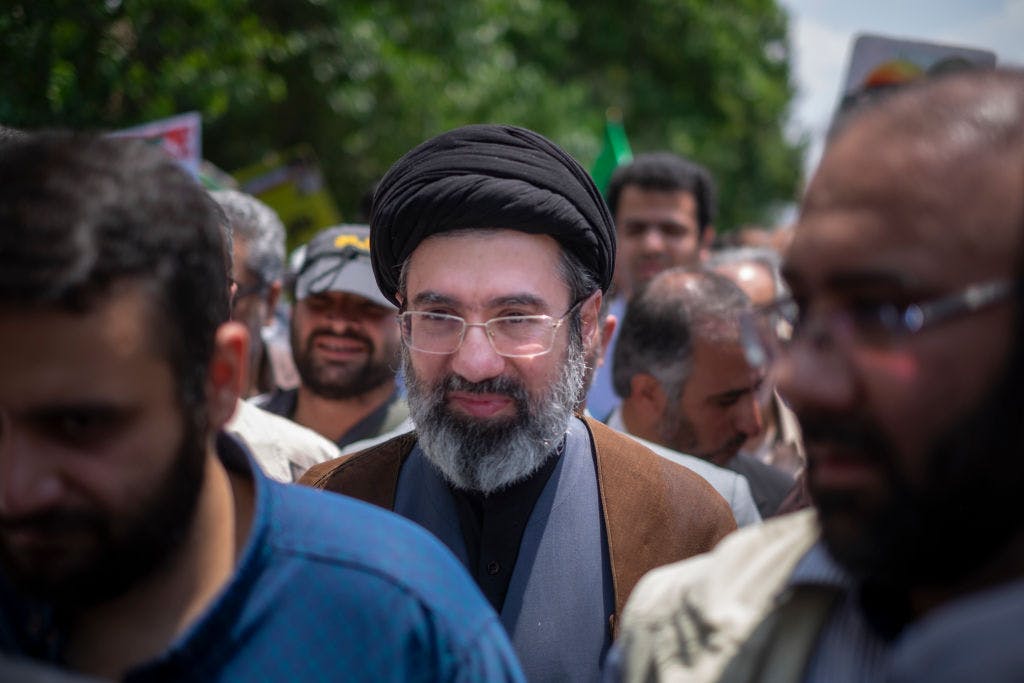
Iran’s newly installed supreme leader, Mojtaba Khamenei, is reportedly recovering from severe injuries and may require plastic surgery after an airstrike that killed his father and predecessor, Ali Khamenei.
Freedom Is Back
In Style
Premium domains for sale
The attack, which also killed his wife and son, has left the 56-year-old leader physically debilitated, largely isolated, and increasingly reliant on hardline military commanders to govern, according to the New York Times, citing senior Iranian officials.
Khamenei has been cut off from most officials as he recovers, surrounded primarily by medical staff amid concerns that revealing his location could make him a target, according to the report. Despite his condition, officials say he remains mentally alert and continues to weigh in on major decisions, though day-to-day authority has increasingly shifted toward hardline military commanders.
Questions about his health have intensified in recent weeks. Since being selected by Iran’s Assembly of Experts following his father’s death in March, Khamenei has not made a public appearance, with only written statements released in his name.
The Times reported that his injuries include significant damage to one leg and one hand, requiring multiple surgeries, as well as severe facial burns that have limited his ability to speak and could likely necessitate reconstructive surgery.
Iranian regime officials have reportedly taken dramatic steps to conceal Khamenei’s location from the United States and Israel. The regime is relying on handwritten messages delivered through a network of trusted couriers traveling by car and motorcycle to avoid detection.
Born into Iran’s ruling elite, Khamenei followed a path that blended religious study with military involvement. As a teenager, he joined an Islamic Revolutionary Guard Corps brigade known as the Habib Battalion during the Iran-Iraq War. He later completed his education at a theological seminary, attaining the rank of ayatollah, and worked closely within his father’s inner circle, helping coordinate military and intelligence operations.
Despite his influence behind the scenes, he has never held elected office or served in a formal senior government role. He has also faced international scrutiny, including sanctions from the U.S. Treasury Department in 2019, and has been accused of involvement in the regime’s crackdown on the 2009 Green Movement protests.
The elder Khamenei was selected as supreme leader following the death of the Islamic Republic’s founder, Ayatollah Ruhollah Khomeini, who overthrew Iran’s dynastic shah during the 1979 revolution. With his son now assuming the position, the transition has raised questions about whether the Islamic Republic is drifting toward another form of dynastic rule.
His rise to power followed the sudden killing of his father on the first day of the United States and Israel’s attack on the Iranian regime. But unlike his father — who maintained a tight grip over nearly all aspects of the government and the IRGC — Khamenei lacks the same religious authority and political stature and appears far more dependent on military leaders.
With Khamenei sidelined by his injuries, hardline generals have taken on a dominant role in decision-making, shaping Iran’s posture at a critical moment. Their growing influence is believed to have played a role in Tehran’s refusal to participate in a second round of talks with American officials in Pakistan this week.
Following the Times report, senior Iranian officials moved quickly to project unity, issuing closely aligned statements reaffirming loyalty to the regime — even as military leaders are reportedly taking on a larger role in decision-making. President Masoud Pezeshkian insisted there are no internal divisions, writing, “In Iran there are no ‘hardliners’ or ‘moderates’… only unity and obedience to the Supreme Leader,” while Parliament Speaker Mohammad-Bagher Ghalibaf and judiciary chief Gholam-Hossein Mohseni-Eje’i echoed the same message.
More from this network:
Domains for Sale · GOTPeople.org · TheDSAPlatform · The Truth About Socialism
What's Your Reaction?
 Like
0
Like
0
 Dislike
0
Dislike
0
 Love
0
Love
0
 Funny
0
Funny
0
 Wow
0
Wow
0
 Sad
0
Sad
0
 Angry
0
Angry
0

I am just an average American. My teen years were in the late 70s and I participated in all that that decade offered. Started working young, too young. Then I joined the Army before I graduated High School. I spent 25 years in, mostly in Infantry units. Since then I've worked in information technology positions all at small family owned companies. At this rate I'll never be a tech millionaire. When I was young I rode horses as much as I could. I do believe I should have been a cowboy. I'm getting in the saddle again by taking riding lessons and see where it goes.
Premium domains for sale



Comments (0)