

Education without 'schooling': Why a godly home is the best place for children to learn and thrive
Premium domains for sale
Freedom Is Back In Style
If God has blessed you with children — and the ability to stay home with them — I urge you to consider keeping them home with you as they launch into more formal education.
Freedom Is Back
In Style
Premium domains for sale
If you can’t stay home with your kids — well, let’s start there.
All children are best served by spending the bulk of their time with the people who love them the most. Period.
The most common reason given for not being able to stay home is financial. I would challenge you and your spouse, however, to prayerfully and creatively consider ways to make it happen.
I’ve seen many sacrifices made so that a family can live on one income and encourage that to be seriously considered before children come along. That being said, it’s also never too late and always beneficial to change your lifestyle so that you can spend more time at home with your kids, at any age, period. They grow up awfully fast.
And by the way, I think an excellent goal for fathers is to pursue income opportunities that allow him to be home-based too (at least some of the time, at minimum). Your children thrive best with abundant time with both of you.
Financial obstacle ... or excuse?
But when it comes to home education, we are usually talking more about moms than dads, so let’s address whether finances are really what’s keeping mom from staying home. A friend of mine, who sacrificed a promising career to stay home with her three-soon-to-be-four children, thinks Christian women should ask themselves where their hearts are when career and home are at odds:
- Am I valuing my own career — and my own time — too highly? Am I willing to submit these things to the Lord?
- Have I not seriously considered staying home, since so many women don’t? Am I willing to be different?
- Am I willing to sacrifice? Am I willing to prayerfully ask God if I should stay home?
If these questions are asked when a baby is on the way, they may need to be asked again when a child reaches what we deem “school-age.”
Which brings us back to home education, which is the term I prefer over “homeschooling.” That implies we are doing institutional school at home, which further implies that institutional school is the ideal, or at least the norm. I think that’s an idea every responsible parent should challenge, particularly Christian parents.
Like Dorothy said ...
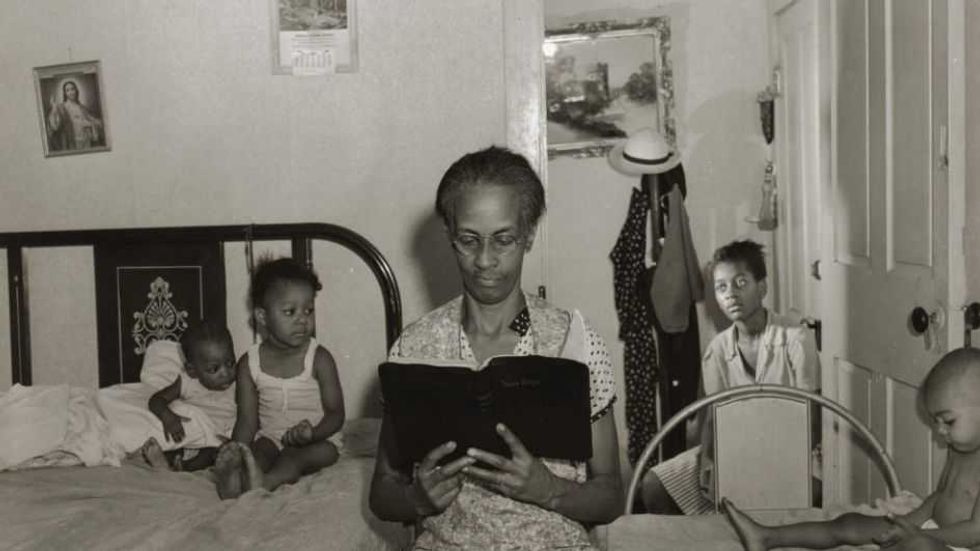
There really is no place like home. No institution can match the power of a godly home as a place for children to grow, learn, and thrive. That applies for all of childhood, starting from birth.
All children are best served by spending the bulk of their time with the people who love them the most. Period.
Daycare cannot possibly provide the nurture, attention, and love that new parents can at home. No preschool can do a better job continuing to nurture a child’s individual needs and gifts as well as loving, committed parents.
And although far too many children do get institutionalized practically from birth, at least parents of babies, toddlers, and preschoolers generally have to pay the institution in question, which has the effect of encouraging parents to at least consider staying home with them, at least part of the time.
But once the children hit school-age, the societal expectation is that the stay-at-home parent (usually mom) will finally be able to go back to work, jump back into a career, get some time to herself, etcetera.
No magic switch
However, there is no magic switch that flips when a child turns 5 or 6, negating their need for, and benefit from, being primarily home with engaged, loving parents.
In fact, I would argue that this is the case throughout what we categorize as the elementary school years. Kids up to about age 12 need their home, family, and parents more than they need an institutional school.
So here’s how you can lay the groundwork in your child’s first years so that home education becomes an organic part of your daily life from their earliest days, making the transition to more formal learning at home more natural when the time comes.
RELATED: 6 ways I'm using 2026 to deepen my relationship with God
 Heritage Images/Getty Images
Home education 101
Education is what you’re doing from your baby’s first day of life, by the way.
Dictionary definition of “education” — the process of imparting knowledge, skills, and judgment.
Your baby begins to learn about the world primarily through his/her interaction with mom and dad. This is God’s design and why He brings children into the world through families.
He equips you, the parents, with the desire to protect and nurture your baby, which generally involves you learning new skills, rearranging your schedule, and buying some stuff! (And boy, will those three tasks continue to dominate your life!)
As the preschool years unfold and children increasingly become active in your household, the most important thing you can do for them is simple and organic:
Establish your home as a safe, orderly, loving, peaceful, and interesting place.
It is simple — but it takes effort.
We’ll finish with some thoughts to guide you toward each of these goals.
Safe
You are your child’s safety. Your daily presence with them fosters a deep sense of security, which is necessary so they can begin to see that they can separate from you, at times.
This does not mean you can never leave, or use a babysitter, but it is helpful if trusted family members or like-minded close friends live nearby and can be part of this security-building experience. After all, when God placed your child in a family, that included the grandparents, aunts, uncles, cousins, etcetera.
A sense of security is also fostered by encouraging children to develop resilience. When they take a tumble, if you see it isn’t serious, a cheerful and calm, “You’re OK!” will send the right message and encourage them to get right back to whatever they were doing. This is not to discourage you from comforting them — on the contrary, comforting and reassuring them that you’re there for them will help them comfort themselves and bounce back more quickly.
There is no such thing, in the baby/toddler/preschool years, as too much time with mom, dad, or other loving family members or friends. When safe and feasible, bring them along for chores and tasks and allow them to “help” as just another form of play — but they are learning all along.
Orderly
Children thrive within boundaries; they want them, they need them, you need them.
Generally keeping to schedules (which change often as babies grow into preschoolers) and generally keeping an orderly environment (they can start helping put toys away at very young ages!) help to foster this sense of order.
Loving
You can’t really express too much affection for each other in a family. Children also need to see that mom and dad love each other. Is this a good place to mention grandparents again? Why yes, it is. Have them come over tonight.
Peaceful
Disagreements arise, but with a little person in the house, strive for a peaceful demeanor. Home should always be a refuge. Yelling is not acceptable, nor are temper tantrums (child or adult).
Interesting
And here is where we finally get to what people think of as “education.” But remember our definition — by providing and modeling safety, order, love, and peace, you already are imparting knowledge, skills, and judgment. That’s the most important “curriculum.”
In part 2, we’ll get into curriculum specifics!
A version of this essay previously appeared at She Speaks Truth.
More from this network:
Domains for Sale · GOTPeople.org · TheDSAPlatform · The Truth About Socialism
What's Your Reaction?
 Like
0
Like
0
 Dislike
0
Dislike
0
 Love
0
Love
0
 Funny
0
Funny
0
 Wow
0
Wow
0
 Sad
0
Sad
0
 Angry
0
Angry
0

I am just an average American. My teen years were in the late 70s and I participated in all that that decade offered. Started working young, too young. Then I joined the Army before I graduated High School. I spent 25 years in, mostly in Infantry units. Since then I've worked in information technology positions all at small family owned companies. At this rate I'll never be a tech millionaire. When I was young I rode horses as much as I could. I do believe I should have been a cowboy. I'm getting in the saddle again by taking riding lessons and see where it goes.
Premium domains for sale























Comments (0)