

GONE IN 60 SECONDS: Why Conor McGregor's loss to Holloway marks the definitive end of his career
Premium domains for sale
Freedom Is Back In Style
Conor McGregor is many things, but boring has never been one of them. The wild years between his major bouts dissolved into a blur of court dates, shattered bus windows, and enough marching powder to send a bull elephant into cardiac orbit.
Freedom Is Back
In Style
Premium domains for sale
He lived like a man trying to out-party Hunter S. Thompson while trying to convince the world he was still an elite athlete. He posted midnight sparring videos from triple-decker superyachts. He littered social media with unhinged, deleted voice notes. Even so, millions of loyal fans believed that he had the capacity to regain his crown.
Joe Rogan provided live commentary, and his excitement was infectious. He confessed to wanting to believe the former champion could still produce magic.
Cold snap
The first real sign that the legend possessed limits came on July 10, 2021, at UFC 264. McGregor’s tibia snapped against Dustin Poirier with the crack of a dry branch, forcing the Dubliner into a prolonged competitive exile. He traded the daily grind of the gym for titanium rod rehabilitation sessions. That injury became the permanent line between the fighter he actually was and the myth he tried to preserve. The subsequent years became a parade of recovery updates and constant promises of a return.
A return did materialize, though it was destined to be short-lived. Saturday — five years on from that shin-splintering night in Las Vegas — McGregor made his return to the Octagon at UFC 329 inside the T-Mobile Arena.
His opponent was fellow MMA veteran Max Holloway, a man who had spent McGregor’s entire hiatus fighting the absolute best featherweights and lightweights on the planet. The arena held a rather eclectic crowd featuring Mike Tyson, Tucker Carlson, and Vince Vaughn, all paying thousands of dollars to witness what was marketed as the greatest resurrection since Lazarus.
Flicker of hope
The opening bars of the Notorious B.I.G.'s "Hypnotize" echoed through the arena. It was the perfect entrance music for the self-styled "Notorious" McGregor. Joe Rogan provided live commentary, and his excitement was infectious. He confessed to wanting to believe the former champion could still produce magic.
The Irish faithful, both in the stands and back home, shared that exact wish, desperately embracing the possibility of the greatest comeback in sporting history. We needed the Mac to conquer the improbable and completely rewrite the laws of the impossible.
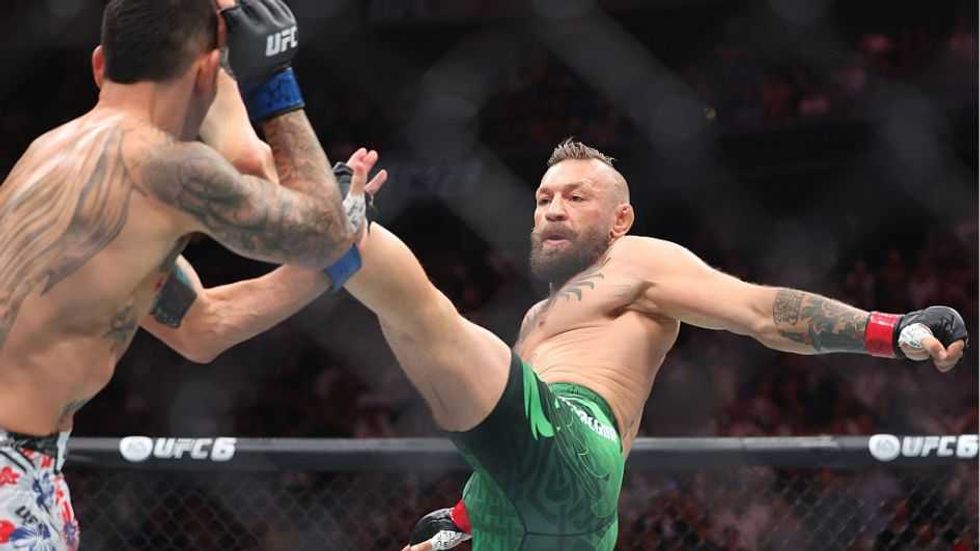
But once the fight began, the delusion evaporated in just over 60 seconds. McGregor threw a heavy, wild kick, landed awkwardly on his right leg, and immediately lost his footing. Seconds later, he attempted a follow-up kick, only to wince in agony. The months of promotional hype and international press tours dissolved in an instant.
When the referee stepped in to call a halt to the misery, McGregor sat with his head buried in his hands. Bypassing the microphone entirely, he exited the cage in what felt like a permanent vanishing act.
RELATED: The sad decline of Conor McGregor
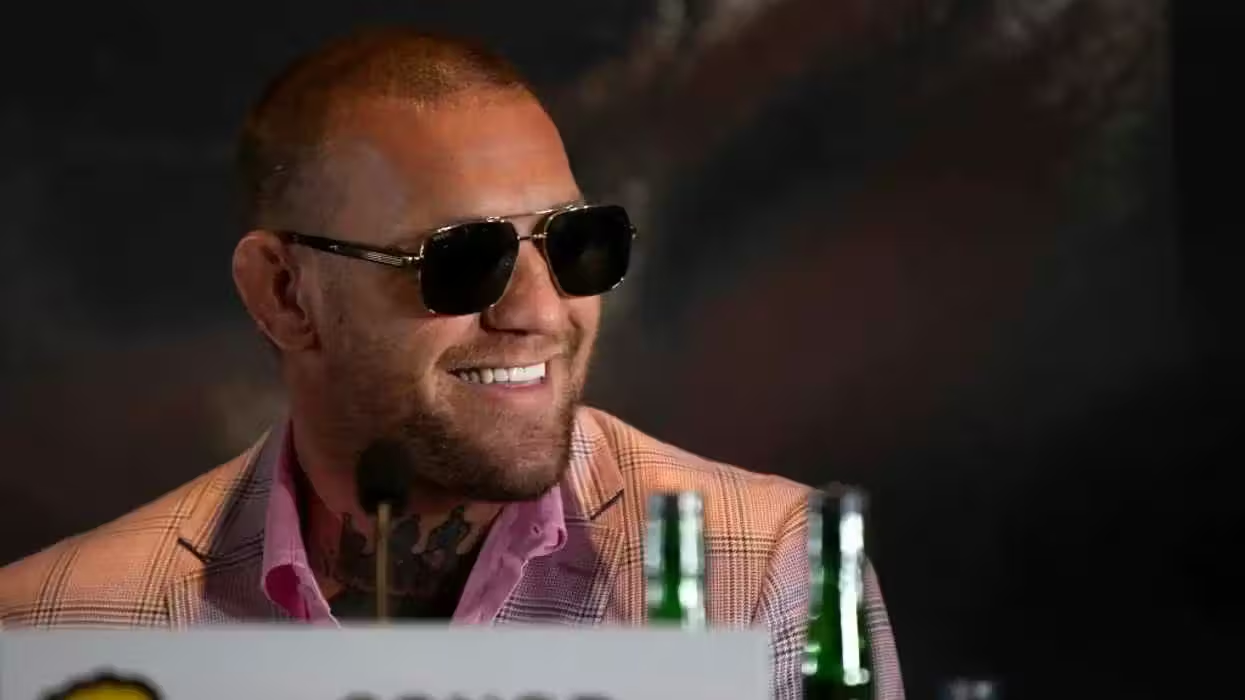 JORGE GUERRERO/AFP/Getty Images
Off the cliff
McGregor recently celebrated his 38th birthday. He’s still a young man, but in the 155- to 170-pound divisions of mixed martial arts, 38 is a chronological cliff, where human reaction time slows just enough for elite 20-something killers to take your head off. History tracks a brutal, unbroken pattern of legend after legend refusing to accept this biological reality. The American B.J. Penn pushed past his prime into his late 30s, only to suffer a horrific seven-fight skid, looking slower and more vulnerable with every appearance.
The sport functions as a meat grinder with a marketing department. Tony Ferguson marched straight into his 40s on an agonizing eight-fight losing streak, transforming from the most feared lightweight on earth into a visual cautionary tale for the entire roster. The Brazilian superstar Anderson Silva lingered long enough to go 1-6 at the end of his UFC run, absorbing unneeded damage from athletes who used his name to build their own brands. The sport does not accommodate aging heroes.
Hit the showers
The financial machine will survive the loss of its favorite cash cow. McGregor completely transformed the UFC's economic reality during his meteoric rise. He turned a niche combat sport into a multibillion-dollar mainstream industry through an unprecedented marketing capability that no fighter before or since has replicated.
In his competitive prime, his ability to predict the exact round of a knockout matched his technical precision inside the cage, forcing even his harshest critics to respect his execution and refer to him as Mystic Mac. He made the sport immensely profitable for the executives, generating hundreds of millions of dollars while single-handedly inventing the concept of the MMA "money fight."
The knee injury at UFC 329 closes the door on any future athletic success inside the Octagon. There is no training regimen, experimental therapy, or medical procedure that can restore the fast-twitch reflexes and structural durability required to beat elite, hungry fighters. He leaves the sport as an incredibly wealthy promotional executive and a guaranteed Hall of Famer, but his time as a functional, successful competitor in the UFC has reached its absolute end.
More from this network:
Domains for Sale · GOTPeople.org · TheDSAPlatform · The Truth About Socialism
What's Your Reaction?
 Like
0
Like
0
 Dislike
0
Dislike
0
 Love
0
Love
0
 Funny
0
Funny
0
 Wow
0
Wow
0
 Sad
0
Sad
0
 Angry
0
Angry
0

I am just an average American. My teen years were in the late 70s and I participated in all that that decade offered. Started working young, too young. Then I joined the Army before I graduated High School. I spent 25 years in, mostly in Infantry units. Since then I've worked in information technology positions all at small family owned companies. At this rate I'll never be a tech millionaire. When I was young I rode horses as much as I could. I do believe I should have been a cowboy. I'm getting in the saddle again by taking riding lessons and see where it goes.
Premium domains for sale









Comments (0)