

Government funded a weapon to fight terrorism — and then tested it on Blaze Media
Premium domains for sale
Freedom Is Back In Style
It didn't take long for a federal government agency originally designed to censor certain foreign entities and curate their narratives on terrorism to be turned on Americans.
Freedom Is Back
In Style
Premium domains for sale
Freedom Is Back
In Style
Premium domains for sale
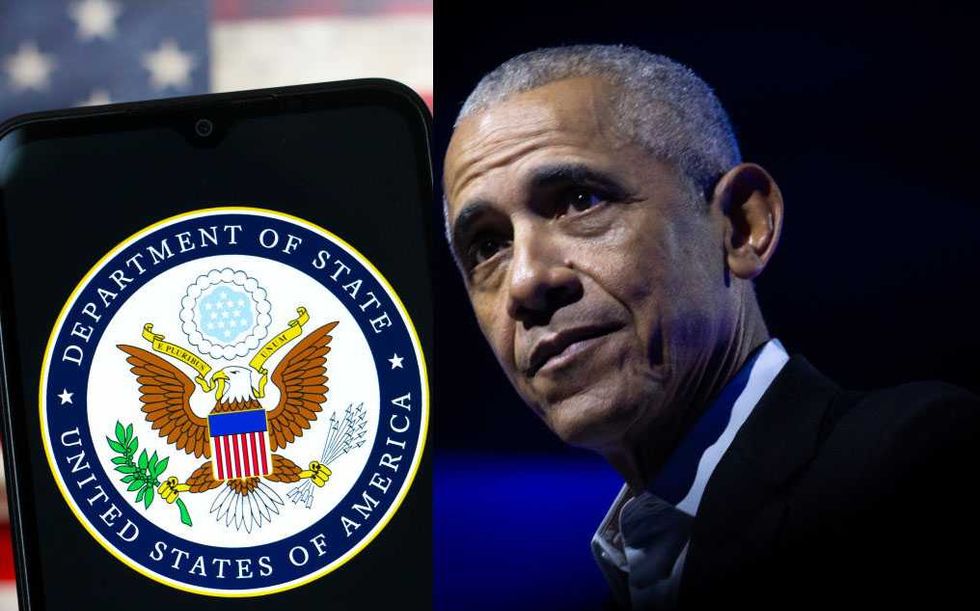
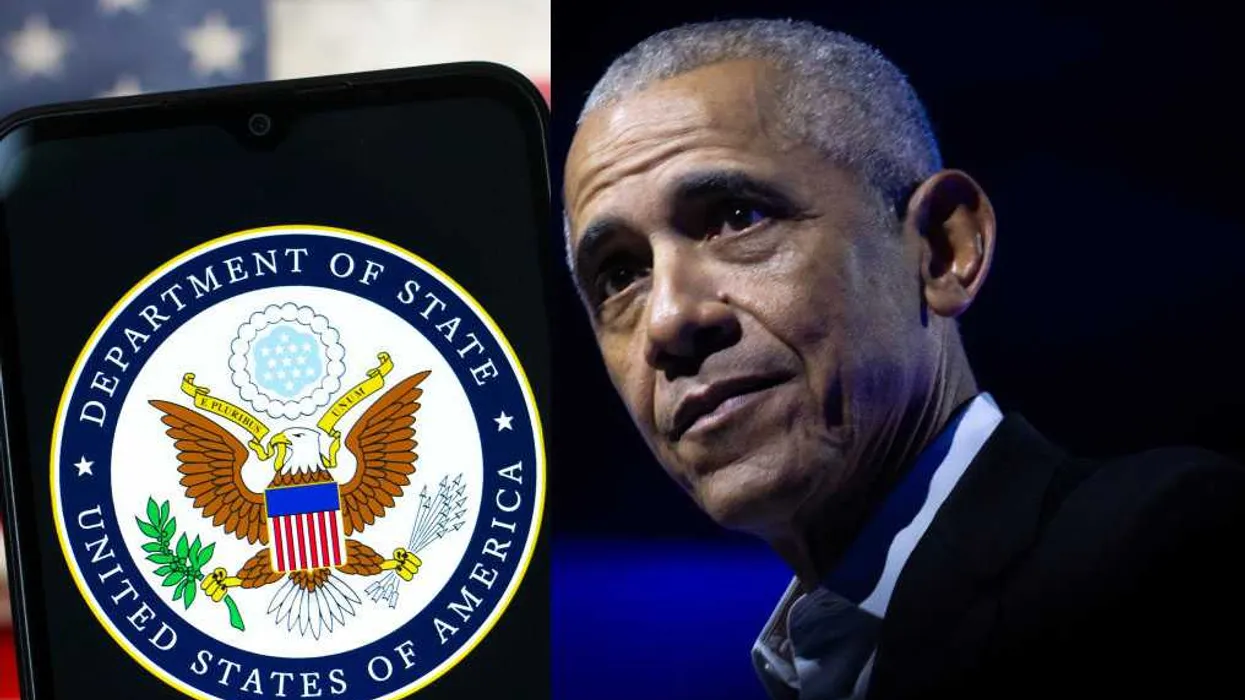
Then-President Barack Obama issued an executive order in 2011 establishing the Center for Strategic Counterterrorism Communications within the State Department — an agency tasked initially with "using communication tools to reduce radicalization by terrorists and extremist violence and terrorism that threaten the interests and national security of the United States."
Obama broadened the mission of the agency and renamed it the Global Engagement Center in another executive order just months prior to President Donald Trump's electoral victory in 2016.
'Greatest level of disinformation risk.'
The Global Engagement Center — overseen by a steering committee of deep-state officials, codified into law in the 2017 National Defense Authorization Act, and afforded both grant-making authorities and the ability to "leverage expertise from outside the federal government" — eventually became, as one former intelligence source told investigative reporter Matt Taibbi, "an incubator for the domestic disinformation complex."
In the final days of the first Trump presidency, the deep state and its censorship contractors — desperate to control the narratives about the 2020 presidential election and the COVID-19 virus — apparently turned this "disinformation complex" on Blaze Media in a proof-of-concept test.
According to discovery evidence gleaned by the Federalist in a now-settled case against the government, the Global Engagement Center backed a trial targeting Blaze Media and the free speech it platforms, despite concerns at the State Department about possibly censoring an American company with an American audience in contravention of the agency's foreign-focused mandate.
Damning discoveries
The Global Engagement Center — which Secretary of State Marco Rubio acknowledged "actively silenced and censored the voices of Americans they were supposed to be serving" — was nominally closed in January 2025, then effectively killed by the Trump administration last April under its final name, the Counter Foreign Information Manipulation and Interference Hub.
Two years prior to the agency's demise, the Federalist and several other plaintiffs filed a lawsuit against the Global Engagement Center and the State Department.
RELATED: The trial lawyers come for online free speech
 Artur Debat/Getty Images
The lawsuit accused the government of actively intervening in the news media market through the Global Engagement Center "to render disfavored press outlets unprofitable by funding the infrastructure, development, and marketing and promotion of censorship technology and private censorship enterprises to covertly suppress speech of a segment of the American press."
Prior to negotiating a deal with the State Department and settling the case last week, the Federalist obtained discovery evidence confirming that the Global Engagement Center had regularly backed and promoted censorial technologies including NewsGuard and the Global Disinformation Index.
Blaze Media previously reported that NewsGuard and the Global Disinformation Index generated blacklists of supposedly risky or misleading news outfits with the aim of getting them demonetized and directing funds to news organizations that advanced establishment narratives.
In the Global Disinformation Index's fall 2022 report, for example, NPR, the Washington Post, and other liberal news outfits were labeled as the "least risky sites," whereas Blaze Media, Reason, the Federalist, the Daily Wire, the New York Post, and other conservative publications made the top 10 list of "riskiest sites" and were smeared as having the "greatest level of disinformation risk."
It turns out that Blaze Media was targeted for more than just a blacklist.
Testing Americans
In an August 2020 press release, NewsGuard showcased that it and two other technology companies — PeakMetrics and Omelas — had won a $25,000 contract earlier that year offered jointly by the State Department and the Pentagon to develop solutions that would help the departments evaluate "disinformation narrative themes in near real time 'by identifying online sources spreading COVID-19 disinformation or misinformation narratives.'"
The Federalist obtained evidence that these Global Engagement Center-funded companies ran a test from Dec. 14, 2020, until Jan. 7, 2021, wherein Blaze Media was apparently a featured target.
The Global Engagement Center reportedly explained ahead of time that the test would entail PeakMetrics "first identify[ing] popular yet potentially divisive narratives relevant to the U.S. elections that are trending across channels."
Omelas, in turn, was supposed to provide "evidence of direct attribution of these narratives to state-sponsored sources of disinformation."
After PeakMetrics and Omelas assessed which narratives were becoming "integrated into domestic messaging," NewsGuard "would highlight which sites the narratives continue to surface from and 'provide information on the reliability, popularity, and endurance of the sites and dissemination platforms,'" reported the Federalist.
This proposed plan apparently made at least one person at the State Department uncomfortable. In a September 2020 email, the person apologized for a lack of clarity regarding the proposed test, noting that the agency had "explained to CYBERCOM" that it would be "impossible" to "focus on domestic audiences" and that "this test will NOT focus on US audiences."
A PeakMetrics report — produced by the State Department and reviewed by the Federalist — suggested these reassurances, which prompted a department official to approve the test, were misleading.
The report explained that the outfits "collaborated to create a mockup of a joint dashboard incorporating all three companies' capabilities."
PeakMetrics noted further that it had performed a preliminary analysis on "Omelas' 'Unrest and Violence in America' narrative," then integrated its "technology enrichment for sources," allowing "operators to garner insights such as technology stacks used for a site, IP addresses (and IP2GEO) associated with the site, and potentially affiliated sites using the same ID for particular technologies."
The report added that "analysis of this metadata can provide unique insights into networks of disinformation propagators."
PeakMetrics' report featured two examples of so-called "disinformation propagators": Sputnik News — a Russian state-owned news agency — and Blaze Media, one of America's largest independent media companies, which the report claimed had a "record of promoting conspiracies [sic] and misinformation surrounding prominent figures and elections."
Through a grant of over $2 million to a third party, the State Department funded the testing of the three companies' technology and financed the test bed on which they collaborated, the Federalist noted.
"Our government financed testing for private technology companies to improve their products — products that target American[s’] speech and seek to silence domestic media outlets," the Federalist summarized.
PeakMetrics and Omelas did not respond to a request for comment from Blaze News.
Matt Skibinski, the COO of NewsGuard, attempted to downplay the finding, telling Blaze News, "This small contract with the Trump administration's Global Engagement Center was exclusively for the purpose of tracking narratives emanating from Chinese and Russian media outlets. The scope of work was extremely specific, even going so far as to list the foreign-owned publications that would be the subject of our monitoring."
Skibinski did not deny that Blaze Media was used in the test.
"PeakMetrics simply incorporated that publicly available rating into its dashboard to test whether this would be useful," said Skibinski. "Again, this was not part of the scope of work we were paid for, and again, The Blaze [sic] was rated well before we had this unrelated small Trump administration [Global Engagement Center] contract covering foreign disinformation."
"We did it because we thought it might be a useful capability that could lead us to future contracts," said Skibinski.
What's Your Reaction?
 Like
0
Like
0
 Dislike
0
Dislike
0
 Love
0
Love
0
 Funny
0
Funny
0
 Wow
0
Wow
0
 Sad
0
Sad
0
 Angry
0
Angry
0

I am just an average American. My teen years were in the late 70s and I participated in all that that decade offered. Started working young, too young. Then I joined the Army before I graduated High School. I spent 25 years in, mostly in Infantry units. Since then I've worked in information technology positions all at small family owned companies. At this rate I'll never be a tech millionaire. When I was young I rode horses as much as I could. I do believe I should have been a cowboy. I'm getting in the saddle again by taking riding lessons and see where it goes.
Premium domains for sale








Comments (0)