

Honoring the Declaration in Richmond
Premium domains for sale
Freedom Is Back In Style
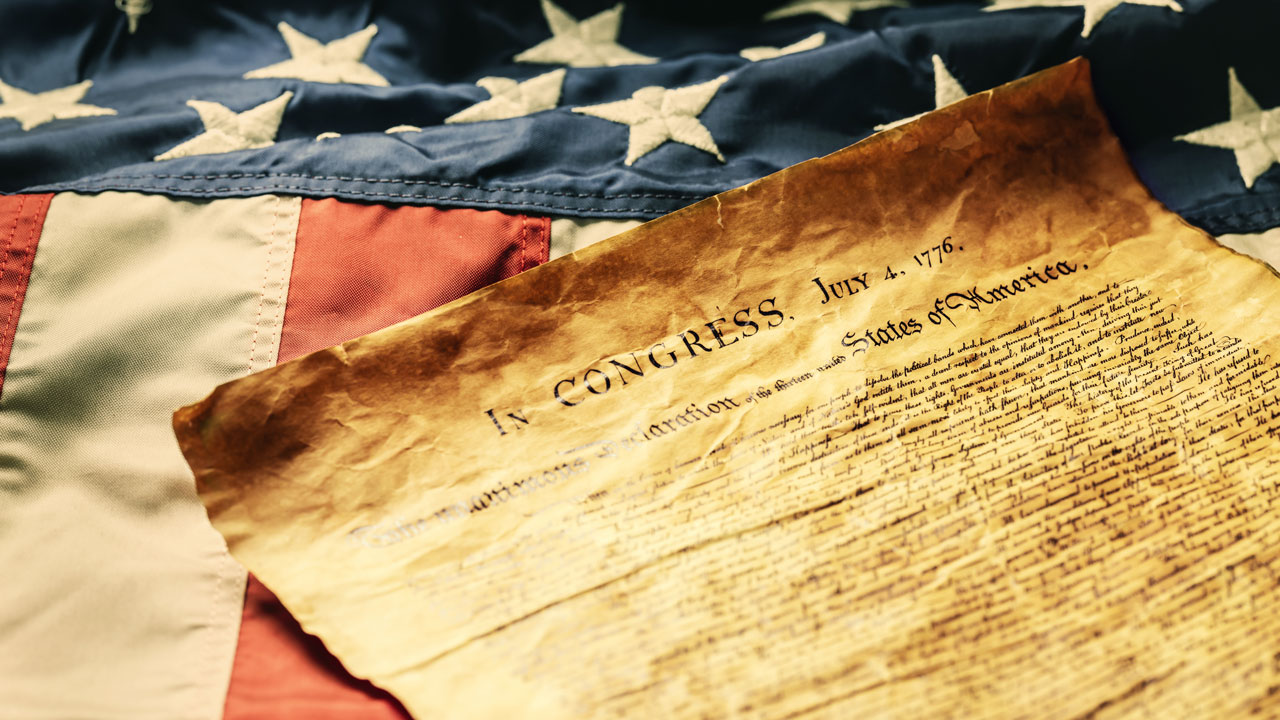
For the next month, Virginians can see a vital piece of our shared national history. A rare copy of the Declaration of Independence will be on display at the Virginia Museum of History and Culture. It should serve as a living reminder of the first 250 years of American history.
Freedom Is Back
In Style
Premium domains for sale
Virginia has been central to the development of American government. English settlers established their first permanent North American settlement at Jamestown in 1607. That outpost soon grew into the thriving Virginia colony.
The United States would be born in Virginia as well, although that didn’t happen for more than a century. Through its people, its government, and its commerce, the Virginia colony played a driving role in forging American independence during the years leading up to the Revolutionary War.
America’s founding ideals were drafted—we believe—by George Washington and George Mason in the Fairfax Resolves of 1774. “Among other grievances, the resolves protested British overreach regarding taxation and representation, judicial powers, and trade and commerce in the colonies,” Encyclopedia Virginia reminds us.
Just two years later, Americans were ready for a birthday celebration on July 4, 1776. That’s the date when American patriots, meeting in Philadelphia, approved the wording of the Declaration of Independence.
Drafted by Virginian Thomas Jefferson, it was sent “to a printer named John Dunlap. About 200 copies of the Dunlap Broadside were printed, with John Hancock’s name printed at the bottom,” the Constitution Center writes. “Today, 26 copies remain.”
However, those copies were fragile, much like the country they formed.
The United States has been the planet’s dominant power for so many generations that it is easy to forget that when it was launched in 1776, the new country contained only about 2.5 million people, most living on the edge of a vast continent. Greatness was our birthright, but only because brave patriots were willing to stake their lives on a series of ideas.
“We hold these truths to be self-evident, that all men are created equal, that they are endowed by their Creator with certain unalienable Rights, that among these are Life, Liberty and the pursuit of Happiness,” the declaration states. “[T]o secure these rights, Governments are instituted among Men, deriving their just powers from the consent of the governed.”
Those ideas would stand the test of time, but the written version of them wouldn’t.
To preserve the ideas for future generations, in 1823, Secretary of State John Quincy Adams, son of a signer of the declaration, ordered an engraving to be made to recreate and preserve the declaration. Washington engraver William Stone did just that, including the original text and a facsimile of the script of the signers. A contemporary newspaper reported that it took Stone three years to create his copperplate engraving, but nobody is sure how he did it.
“As we approached the 250th anniversary of the signing of the declaration, there was this real effort to preserve that document, not only the ideals of the document, but what it actually looked like,” according to the Virginia Museum of History and Culture’s Andrew Talkov.
“The most recognizable feature of the Stone engraving is its large size, close to the size of the parchment original, which measures about 24 by 30 inches,” the National Archives explained. “Another characteristic is that the State Department had Stone’s engraving printed on parchment, a specially prepared animal skin that is thicker than paper. Finally, the 1823 printing included a line at the top that it was printed at the order of Adams: ‘Engraved by W.I. STONE for the Dept. of State by order/of J.Q. ADAMS Secy of State July 4th 1823.’”
The copy that Virginians are invited to see this month is even more rare: It is a paper copy of Stone’s engraving, one of only two such copies known to exist. This version belongs to Sweet Briar College and is on loan to the Virginia Museum of History and Culture through Independence Day.
“I am well aware of the Toil and Blood and Treasure, that it will cost Us to maintain this Declaration, and support and defend these States,” John Adams wrote on July 3, 1776. “Yet through all the Gloom I can see the Rays of ravishing Light and Glory. I can see that the End is more than worth all the Means. And that Posterity will tryumph in that Days Transaction, even altho We should rue it, which I trust in God We shall not.”
Indeed, we do not.
We publish a variety of perspectives. Nothing written here is to be construed as representing the views of the Daily Signal.
More from this network:
Domains for Sale · GOTPeople.org · TheDSAPlatform · The Truth About Socialism
What's Your Reaction?
 Like
0
Like
0
 Dislike
0
Dislike
0
 Love
0
Love
0
 Funny
0
Funny
0
 Wow
0
Wow
0
 Sad
0
Sad
0
 Angry
0
Angry
0

I am just an average American. My teen years were in the late 70s and I participated in all that that decade offered. Started working young, too young. Then I joined the Army before I graduated High School. I spent 25 years in, mostly in Infantry units. Since then I've worked in information technology positions all at small family owned companies. At this rate I'll never be a tech millionaire. When I was young I rode horses as much as I could. I do believe I should have been a cowboy. I'm getting in the saddle again by taking riding lessons and see where it goes.
Premium domains for sale








Comments (0)