

Hollywood’s Gatekeepers Lost Their Grip. Young White Directors Are Back.
Premium domains for sale
Freedom Is Back In Style
As you know, I spent several years working on a movie that you may have seen called “Am I Racist?” It’s about the corruption and moral depravity of the diversity, equity, and inclusion (DEI) industry, which I infiltrated in the film.
Freedom Is Back
In Style
Premium domains for sale
I donned a disguise so cunning and so mysterious that it fooled the brain trust of American DEI, including Robin DiAngelo herself. I’m very proud of the film, which quickly became the top documentary of the decade.
We managed to condense the insanity of DEI into a concise, 1-hour 40-minute story, which seemed like quite an achievement at the time. After all, DEI is a sprawling industry, with all kinds of fake lingo and bureaucracy, along with support from every major institution on the planet. How can you really do a comprehensive takedown of DEI in less than 1 hour and 40 minutes? We needed every minute we got. Or so we thought.
In retrospect, maybe there was a way to shoot a much shorter film. The following footage you may have seen is from New York following the Knicks’ victory in the NBA Finals. In just about ten seconds, this footage does a better job exposing the absurdity of the DEI industry than anything I’ve seen since “Am I Racist?”

This is a tour de force. It depicts a morbidly obese woman overturning a Knicks-themed garbage can, spewing trash all over the sidewalk, before walking away with the said can, looking like she’s just carried out the heist of the century.
Watch:
As expected, Knicks fans were stealing the signature blue and orange garbage cans during the parade yesterday
pic.twitter.com/0UXyHHsVSv— Barstool Sports (@barstoolsports) June 19, 2026
Source: @barstoolsports/X.com
and
It took me a while, but I finally found the video of the fat slob riding the train with the stolen Knicks garbage can.
Should she face consequences for stealing public property? https://t.co/MhIDyPnyUN pic.twitter.com/KTixa121xF
— I Meme Therefore I Am ???????? (@ImMeme0) June 21, 2026
Source: @ImMemeo/X.com
From the moment I saw this footage, I knew that there were only three options. She could be unemployed. She could be a DEI executive. Or she could be a government employee — probably a teacher, but maybe a DMV worker. There was simply no other possibility — no chance that she was a functioning, productive member of society. The only question was, what kind of leech was this individual, exactly?
And now we have our answer, courtesy of the New York Post:
A woman caught on video emptying a public trash can on the street then stealing it during New York City’s Knicks championship parade was a director at JPMorgan Chase who was fired Tuesday over the incident, The Post has learned. Angie Báez, 40, was promoted to executive director of Community and Industry Engagement for Card and Connected Commerce at JPMorgan Chase more than a year ago, according to her LinkedIn profile. She previously served as executive director of Diversity, Equity, and Inclusion at New York-based review website The Infatuation, which Chase acquired as part of its broader push into lifestyle and experiential content. Sources say the bank looked into the incident after the video surfaced and a JPMorgan Chase spokesperson told The Post, “This employee is no longer with the company.
So if the choices were “unemployed, DEI executive, or government employee,” Angie Báez turned out to be the second option. Now she’s the first option. And soon, presumably, she’ll be the third option. She’ll get the trifecta.
As eager as JP Morgan was to fire this woman — and they were probably trying to do it for a long time — the New York City government will be just as eager to offer her a job at city hall. That’s typically how things like this go. With qualifications like this, she can run Mamdani’s sanitation department.
This is one of those stories that — even though everyone should’ve seen it coming — does illustrate a very important truth about DEI. The job of DEI executives, always and everywhere, is to flood society with literal garbage.
Their whole reason for existing is to walk into an orderly environment where everything’s going well, overturn the nearest garbage can, and force everyone else to deal with the results. They plunder everything they see and leave a mess in their wake, without any shame whatsoever, because their mission in life is to make the world as repulsive as they are.
This obese female JP Morgan DEI executive stealing a trash can is related to the campaign to drive white males out of the film industry for decades in obvious ways.
Nowhere has the DEI phenomenon been more evident than in the creative fields over the past few decades. White men have been driven out of the film and television industries solely because of their skin color and gender. As Compact Magazine has reported:
White men directed 69 percent of TV episodes in 2014, and just 34 percent by 2021. But that remaining third went overwhelmingly to established names, leaving little space for younger white men. Since 2021, 11 directors under 40 have been nominated for Emmys. None have been white men.
Whenever this comes up, the inevitable response you hear from the Left is that plenty of the most successful directors are white men. And they’ll cite directors like Steven Spielberg, Clint Eastwood, Ridley Scott, Martin Scorsese, George Lucas, and so on. Never mind the fact that the youngest director on this list is in his late 70s.
And this gets to the heart of the problem, which is that, to the extent that white men are still successful in the industry, it’s because they were grandfathered in. And the Compact piece has the data on this:
Between 2004 and 2013, over forty Gen-X white men received Academy Award nominations for screenwriting. In the following decade (2014-2023), more than fifty Gen-X white men were nominated—alongside just six white male millennials.
They’re pulling the ladder up behind them, in other words. The successful white male directors and screenwriters aren’t going to surrender their positions in the name of DEI. But they’re happy to sign off on new “diversity” rules that punish up-and-coming screenwriters and directors for being white.
And the results have been very evident. Spielberg was 28 when “Jaws” came out. There hasn’t been a single major, white male director born on or after 1989. So that era’s Spielberg would have been rising to prominence in 2017, which was around the time anti-white male discrimination was peaking — just after Obama’s first term, but also during the initial Trump backlash.
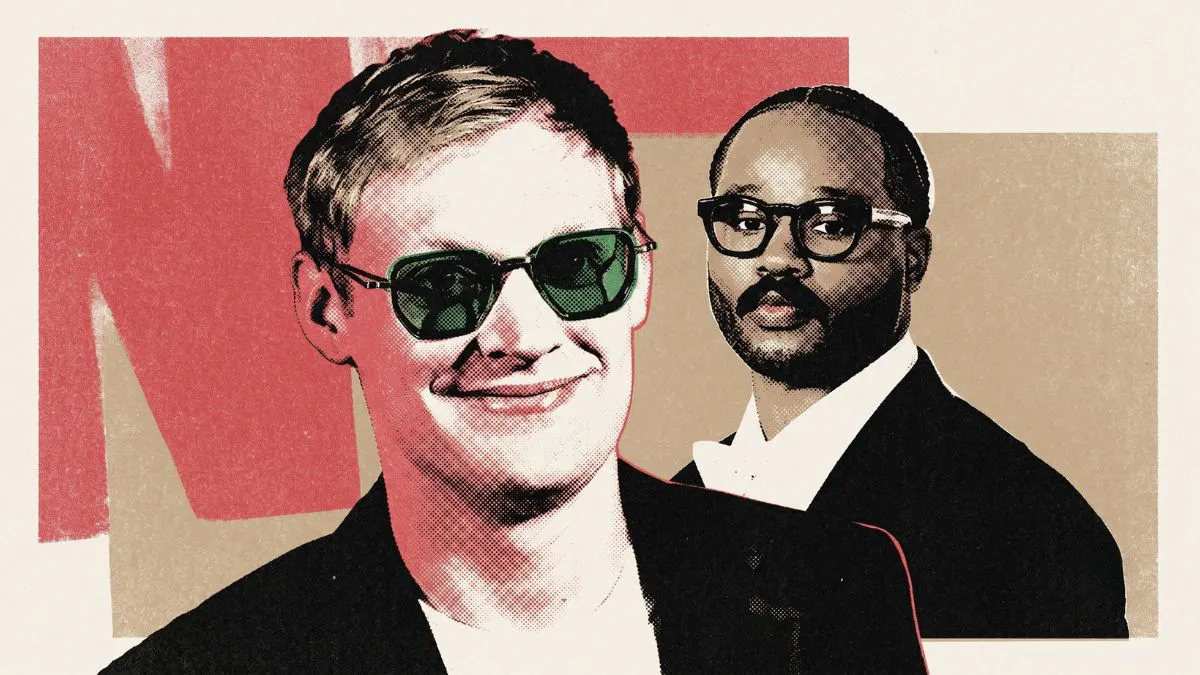
Today — instead of getting a new Spielberg — we’re getting directors like Ryan Coogler, who produce films like “Sinners,” which is explicitly anti-white, and “Black Panther: Wakanda Forever.”
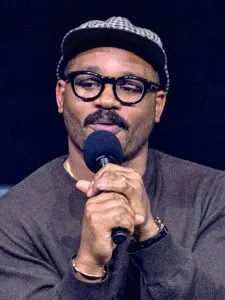
How did Ryan Coogler get his start in the industry? It’s an important question to ask, especially since filmmaking is one of the most competitive industries imaginable. Everyone wants to be a director. It’s a dream job. So how did Coogler stand out from the crowd? It turns out that he applied to something called the Sundance Institute.
Back in 2012, he was accepted into the Sundance Screenwriters Lab, a highly competitive and intensive incubator that provided him with mentorship and, most importantly, grant money to make his first film, along with all of the necessary staff. Actually, they provided a lot more than that.
Watch as Ryan Coogler explains what motivates him to make films, and then listen as he explains how Sundance basically made the film for him.
Watch:
First, he says that filmmaking is all about helping audiences see people they wouldn’t normally meet in real life, which is absurd. It’s a principle of DEI that you hear all the time, even though it’s completely false. “Representation” does not make a good story, nor does it contribute to a good story.
And then, without missing a beat, Coogler states that he wanted to make films in response to the death of Oscar Grant, one of the original BLM heroes from back in 2009. Oscar Grant was resisting arrest around 2 A.M. on a train platform in Oakland when an officer attempted to taser him. The officer mistakenly grabbed his gun and shot him. It was an accident. The cop said he was going to use his Taser, and then he reacted with shock when he fired. It was a tragedy, but it wasn’t murder, and it certainly had nothing to do with race.
But for Coogler, this incident was going to be the basis for his filmmaking. He decided to make fake race narratives into a fundamental pillar of the movies he created. And hearing this, the Sundance Institute did all of the hard work for him. They got him a house. They got him editors. They got him cinematographers.
They connected him with Forest Whitaker’s production company, which produced his film. Every day, the liberal white women running this program wanted to know if he needed anything else. And then once the film came out, Sundance gave it a bunch of awards.
There’s nothing organic about any of this. He’s a vessel for white liberal guilt. Coogler is a decent filmmaker. He’d be making pretty good movies even without all of this help. But we can say with certainty that he got a major boost in this process, not only because of his politics, but because he’s not white.
That’s not a conjecture. It’s based on the words on the Sundance Institute’s website:
“We aim to reflect inclusion, racial equity, and accessibility across our organization and in all our programs and platforms. This includes, but not limited to, staff, artists, fellows, advisors, patrons, and guests of Sundance Institute.”
Sundance also notes:
Our events and programs are designed to encourage diverse perspectives while maintaining a culture of mutual respect. We are committed to freedom of creative expression and uphold anti-racist, anti-sexist, and anti-discriminatory actions in all areas of the Sundance Institute community.
As you probably know, in DEI-speak, being “anti-racist” means a lot more than “we don’t discriminate.” Quite the contrary. Being “anti-racist,” as Ibram X Kendi a.k.a. Henry Rogers told us, means that you engage in active discrimination against white people in order to benefit non-whites.
That’s what it means for the Sundance Institute to “reflect racial equity in all our programs and platforms.” It means that, if you’re a white kid from the suburbs who wants to make actual films (instead of racial propaganda), the Sundance Institute is more likely to pass over your application, which means you’ll probably never get your big break.
As you may remember, back in 2015, there was an activist campaign called “Oscars so White,” which came about because all the acting nominees were white. In response, the Academy announced that it had doubled the number of female members and tripled its “members of color.”
The Academy also announced that, in order to qualify for a Best Picture nomination, “films will have to meet diversity and inclusion standards. Among them is the rule that at least one of the lead actors or significant supporting actors is from an underrepresented racial or ethnic group in a specific country or territory of production.”
This is the same “representation” nonsense that Coogler was pushing at Sundance, only now it’s mainstream.
As a professor named Harald Uhlig pointed out at the time, “Hollywood movies are watched worldwide. If there truly were interest in diversity to ‘reflect the lives and complexions of movie audiences,’ at least half of the participants should be Asian. Many should be Arab. Many from Africa. And most of them should not be nearly as beautiful as the typical lead actor or actress.”
No one could argue with what the professor was saying. They tried to have him fired instead. In Hollywood, and everywhere else, discrimination against white talent became mandatory. James O’Keefe recorded a Disney executive, on camera, admitting that white people — including the executive himself — are disadvantaged in the industry.
Watch:
Senior Vice President at Disney: “There’s no way we’re hiring a white male”
Stop funding companies that hate you.#BoycottDisney. Pass it on.
— End Wokeness (@EndWokeness) June 20, 2024
Source: @EndWokeness/X.com
That video is from a couple of years ago. It was probably the most difficult period for white males to get into the entertainment industry, particularly if they weren’t rich communists. But a lot has changed since this video was recorded. It’s now becoming much more common for white males to do an end run around the typical Hollywood machine — to bypass programs like the Sundance Institute and reach audiences through independent distribution.
This past month, the two biggest films in theaters were “Backrooms” and “Obsession” — projects made and conceived by young white guys on YouTube — “Backrooms” began on 4Chan, had a $10 million budget, and just surpassed $300 million worldwide. “Obsession” put up similar numbers with an even smaller budget.
This is extremely dire news for the Hollywood elites who have worked for so long to exclude white males from the industry. That group is finding their way back, without Hollywood’s help. And they’re doing a lot better than the mainstream films that the industry is producing. Now Curry Barker, who’s behind “Obsession,” is set to direct a remake of “The Texas Chainsaw Massacre.” He made it in the industry, without Sundance doing all the work for him.
There are other examples of white male filmmakers bypassing Hollywood as well. This is from Tech Crunch:
The two releases [of Backrooms and Obsession] follow the surprise success of “Iron Lung,” a video game adaptation released earlier this year. Directed by Mark Fischbach — better known under his YouTube account name Markiplier — “Iron Lung” grossed nearly $41 million domestically.
This explains why, as has been reported by the Hollywood Reporter, movie studios are now flocking to Reddit and YouTube to find IP for films. There’s a reason why those places — YouTube in particular — have suddenly become goldmines for creative ideas and creative talent. It’s because those are places where talented people can find a voice without having to filter through Hollywood’s diversity quota system. It’s where young white males with talent and great ideas can go and be discovered. Hollywood is now doing an end run around its own diversity initiatives.
And this is the second big factor in possibly bringing back white male directors: Audiences are tired of woke slop and want something radically different.
All of this progress is infuriating Leftists who were convinced that, post-2020, they’d continue to have a stranglehold on all media for the indefinite future. Over at a website called The Ankler, they’re panicking over charts like this one:
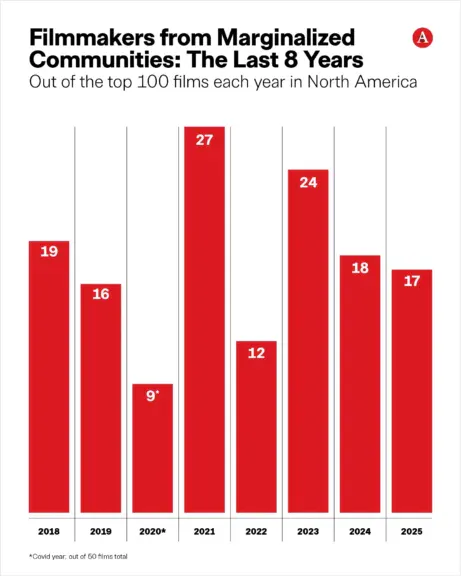
It purports to show the number of films made by non-whites each year out of the top 100 films. As you can see, the number peaked in 2021, and things have been downhill ever since. And the media journalists at The Ankler aren’t taking the news well:
Okay, not good. I mean, pretty terrible for only 17 percent to be directed by non-whites, given the makeup of the country, not to mention the world and the Hollywood history we’re supposedly overcoming.
So the implication here, again, is that every demographic group needs to have proportionate representation among the top directors, even if they’re not producing good content. They’re not accounting for the quality of the films at all, because they don’t actually care about films. Their only concern is to prevent whites from making them.
Then there’s this chart showing the number of black filmmakers out of the top 100 films:
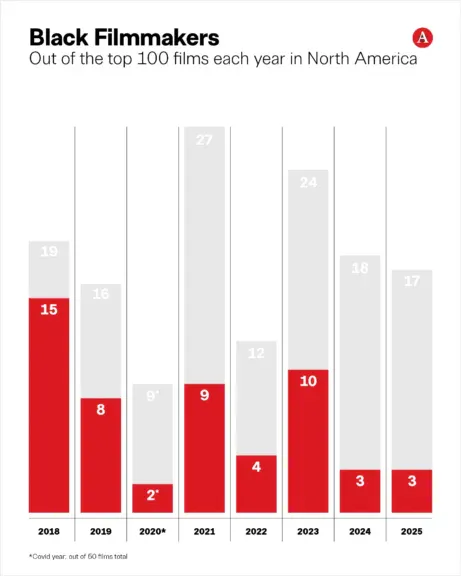
It’s also dire, from their perspective. But worst of all is the representation of Latinos:
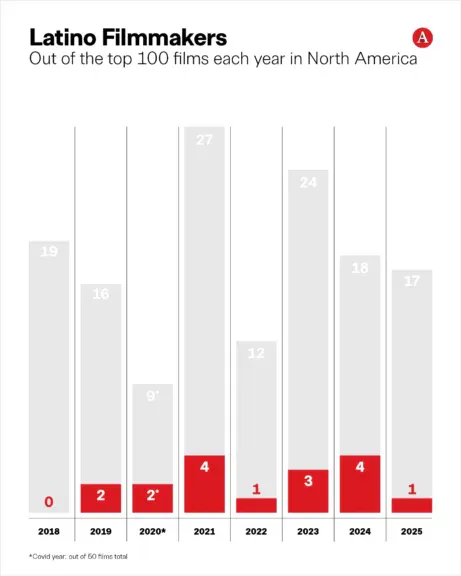
They’re really not performing well: “Since 2018, Latino directors have gone from zero films a year to one film a year, for a group that makes up approximately a quarter of the U.S. box office totals.”
And then the article ends with this paragraph, which I’m going to read verbatim because the lack of self-awareness is truly extraordinary to behold:
[If you] think that the direction of the film industry in the last decade represents any success — commercially, culturally, you name it. And … with the changes happening in the world, looking ahead 10 years, how much do you think an industry making basically giant action films (and sometimes horror films) composed by a narrow demographic band representing, say, the most privileged 10 percent of the population, is going to be relevant to anyone? We need to tell different kinds of stories in different ways.
This is all completely correct, but the author doesn’t understand why. No, the direction of the film industry over the past decade hasn’t been a success. It’s been terrible, precisely because of all the DEI mandates that have excluded young white males — particularly white males who aren’t deranged Leftists — from the industry. That’s why films are less creative. It’s why no one’s watching them anymore. And it’s why all the stories sound the same.
But the industry can obviously be “relevant,” as evidenced by “Backrooms” and “Obsession.” If young directors are making films that are bringing in $300 million on a $10 million budget, then the movie industry isn’t dead. It’s just returning to what it was before the Left began a coordinated effort to destroy it in order to advance their own political agenda.
The fact is, no matter how you feel about it, white males have historically accounted for most of the greatest artists of all time, in almost every artistic medium imaginable. This is especially true for film, where any credible list of the greatest filmmakers of all time will not just mostly include white males, but will be basically only white males. Spielberg, Scorsese, Hitchcock, Coppola, Kubrick, Lumet, the Coen Brothers, Tarantino, Scott, Fincher, Nolan, Ford, Welles, etc.
When you go out of your way to exclude, marginalize, or minimize this demographic — as a punishment for being so historically great at the job — then you end up with a worse product. So any move away from this kind of discrimination is not just a win for “racial equality” — which everyone pretends to care about — but a win for the art form itself.
The truth is that they made a fundamental mistake when they assumed that talented white men could be silenced merely by shutting them out of the bureaucracy that manufactures filmmakers, musicians, authors, and everyone else. That was a temporary setback, yes.
But the thing about talented people is that, eventually, they’ll find a way to outsmart the lazy, the bitter, and the entitled. While untalented people who’ve never done anything worthwhile in their lives, like the obese JP Morgan DEI executive, cannot achieve anything or go anywhere without being artificially put there. But sheer talent can still win in the end.
And, as the 4Chan-to-YouTube-to-theaters pipeline clearly demonstrates, after many years of audiences having to endure turgid Hollywood slop, that’s exactly what’s happening.
More from this network:
Domains for Sale · GOTPeople.org · TheDSAPlatform · The Truth About Socialism
What's Your Reaction?
 Like
0
Like
0
 Dislike
0
Dislike
0
 Love
0
Love
0
 Funny
0
Funny
0
 Wow
0
Wow
0
 Sad
0
Sad
0
 Angry
0
Angry
0

I am just an average American. My teen years were in the late 70s and I participated in all that that decade offered. Started working young, too young. Then I joined the Army before I graduated High School. I spent 25 years in, mostly in Infantry units. Since then I've worked in information technology positions all at small family owned companies. At this rate I'll never be a tech millionaire. When I was young I rode horses as much as I could. I do believe I should have been a cowboy. I'm getting in the saddle again by taking riding lessons and see where it goes.
Premium domains for sale





















Comments (0)