

House Could Grill Barrett, Kagan After Contentious Rulings–What to Expect as Supreme Court Justices Testify To Congress for First Time in 7 Years
Premium domains for sale
Freedom Is Back In Style
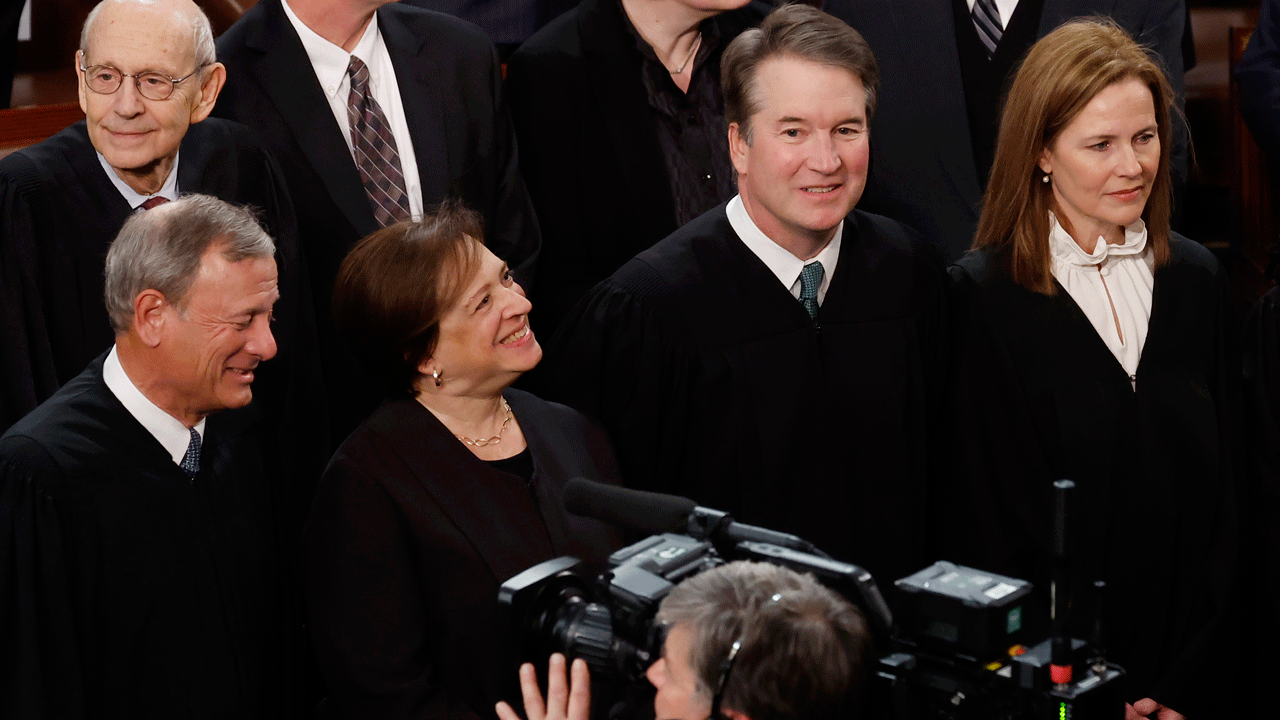
While two Supreme Court justices are scheduled to field questions from a House panel Tuesday about the court’s budget, it’s plausible, if not likely, that members will use the opportunity to press the justices about some highly contentious cases.
Freedom Is Back
In Style
Premium domains for sale
Justices Amy Coney Barrett and Elena Kagan will appear before members of the House Appropriations Subcommittee on Financial Services and General Government. Some of the subcommittee members have been outspoken about recent high court rulings.
The subcommittee’s ranking member, Rep. Steny Hoyer, D-Md., expressed outrage over the June 29 ruling reversing the 90-year-old precedent in Humphrey’s Executor v. United States, allowing a president to remove members of executive branch boards and commissions. The recent case of Trump v. Slaughter involved a member of the Federal Trade Commission.
Hoyer said the high court was “captured by the twisted ideology of unitary executive power” after the majority overturned the Humphrey’s precedent.
“We are about to celebrate 250 years of an America whose Founders were more concerned about the tyrannical over-concentration of power in the hands of one leader than anything else. This Court’s decision in Trump v. Slaughter rejects stare decisis and takes us back to a spoils system,” Hoyer said in a public statement.
Barrett, nominated by President Donald Trump in 2020, is considered part of the court’s conservative wing. Kagan, nominated by President Barack Obama in 2010, is considered part of the court’s liberal wing.
It’s fairly rare for justices to appear before a congressional panel; Kagan and Justice Samuel Alito were the last justices to appear before Congress, in 2019. However, the practice was somewhat common up to the mid-20th century, Georgetown University law professor Stephen I. Vladeck wrote.
Regarding an April ruling on a Louisiana redistricting case, Hoyer said the majority undermined the 1965 Voting Rights Act in striking down the state’s congressional map.
“By allowing Louisiana to redraw its congressional map in a way that dilutes the voting power of minority communities, the six Republican-appointed justices are participating in a brazen ploy to help Republicans keep their House Majority; it is an affront to everything for which John and so many others in the Selma march bled,” Hoyer said in a press release.
However, Hoyer praised the high court for striking down President Donald Trump’s executive order limiting birthright citizenship.
“Once again, the highest court in our land affirmed that the president has misread the clear meaning and intent of part of the Constitution,” Hoyer said of the June 30 ruling. “It ruled that those who are born in this country have the right, by virtue of that birth, to call it home as a citizen.”
Hoyer and other Democrats have criticized the Supreme Court for the 2022 decision in Dobbs v. Jackson overturning the 1973 Supreme Court case of Roe v. Wade, which nationalized a right to abortion.
After a draft of the opinion was leaked in May 2022, Rep. Mark Pocan, D-Wis., also a committee member, said in a statement, “Safe abortions will always be accessible to the wealthy. This ruling would take away bodily autonomy from so many, particularly affecting minority and low-income communities.”
Subcommittee Chairman Rep. David Joyce, R-Ohio, after the Dobbs ruling was released, said: “The Constitution does not confer the right to abortion. It does, however, provide states with the power to regulate the practice as they see fit. Today’s Supreme Court decision is a long overdue victory for states’ rights and the sanctity of life.”
In 2023, another subcommittee member, Rep. Glenn Ivey, D-Md., called the high court’s ruling that universities and colleges could not make solely race-based admission decisions “catastrophic.”
“And yet, the Supreme Court today turned a blind eye to this history, striking down the consideration of race in college admissions as if generations of slavery, segregation, and Jim Crow did not exist or efforts to ameliorate these entrenched disadvantages in higher education no longer serve the cause of justice. That is a tragedy,” Ivey said at the time.
In 2019, Kagan and Justice Samuel Alito testified before the same House committee. In 2011, Justices Anthony Kennedy, a Ronald Reagan appointee, and Stephen Breyer, a Bill Clinton appointee, testified before the House Appropriations Committee.
More from this network:
Domains for Sale · GOTPeople.org · TheDSAPlatform · The Truth About Socialism
What's Your Reaction?
 Like
0
Like
0
 Dislike
0
Dislike
0
 Love
0
Love
0
 Funny
0
Funny
0
 Wow
0
Wow
0
 Sad
0
Sad
0
 Angry
0
Angry
0

I am just an average American. My teen years were in the late 70s and I participated in all that that decade offered. Started working young, too young. Then I joined the Army before I graduated High School. I spent 25 years in, mostly in Infantry units. Since then I've worked in information technology positions all at small family owned companies. At this rate I'll never be a tech millionaire. When I was young I rode horses as much as I could. I do believe I should have been a cowboy. I'm getting in the saddle again by taking riding lessons and see where it goes.
Premium domains for sale




















Comments (0)