

How I Escaped The Postliterate Trap
Premium domains for sale
Freedom Is Back In Style
My preteen daughter came home from day camp the other day complaining about some of the girls in her bunk. She used an interesting phrase I had never heard before, calling them “phone kids.” They were children who, even without their phones in hand, seemed wired differently.
Freedom Is Back
In Style
Premium domains for sale
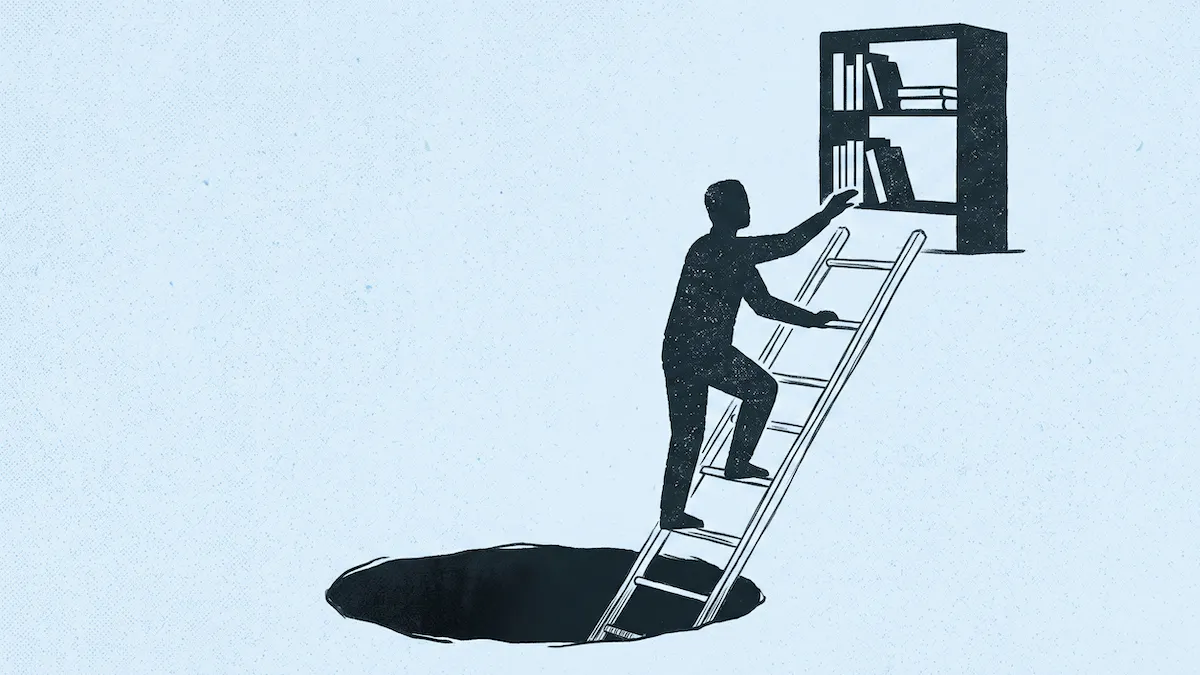
It was a fascinating and surprisingly astute observation, and one I was reminded of while reading a chilling cover story in the August issue of The Atlantic. In “The End of Reading Is Here,” staff writer Rose Horowitch chronicles not just how reading for pleasure and schoolwork has fallen off a cliff since the advent of smartphones and social media, but how those changes are rewiring our brains.
Horowitch writes, “Americans are probably reading more words than ever before. What has changed is what they read, and how. People are bombarded with emails, text messages, X posts, Reddit threads, Instagram captions. This explosion of textual fragments has come at the expense of devoting sustained attention to longer written works that convey rich and complicated information. Maryanne Wolf, a cognitive neuroscientist at UCLA, argues that people are losing the ability to think deeply about writing. That doesn’t mean they are forgetting how to decode individual words. Rather, they are losing the higher-order abilities of comprehension and synthesis. America, in other words, isn’t illiterate. It’s postliterate.”
It was that idea of rewiring that made me think back to my daughter’s remark about “phone kids” and wonder whether they really are different.
Over the course of nine years, I gave birth to six babies. What people say about “pregnancy brain” and “baby brain” is real, and for the better part of a decade, it felt as though my own brain had turned to mush. When my book with The Daily Wire came out, I was two months postpartum, with a toddler and a sleepwalking preschooler at home. During one interview, I went spectacularly viral when my brain simply stopped working. Asked a basic question about the central premise of the very book I had written, I completely blanked.
Over the past year, as my youngest turned two, I decided it was finally time to pull myself out of that dreamlike fog and force myself to become a reader again. I recognized in myself many of the habits Horowitch described and didn’t want to become a phone zombie. As a homeschooling mother, I realized — to my embarrassment — that my children were better read than I had been for nearly a decade.
I made one obvious mistake at the outset. I tried to catch up with my preteens by diving straight into a difficult translation of Plutarch — a bit like deciding to run a marathon after spending 10 years on the couch.
No, what I needed was a couch-to-5K program, but for reading.
It turns out the experts agree. Horowitch writes, “Reading books is a workout for the attention span. The more you read, the easier it is to read, and the more you’re rewarded with new understanding. Eventually the process is more pleasurable than it is challenging. But as with physical exercise, the converse is true as well: The less you read, the more difficult it is to read, and the rockier the path to acquiring knowledge.”
The first place I turned was, somewhat counterintuitively, the internet. More specifically, my friend Brielle Persun, a lifestyle and bookish content creator. Following her introduced me to an entire ecosystem of readers reviewing and discussing books. Before long, I found several creators whose tastes aligned with mine. If they loved “East of Eden” and “One Hundred Years of Solitude” as much as I did, I figured I could trust their recommendations on everything else.
“One of my favorite things about BookTok and online reading communities is how they’ve made reading feel social again and, honestly, made reading cool again,” Persun told me. “The internet has introduced millions of people to books they may have never discovered otherwise, while creating spaces where readers can connect, discuss, and genuinely celebrate stories together. As a creator, I’ve watched books spark conversations, friendships, and even help people through difficult seasons of life. It’s a reminder that reading has always connected people, and the internet has simply made that connection more accessible and exciting than ever.”
Social media doesn’t just spread book recommendations; it helps sell books, too. Josh Centers, publisher of Chapter House, which produces beautifully designed editions of classic works for the next generation, told me, “Despite its many evils, social media has been an essential channel for spreading the word about our books. We have been blessed with many thousands of followers, but we ultimately want our accounts to be off-ramps. If someone sees one of our posts and closes the app to go read to their children, that post did its job.”
It’s no surprise, though, that the biggest breakthrough in rebuilding my reading habit came from disconnecting entirely.
On the Jewish Sabbath, known as Shabbat or Shabbos, my phone is off. As my children have grown older, those quiet hours have increasingly become time I can spend reading for myself instead of rereading Dr. Seuss and “Go, Dog. Go!” to my children for the hundredth time.
The inspiration for spending the Sabbath reading came from my friend David Bashevkin, who started an online community called “Shabbos Reads,” where people share on social media what they read over the Sabbath. The goal, Bashevkin told me, is to advertise “both the beauty of Shabbos and the beauty of reading, that I think go hand-in-hand. In the Internet world, we’re always trying to maximize efficiency. But what Shabbos and reading are trying to train our minds and hearts to do is to sit with long-form ideas, thoughts, and experiences and let them unfold in our lives.”
During the week, I set aside screen-free moments as well. When I’m putting my younger two sons to bed, I leave my phone out of their bedroom. When I’m sitting in their room for 20 minutes waiting for them to fall asleep (and policing their horseplay), I sit with my hardest reading: a daily Bible study and my frenemy, Plutarch. These short bursts of harder reading help with my stamina for the material that is more uphill than a mere novel.
Several months into this experiment, I’m happy to report that I’m well on my way to a 5K. Maybe I’m still riding a scooter toward the finish line, but after finding a more accessible translation of Plutarch, I may even be able to call myself a reader again.
***
Bethany Mandel (@bethanyshondark) is a homeschooling mother of six and a writer. She is the bestselling co-author, with Karol Markowicz, of “Stolen Youth: How Radicals Are Erasing Innocence and Indoctrinating a Generation.”
This article is part of Upstream, The Daily Wire’s new home for culture and lifestyle. Real human insight and human stories — from our featured writers to you.
More from this network:
Domains for Sale · GOTPeople.org · TheDSAPlatform · The Truth About Socialism
What's Your Reaction?
 Like
0
Like
0
 Dislike
0
Dislike
0
 Love
0
Love
0
 Funny
0
Funny
0
 Wow
0
Wow
0
 Sad
0
Sad
0
 Angry
0
Angry
0

I am just an average American. My teen years were in the late 70s and I participated in all that that decade offered. Started working young, too young. Then I joined the Army before I graduated High School. I spent 25 years in, mostly in Infantry units. Since then I've worked in information technology positions all at small family owned companies. At this rate I'll never be a tech millionaire. When I was young I rode horses as much as I could. I do believe I should have been a cowboy. I'm getting in the saddle again by taking riding lessons and see where it goes.
Premium domains for sale






















Comments (0)