

How The Kids Learned To Love Richard Nixon
Premium domains for sale
Freedom Is Back In Style
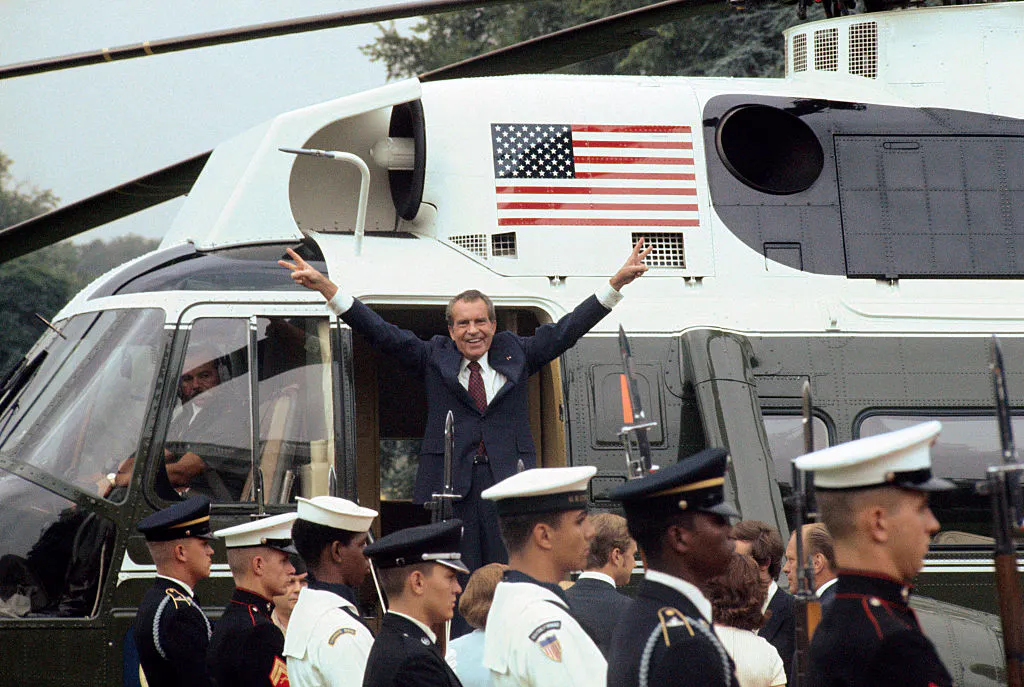
In 1972, Richard Nixon was re-elected with over 60% of the popular vote. Just a few years later, he left office as the most disgraced president in history.
Freedom Is Back
In Style
Premium domains for sale
His resignation cemented his legacy as one of scandal, and for half a century Nixon has been associated with Watergate: “I am not a crook.”
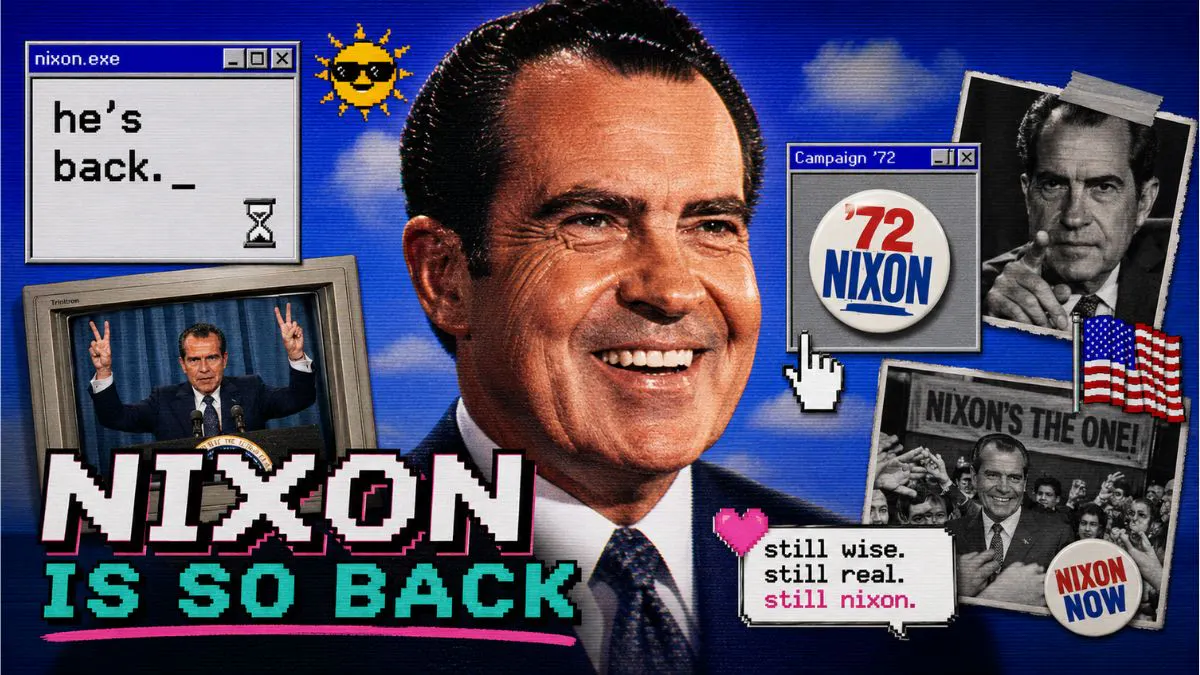
But something’s happening online that may once and for all disprove Fitzgerald’s dictum that there are no second acts in American lives. Across social media, Tricky Dick is blowing up — with memes, edits, and merchandise marketed at Gen Z. Thirty-two years after his death, America’s 37th president is popular again. And for the first time ever, he’s cool.
“It’s frightening and terrifying and sad,” Watergate prosecutor Jill Wine-Banks told Vanity Fair. “It’s part of the whole process of history being rewritten and obliterated.”
The Vanity Fair piece, titled “Richard Nixon’s Instagram Redemption Is Perfect for Our Post-Truth World,” is a pearl-clutching jeremiad straight out of Joe Scarborough’s Id. For 2,000 words, Wine-Banks and Watergate mastermind-turned-informant John Dean assert Nixon’s villainy while cautioning that the Nixon Foundation’s attempt at rehabilitation is some kind of conspiracy to make Donald Trump’s “lies” acceptable.
For those of us who only learned about Nixon as a historical figure — that is to say, at least half of the country — it’s not hard to imagine this conspiracy. After all, that’s what Nixon was about: Watergate, of course, but also the Oval Office recordings, Kissinger’s scheming diplomacy, and the Committee to Re-Elect the President, infamously abbreviated to CREEP. Surely some shadowy cabal of Republican elites were behind this social media blitz.
But the truth is simpler, and to the extent that there is a conspiracy, it’s among Nixon’s opponents. The guys behind the memes are just doing their job. They happen to be really good at it. And like the man whose legacy they steward, they’re now being attacked for their success.
James Byron was named president and CEO of the Nixon Foundation in 2021, at the ripe age of 28. A history major who briefly served as an advisor to the Archivist of the United States, Byron says this is his dream job. It’s clear when you talk to him that this is an understatement.
Byron is hardly alone. The Nixon foundation team is excited to tell the story about America’s most misunderstood president. Nowhere is this clearer than with Chris Barber, the Foundation’s 35-year-old marketing director and the man behind the memes.
Hearing Barber’s age is likely a shock to anyone who’s seen his videos, which are the most Gen Z things of all time. Smash cuts of Nixon speeches overlaid with TikTok rap and strobe light transitions dominate the Foundation’s Instagram page and are frequently shared on X. In the comments section, Zoomer argot abounds in praise of Dick.
Among you young men, there may be a Vice President Nixon! pic.twitter.com/7tqj0Lltmq
— Richard Nixon Foundation (@nixonfoundation) June 10, 2026
“Aura farming from the grave is crazy,” writes one commenter. “Someone is on one at the Nixon foundation and I’m thrilled,” adds another. “This shit is in my Spotify liked list holy moly.”
Thanks to Barber’s edits, the Nixon Foundation has racked up 250 million views across social media platforms since October 2023. Subscribers climbed from 65,000 to 450,000 in that same window. Today, over half of the Foundation’s Instagram audience is under 35.
But the Nixon renaissance is not merely an online phenomenon. Nixon Library attendance is up 30% year-over-year. This May the Foundation sold more merchandise than they’ve sold in 10 years. When the Foundation dropped a line of “Nixon–Maxxing” hats, they sold out in 90 minutes. So did the second order the Foundation scrambled to release. They sold 200 hats in total, completely clearing the shelves.
Nixonmaxxing hats sold out in a few hours.
Restock alerts here → https://t.co/dh622ATSqx pic.twitter.com/lp503q1lEr
— Richard Nixon Foundation (@nixonfoundation) February 14, 2026
It’s tempting to chalk this whole thing up to Gen Z being ironic. And of course, that’s part of it. But Vanity Fair isn’t dragging out John Dean to sound the alarm on a mere social media bit. Something else is happening here, something deeper — and it has people panicking.
Perhaps the best way to understand this is to migrate over to the Nixon Foundation’s YouTube channel, where memes give way to clips of Nixon’s speeches. Here the videos — which frequently amass more than 3 million views — are not cheeky or funny. They’re just Nixon: Nixon talking about Bill Clinton, Nixon being prescient on Russia and Ukraine, Nixon waxing philosophical about what constitutes a good life.
People may get pulled in by the edits, but Nixon himself is holding their attention. That’s not surprising. If one is interested in Congress, communism, and China, to say nothing of the presidency and the media, one is de facto interested in Nixon. He helped shape and was shaped by all of those institutions. It’s impossible to understand them, or our time, without understanding him.
The Honorable Richard M. Nixon pic.twitter.com/xjDbQPvqa1
— Richard Nixon Foundation (@nixonfoundation) May 20, 2026
For Nixon’s critics, this is the problem. Conventional wisdom and AP U.S. History textbooks hold that you’re allowed to say one good thing about Nixon: he opened China. Otherwise, it’s all stagflation, pancake makeup, and burglary. Americans cannot be allowed to appreciate Nixon the man in full because doing so would shatter the totalizing impulse that has dominated American politics since Woodward and Bernstein first went to press.
This point really cannot be overstated: the Nixon revival is a threat not because it gives cover to Trump to lie, cheat and steal, but because it could make Americans realize that the people they trust to render judgement on politicians are not always honest brokers.
And God forbid people start looking at Watergate with fresh eyes. They might learn that Bob Woodward never actually used the codeword “Deep Throat” for Mark Felt, and that his book agent made it up to sell more copies of “All The President’s Men.” They might learn that the reason Woodward and Carl Bernstein never revealed Felt’s identity was because he was a career FBI agent with an axe to grind against Nixon, who passed Felt over for the director job. They might learn that Felt was the mastermind behind COINTELPRO, a controversial FBI program to infiltrate and dismantle radical Left groups.
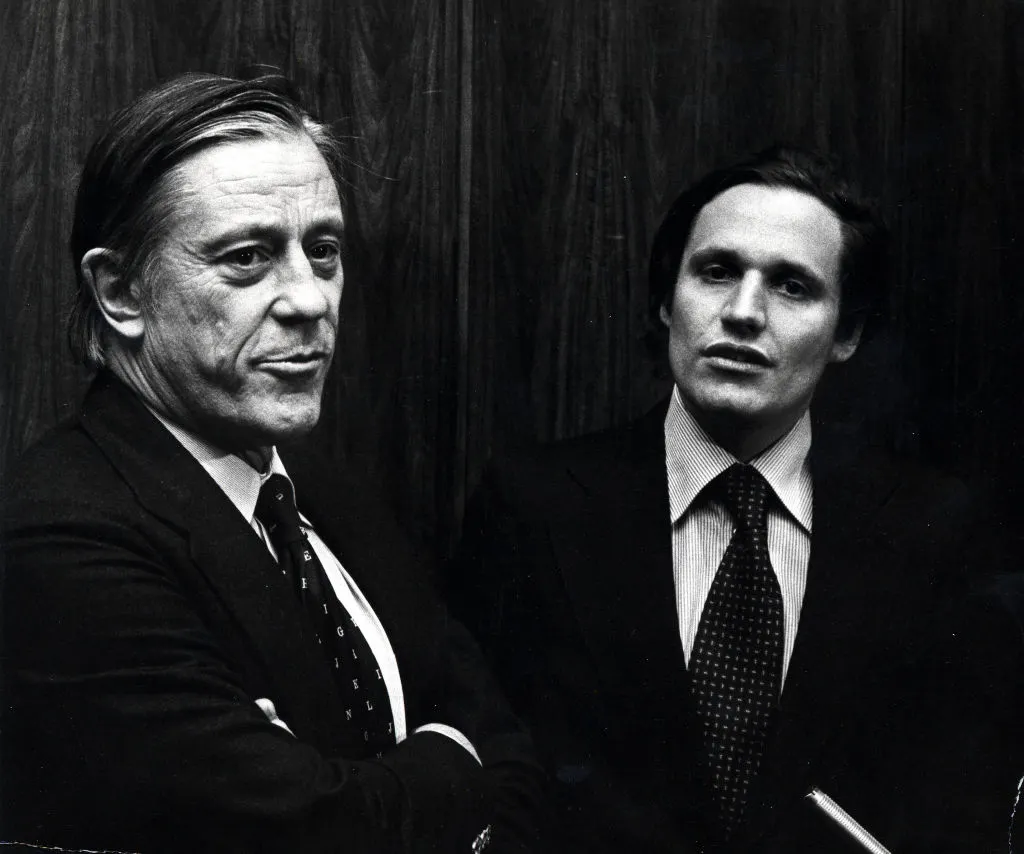
Ben Bradlee and Bob Woodward (Ron Galella/Ron Galella Collection via Getty Images)
They might also discover that Washington Post publisher Ben Bradlee had serious misgivings about Woodward and Bernstein’s reporting. In 2012, New York Magazine — no Nixonian rag, to be sure — published excerpts from Bradlee’s personal papers in which he said “There’s a residual fear in my soul that that isn’t quite straight.”
“Dealing with Woodward and Bernstein became — as they became more skilled in subterfuge, as they became more skilled in double meanings and triple meanings and quadruple, it became quite hard to deal with … Their great habit was to come around about 7:30 at night to say they had a helluva story … because they thought the guard would be down and they could slip it into the paper without the usual sort of grilling.”
The author of that piece, Jeff Himmelman — who discovered the papers while writing Bradlee’s authorized biography — confronted Woodward about the quote. To put it succinctly, Woodward freaked out. Later Himmelman found that the tape containing those comments, one in a series of 13, had disappeared. He asked Bradlee if he thought Woodward had taken it. “Maybe,” Bradlee laughed.
That piece is 14 years old and I can guarantee you most Americans have never read it. The fact is, the media industrial complex has — in an ironic twist, given the subject matter — worked to keep the full truth of Watergate under wraps. Because Watergate is the modern media’s foundational myth. Before Woodward and Bernstein, journalism largely consisted of reporting facts, and investigative journalism meant exposing real scandals in the public interest.
Watergate changed that. From that moment on, investigative journalism became inherently political, and politicians became trophies to hunt. Journalists’ political sympathies being what they are, this necessarily meant that Republicans were always in the crosshairs. To interrogate Watergate is to interrogate the very foundations of our media and the way we see politics. There’s a reason political scandals get the “-gate” suffix. For the status quo to hold, Watergate must be a triumph, and Bob Woodward must be a hero. Which means Nixon must be the villain.
Getty Images
For a while, it seemed that this would always be the case. But then, during the first Trump administration, Americans saw for the first time what the “deep state” really was. Not some imagined rightwing boogeyman but an actual, active network of entrenched bureaucrats willing to subvert a president to push their own political agendas.
The veil dropped. If this happened now, people realized, it could have happened then. Suddenly old doubts became new. The idea that Nixon was targeted by the bureaucracy, which political scientist John Marini first argued in 1992, was back on the table. The fact that Nixon only set up his wiretaps because he discovered American military commanders were wiretapping the White House — which historian James Hougan first revealed in his 1984 book “Secret Agenda” — was put into the light earlier this year when James Rosen exposed the long-buried grand jury hearing where Nixon explained the situation.
In 2025, Bill Murray appeared on the Joe Rogan Experience. Years earlier, Woodward published a book about Murray’s friend, the late comedian John Belushi. Remarking on the book’s myriad falsehoods, Murray told Rogan “I read like five pages … and I went, ‘Oh my God. They framed Nixon.'”
Murray’s joke gets at something real. Pull at one thread and the sweater unravels. Start noticing and it’s hard to stop. The Nixon renaissance is about reevaluating the narrative we’ve been fed about our history, our government, and our media, sure, but it’s also the result of a curious drive that springs up naturally when something that for so long has been off limits is suddenly placed on the table.
55 years ago, the Moratorium to End the War in Vietnam was observed across the United States. President Nixon’s response was firm: “Under no circumstances will I be affected whatsoever by it.” pic.twitter.com/6gcUBE729i
— Richard Nixon Foundation (@nixonfoundation) October 16, 2025
It’s especially clear why Gen Z would be excited about this prospect. They learned the standard “Nixon bad” narrative from teachers who themselves only knew this one-dimensional Nixon. But more generally, Gen Z has every reason to question the “truths” they’ve been fed. They came of age during COVID lockdowns and peak woke, and have now seen those movements and the people who pushed them collapse in disgrace. Their generation’s drive to question authority and push the bounds of acceptable thought has led them to embrace people like Hasan Piker and Nick Fuentes, figures whose ideas threaten the foundation of our democracy.
But this has also led them to praise the aura of a self-made California Quaker who dedicated his life to public service and remained in the arena even after the people and country he fought for rejected him time and again.
Richard Nixon always seemed like something from a bygone age, always just a few steps behind where America was trending. But perhaps, like so much else about Nixon, we got it wrong. Maybe Nixon wasn’t a relic come too late, but a visionary come too early. Maybe his time is now.
More from this network:
Domains for Sale · GOTPeople.org · TheDSAPlatform · The Truth About Socialism
What's Your Reaction?
 Like
0
Like
0
 Dislike
0
Dislike
0
 Love
0
Love
0
 Funny
0
Funny
0
 Wow
0
Wow
0
 Sad
0
Sad
0
 Angry
0
Angry
0

I am just an average American. My teen years were in the late 70s and I participated in all that that decade offered. Started working young, too young. Then I joined the Army before I graduated High School. I spent 25 years in, mostly in Infantry units. Since then I've worked in information technology positions all at small family owned companies. At this rate I'll never be a tech millionaire. When I was young I rode horses as much as I could. I do believe I should have been a cowboy. I'm getting in the saddle again by taking riding lessons and see where it goes.
Premium domains for sale








Comments (0)