

I Was There For The Freedom Convoy — And The Crackdown That Followed
Premium domains for sale
Freedom Is Back In Style
The following excerpt is taken from the new book “End of the Road: Inside the War on Truckers,” by Gord Magill. (Creed & Culture Books, 2026)
Freedom Is Back
In Style
Premium domains for sale
* * *
On Saturday, January 29, 2022, thousands of trucks and other vehicles from across the country entered the city of Ottawa. I was there to welcome the Western Canada convoy with a group of friends on an overpass above Highway 417, about half an hour west of the city. The truckers were animated by righteous frustration, yet I saw thousands of people full of love for one another, smiles, outbursts of hugs, and national flags attached to hockey sticks. There was even a sense of relief: it was as if a nation exhaled and exulted, “Finally, the cavalry is here to save us from our captors.” There are no words to adequately describe the feeling of everyone I interacted with on that overpass and also later when we went into Ottawa to join the party on Wellington Street.
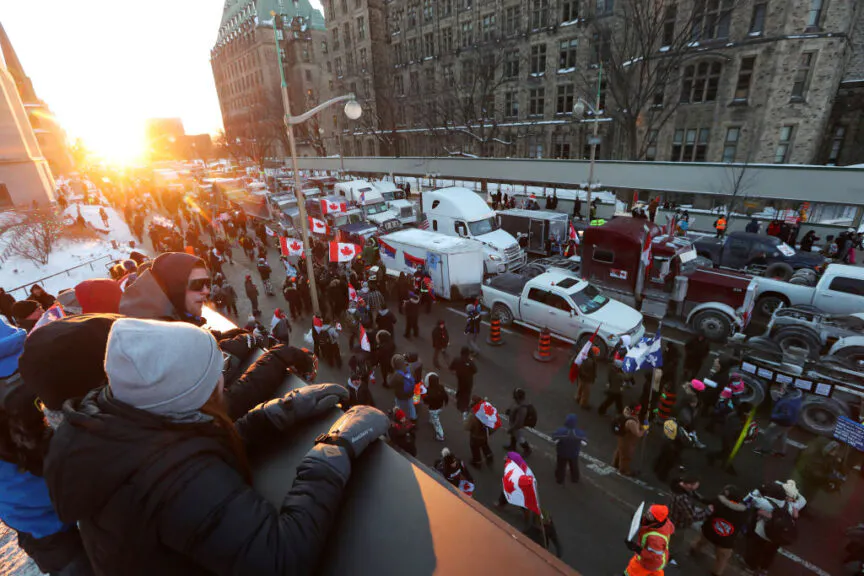
David Kawai/Bloomberg via Getty Images
People outside Canada could tell that the cause of the Freedom Convoy was just. When I went back to America after that weekend in Ottawa, as the Convoy settled in for what would be a three-week-long winter encampment, I was amazed to find my American neighbors cheering us on in solidarity. I delivered propane and hauled logs in the weeks after I came home, and I had never seen so many Canadian flags flying in the United States. It was unbelievable.
People I met while working or otherwise traveling, upon finding out that I was a native Canadian and a trucker, would exclaim, “Good for you guys; someone had to stand up to this nonsense,” or “Man, I thought Canadians were p*ssies, but those truckers have made me change my mind about you guys.” At the time, I had been living in America for six years, and almost no one had ever said anything about where I was from. For a hot minute, I was a minor celebrity simply for being from Canada.
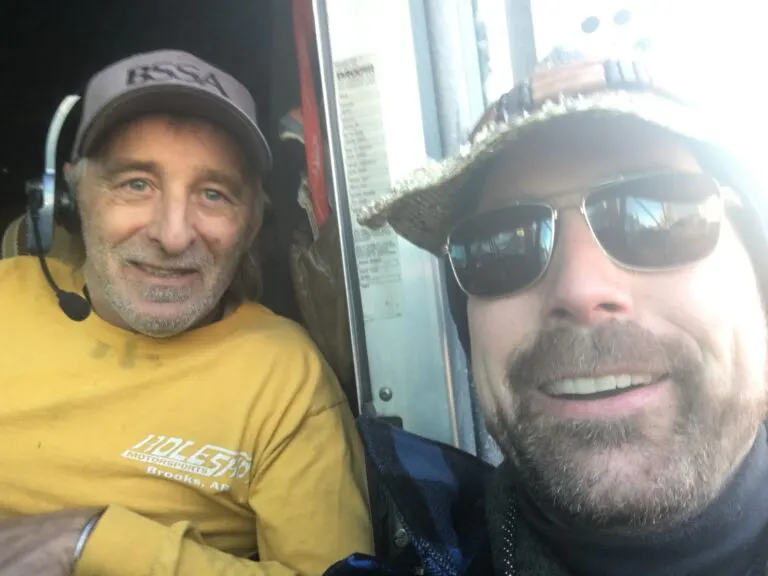
Gord Magill at Freedom Convoy.
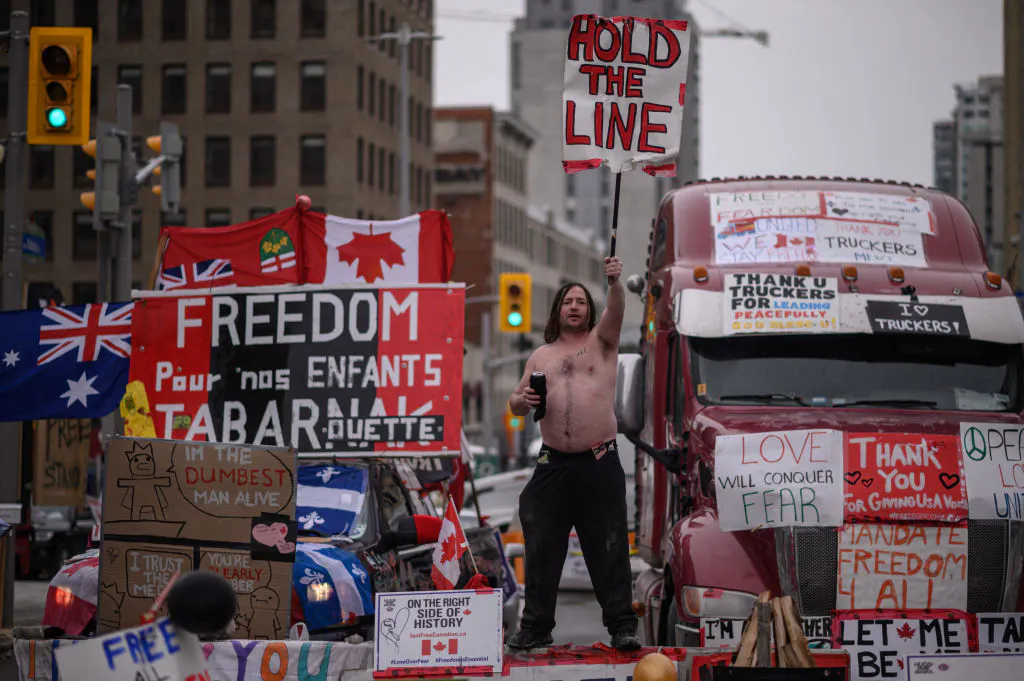
Up north, however, things were not looking good for my colleagues in the protracted standoff between the truckers and a government whose officials refused to speak with them. In total, thirteen Convoys had arrived in Ottawa, and numerous protests were held at other sites across the country, most famously at Coutts, Alberta, and on the Ambassador Bridge, which connects the Canadian city of Windsor with Detroit and is the busiest of all border crossings between Canada and the U.S. Although everything was more or less peaceful—despite the outright lies and fabrications of the Canadian media about the truckers’ behavior in Ottawa—the two border-protest sites gained the attention of very powerful people outside Canada whose interests were not at risk from the hockey games, bouncy castles, and techno parties taking place in the streets of Ottawa.
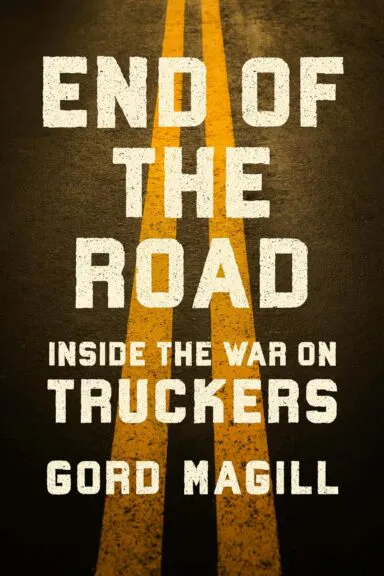
Cover credit: Creed & Culture
In Coutts, Tony Olienick had found an atmosphere similar to that which presided in Ottawa. People were peacefully assembling and saying no to the mandates that were ruining their lives. He met and spoke with Americans who had come to the Sweetgrass, Montana, side of the border and to bask in solidarity and common cause with the protesting truckers. Tony also volunteered as a sort of security detail for the protest site. It should be noted that although the government and media were claiming that the protesters had shut down the border, the crossing itself remained open for all but three days during the three weeks of the Coutts protest. Other, nearby border crossings remained open the whole time and were available for trucks to use, although with more limited hours than the normal 24/7 customs services available at Coutts.
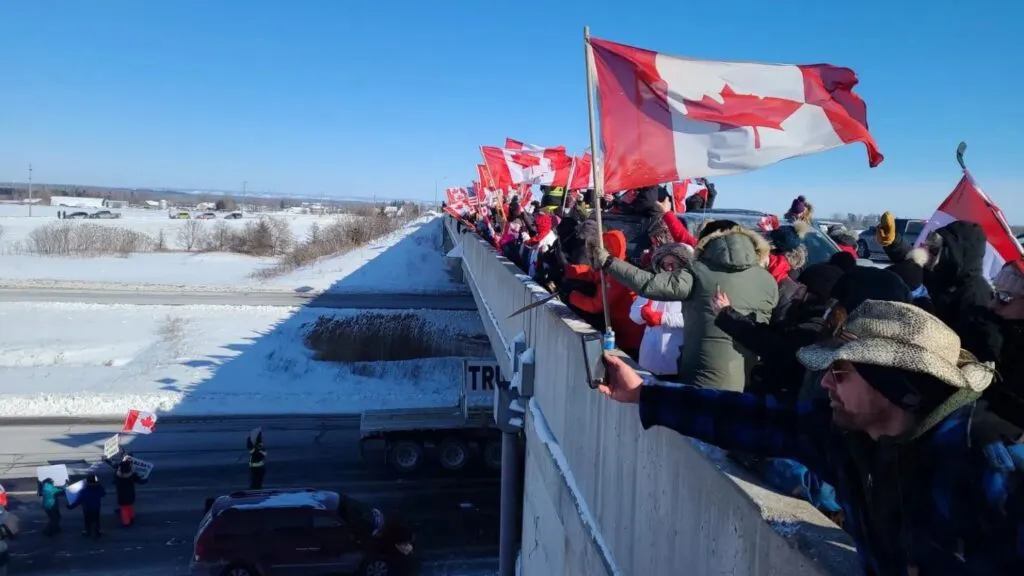
Gord Magill personal archive
The perception that Coutts was closed, along with the growing protest at the Ambassador Bridge in Ontario, which forced most truck traffic to cross at the Bluewater Bridge between Sarnia and Port Huron, was useful for those who were antagonistic to the aims of the Convoy. Wild and unsubstantiated claims about the cost to the economy were thrown around, mostly based on guesstimates made by business associations. Were there delays at those other crossings from diverted traffic? Obviously, and they were sometimes substantial. Did the protests cause delays in shipments and disruptions to the fragile nature of just-in-time delivery schedules for automakers? Of course. Yet not one of those who complained about the supposed costs of the Convoy ever compared these guesstimated costs to the costs to the entire world from the madness of the COVID regime, which lasted the better part of three years, not three weeks, and was solely the responsibility of government, not of citizens who wanted their lives back.
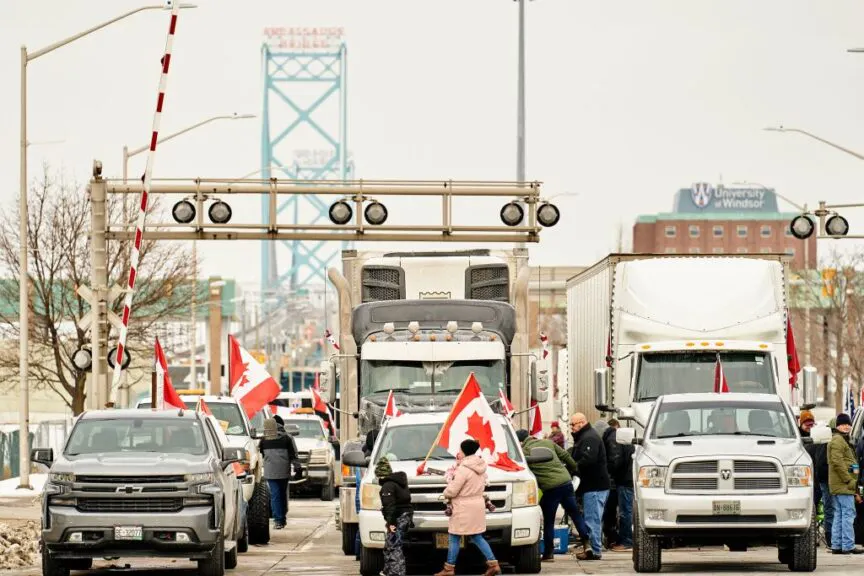
GEOFF ROBINS/AFP via Getty Images
The whining of the automotive industry, one of the most powerful corporate interest groups in America, got the attention of the Biden Administration. Brian Deese, director of the National Economic Council, got the ear of Trudeau’s Deputy Prime Minister and Finance Minister Chrystia Freeland, who set up a call between Trudeau and Biden on February 11, 2022. It is believed that this phone call set the wheels in motion for the ultimate crackdown on the Convoy.
Biden’s White House put out a statement about the call with Trudeau, and it is worth a read:
Today President Biden spoke with Prime Minister Justin Trudeau of Canada to discuss the ongoing blockade of key bridges and crossings between the United States and Canada, including Detroit/Windsor, Sweetwater/Coutts, and Pembina/Emerson. The two leaders agreed that the actions of the individuals who are obstructing travel and commerce between our two countries are having significant direct impacts on citizens’ lives and livelihoods. The President expressed his concern that U.S. companies and workers are experiencing serious effects, including slowdowns in production, shortened work hours, and plant closures. The Prime Minister promised quick action in enforcing the law, and the President thanked him for the steps he and other Canadian authorities are taking to restore the open passage of bridges to the United States. (Bold mine)
Significant direct impacts on citizens’ lives and livelihoods. Oh, like the long nightmare of the COVID regime?
The Coutts border crossing was only ever fully closed for three days, and two other border crossings were available to use. There are no automotive plants in that part of the prairie on either side of the border, and the only road closure that took place anywhere near Coutts was of Alberta Provincial Highway 4 at Milk River, a few miles north of Coutts; it was closed by the RCMP, not the protesters. In any case, the protest at Coutts was about to become the centerpiece of Trudeau’s rationale for the invocation of the Emergencies Act, whose outrageous violations of basic liberties included throwing an innocent trucker in jail, where he remains three-and-a-half years later at the time of this writing.
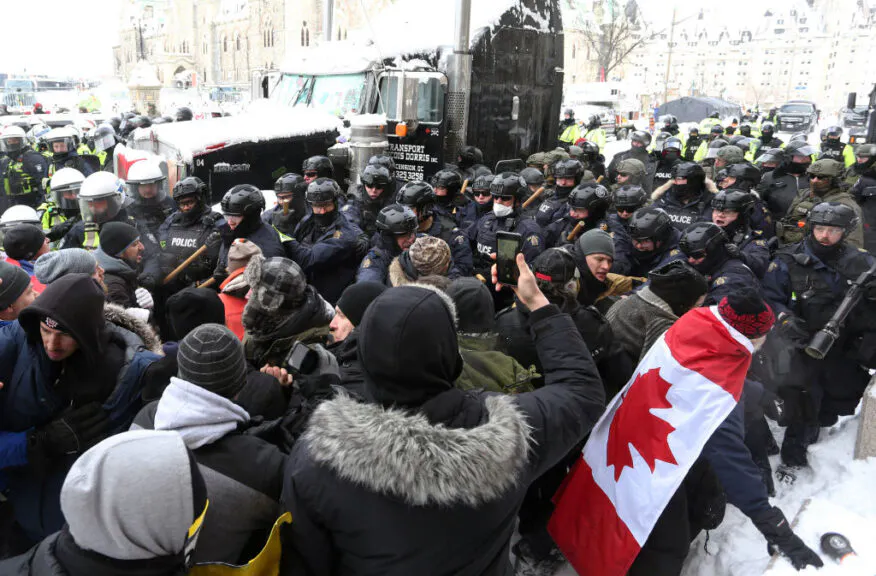
DAVE CHAN/AFP via Getty Images
By this time, the Freedom Convoy protest sites were crawling with undercover officers, or UCOs, who poked around looking for any hint of illegal activity or actionable intelligence that could be used against the protesters. Meanwhile, the federal government was waging a media smear campaign later found to have been planned by the staff of Public Safety Minister Marco Mendicino. This campaign failed to dent the widespread support the Convoy had in Canada and around the world: almost everyone except the most hopelessly naïve saw right through a staged Nazi flag photo and the usual tiresome accusations of white nationalism and racism. Anyone who went to a Freedom Convoy site to avail themselves of reality unmediated by state propaganda was surrounded by solidarity, happiness, and a genuine outpouring of love. Trudeau was losing the PR battle. He needed scapegoats. He searched for a pretext for invoking the Emergencies Act, something he had been considering since the early days of the protest but couldn’t pull off because those damn truckers were so well behaved. Allegations from UCOs at Coutts would give Trudeau everything he needed.
* * *
Originally hailing from Hamilton, Ontario, Gord Magill has spent most of his life behind the wheel. From spinning along the ice roads of Canada’s Northwest Territories, to hauling logs down volcanos in New Zealand, to steering Road Trains across the outback of Western Australia, to running freight along the interstates of America, Gord has spent over twenty-five years trucking all over the world. His writing about the industry has appeared in Newsweek, the American Conservative, and American Affairs, among other outlets. Magill lives in Ithaca, New York.
The excerpt from “End of the Road: Inside the War on Truckers” by Gord Magill is published by permission of Creed & Culture Books. Copyright 2026 Gord Magill. Chapter 13: The Truckers Strike Back.
More from this network:
Domains for Sale · GOTPeople.org · TheDSAPlatform · The Truth About Socialism
What's Your Reaction?
 Like
0
Like
0
 Dislike
0
Dislike
0
 Love
0
Love
0
 Funny
0
Funny
0
 Wow
0
Wow
0
 Sad
0
Sad
0
 Angry
0
Angry
0

I am just an average American. My teen years were in the late 70s and I participated in all that that decade offered. Started working young, too young. Then I joined the Army before I graduated High School. I spent 25 years in, mostly in Infantry units. Since then I've worked in information technology positions all at small family owned companies. At this rate I'll never be a tech millionaire. When I was young I rode horses as much as I could. I do believe I should have been a cowboy. I'm getting in the saddle again by taking riding lessons and see where it goes.
Premium domains for sale


Comments (0)