

Is It New Boss Same As The Old Boss For Britain’s Andy Burnham?
Premium domains for sale
Freedom Is Back In Style
Until its recent by-election, few in Britain (let alone the rest of the world) had heard of Makerfield.
Freedom Is Back
In Style
Premium domains for sale
Sandwiched between Manchester’s northwestern border and the town of Wigan, the history of the Makerfield constituency is typical of that part of the world. Home to the satellite towns that helped power the Manchester “cottonopolis” during the nineteenth century, when the city was renowned for its textile industry, the area was once relatively affluent.
The years since have not been so kind. While Makerfield has a relatively high home ownership rate, much of the constituency exhibits the hallmarks of British post-industrial decline – economic inactivity is high, with 10% of the population claiming Personal Independence Payments, a form of disability welfare.
As if life wasn’t hard enough for residents, they now have another issue to contend with: Andy Burnham.
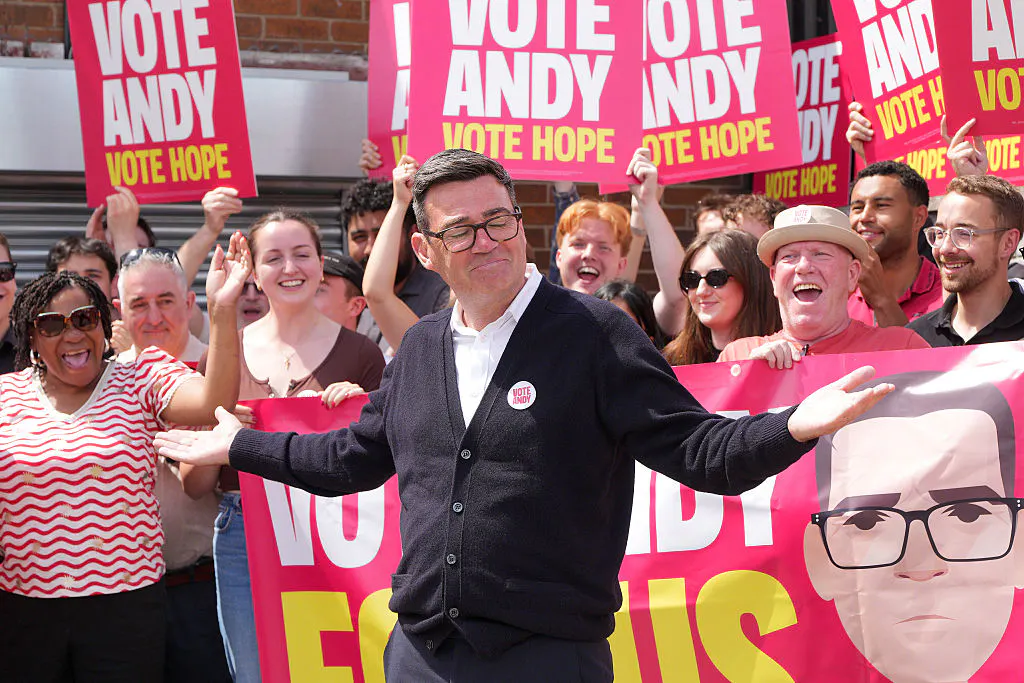
In the most consequential by-election of this century, Burnham — representing the Labour Party — won the constituency with 54.8% of the vote. The reason this was no ordinary local election is that Burnham has used this victory as a springboard to challenge the faltering Prime Minister Keir Starmer for leadership of the Labour Party, and thus the country.
Keen followers of politics in the U.S.A. may have noticed that Starmer isn’t doing so well. After failing to deliver on almost all of his electoral promises over the last couple of years, Starmer has, for some time now, been in multiple Mexican standoffs as he has attempted to fend off leadership challengers in his own party.
As President Donald Trump has announced on social media, Britain’s adenoidal prime minister knows the game is up, and it is widely expected that he will resign as soon as Monday, paving the way for Burnham to re-enter parliament (he had been Mayor of Manchester since 2017) and trigger a leadership vote that he is the favorite to win.
In his victory speech at Makerfield, Burnham acknowledged that “everyone knows that politics isn’t working.” The question is, is he really the man to change that?
Burnham has been the favorite for a while to succeed Starmer as prime minister. Despite his net favorability ratings taking a hit in recent weeks, according to research from Public First, he is still the Labour Party’s greatest hope for taking on Nigel Farage and Reform U.K. — who could well win the next general election.
On the surface, part of Burnham’s appeal is that he does a decent job at the “normal guy” routine (that is, when he’s not shouting at journalists on the campaign trail). For a U.S. audience unfamiliar with the Greater Manchester area, it is apparently political suicide not to constantly pay homage to the region’s cultural heritage. This largely involves making regular references to football (soccer), the band Oasis, and beige fast food — in Burnham’s case, chips and gravy.
He achieves this with flying colors, but it takes more than regional sycophancy to run a country. Here, Burnham has his work cut out for him.
Not only has Starmer done little to address the deep cultural divisions in Britain brought about by decades of short-sighted mass migration, but he has also failed to fix our economic woes.
In the build-up to the general election in 2024, which Starmer won with a historic landslide, he and Rachel Reeves (now Chancellor of the Exchequer and also on the chopping block) promised that their Labour Party would differ from previous iterations. They would boost economic growth by ushering in a housebuilding revolution through radical supply-side reforms; they would give businesses the room they needed to innovate; and make tough, necessary reforms to the welfare state to get Britain back on a stable fiscal footing. With housebuilding stagnant, businesses straddled with yet more red tape and higher taxes, and his already minor welfare reforms diluted beyond all recognition, he has failed on every metric.
There is little evidence that Burnham will prove much better.
First, his economic literacy is highly questionable. Among the British Right, Burnham is most notorious for having said Britain is too much “in hock” to the bond markets, implying that we should be able to borrow as much as we like without any consequences. Our national debt is approximately £2.9tn — approaching 100% of GDP — and bond traders are understandably nervous that Burnham is going to be fiscally reckless. Though Burnham has recently softened his approach to the bond market, some of those whom he is rumored to have taken on as economic advisors have called for wholesale reform of Britain’s fiscal rules.
It would be one thing if Burnham were considering changing these rules to facilitate pro-growth, free-market reforms, but he isn’t. Burnham will take into government the approach he adopted as mayor of Manchester, what he calls “business-friendly socialism.” Manchester — where skyscrapers now stand where mills once lined the streets — is used as evidence of his success. Yet the extent to which Manchester’s regeneration can be attributed to Burnham is widely questioned, and Manchester City Council is heading towards being the most indebted in the country, with liabilities of around £1.6bn.
The grim likelihood is that Burnham will join what is becoming a very long line of failed recent prime ministers. It may shock American audiences to learn that the last prime minister to serve a full term was David Cameron, and he left office over a decade ago. On our current trajectory, the metrics point to things getting worse in Britain before they get better, and Burnham shows no sign of wanting to reform the economy and state in a way that would make us more prosperous.
If international onlookers are genuinely invested in the future of Britain, then they shouldn’t look to Burnham for a sign of what the future may hold, but to the debates currently raging at the other end of the political spectrum.
***
Joseph Dinnage is Senior Press Officer at the Prosperity Institute.
More from this network:
Domains for Sale · GOTPeople.org · TheDSAPlatform · The Truth About Socialism
What's Your Reaction?
 Like
0
Like
0
 Dislike
0
Dislike
0
 Love
0
Love
0
 Funny
0
Funny
0
 Wow
0
Wow
0
 Sad
0
Sad
0
 Angry
0
Angry
0

I am just an average American. My teen years were in the late 70s and I participated in all that that decade offered. Started working young, too young. Then I joined the Army before I graduated High School. I spent 25 years in, mostly in Infantry units. Since then I've worked in information technology positions all at small family owned companies. At this rate I'll never be a tech millionaire. When I was young I rode horses as much as I could. I do believe I should have been a cowboy. I'm getting in the saddle again by taking riding lessons and see where it goes.
Premium domains for sale



















Comments (0)