

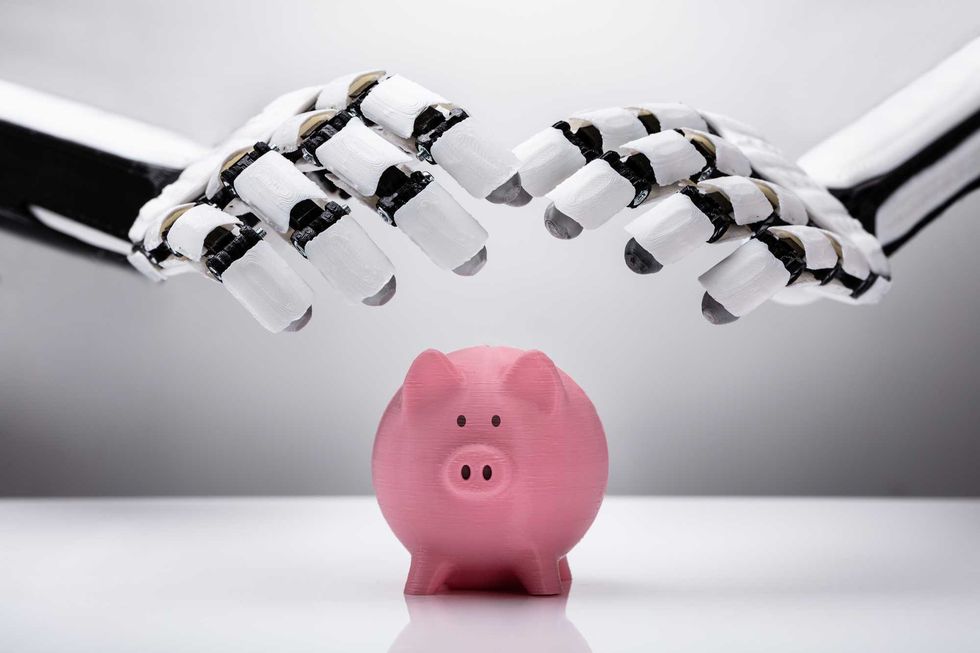
It only took weeks for AI usage to break the corporate piggy bank
Premium domains for sale
Freedom Is Back In Style
Last month, I wrote here that the AI bubble was about to pop and that when the subsidies ran out, the bill would land on the customer. The whole thing rested on one ugly fact: The companies selling AI were losing money on nearly every power user and pretending otherwise.
Freedom Is Back
In Style
Premium domains for sale
I figured we had a year or two before the cracks really showed. Maybe three. But the receipts started landing within weeks. What I got wrong wasn't the diagnosis, but who would blink first. I figured the pain would start at the bottom, with small shops priced out when their renewals came due. Instead, it started at the very top, with the richest companies on earth — including several of the same outfits building and selling the stuff.
The message was: Get on board or get left behind.
The implications are massive. Let's review.
Uber torched its entire AI budget in four months
Uber's CTO, Praveen Neppalli Naga, told the Information in April that the company had already burned through its full 2026 AI coding budget. Four months in. Gone.
The culprit was Anthropic's Claude Code. Uber rolled it out to its engineers in December 2025, and usage roughly doubled by February as adoption climbed from a third of the organization to better than four-fifths. By April, Naga was, in his words, back to the drawing board, because the budget he planned for the year had vanished in a third of it. Per-engineer costs were reportedly running anywhere from $500 to $2,000 a month.
On the "Rapid Response" podcast, Uber president Andrew Macdonald admitted he can't connect all that token spend to anything customers can actually see. Asked whether the AI was producing more useful features, he said flatly, "That link is not there yet" and that the spending gets harder to justify when AI isn't free.
Uber dropped roughly $3.4 billion on R&D in 2025, with AI a big chunk of that. Now the company has slapped a cap on it. Employees get $1,500 worth of tokens per coding tool each month, and the company is still trying to figure out what, exactly, it bought.
Microsoft revoked its own people's Claude Code licenses
Microsoft is canceling internal Claude Code licenses across its Experiences + Devices division, the group behind Windows, Teams, Outlook, and Surface. The cutoff is June 30, 2026, which happens to be the last day of Microsoft's fiscal year.
The pilot launched in December 2025. Engineers liked Claude Code so much that they started ditching Microsoft's own GitHub Copilot CLI for it. Six months later, the company is pulling the plug and herding everyone back to Copilot. Token billing turned what looked like a flat seat license into a runaway tab, and Microsoft's finance people reached the same conclusion Uber's did.
Remember, this is Microsoft. They put money into Anthropic. And they still couldn't justify keeping the lights on for their own engineers to use the tool.
Meta flipped from 'tokenmaxxing' to 'tokenminimizing'
"Tokenmaxxing" was Silicon Valley's newest bit of corporate slang, and it means exactly what it sounds like: Burn tokens to hit a target, climb a board, prove you're "innovative." Output optional.
For two years, Meta pushed staff to use AI for everything. Internal leaderboards tracked who burned the most tokens, handing out titles like "Token Legend." The message was: Get on board or get left behind.
Now the memo reads differently. In June, Meta told roughly 6,000 employees the company clamping down on AI costs by capping token usage and building an internal dashboard to track who's spending what. The Information called it "tokenminimizing," and the company admitted internal AI use alone is on track to cost billions this year.
Here's the context that makes it sting. Meta raised its 2026 capital expenditure forecast to between $125 billion and $145 billion, nearly all of it AI infrastructure. It also announced about 8,000 layoffs in April, roughly 10% of the company, with cuts beginning May 20.
RELATED: Shadowy companies are selling access to your smart TV — and its data
 JDawnInk/Getty Images
So: Meta is spending more on AI than ever, fired thousands of people to help pay for it, and now can't afford for the survivors to actually use the thing. Got it.
Amazon shut down its AI leaderboard
Amazon ran an internal leaderboard called KiroRank that scored employees on AI usage. The idea was to gamify adoption and reward the heaviest users.
It worked a little too well. Staff started "tokenmaxxing," assigning AI agents pointless busywork just to climb the board. Some reportedly used AI for tasks they could have knocked out faster by hand, burning compute to chase a number. First reported by the Financial Times, Amazon killed KiroRank at the end of May. Senior VP Dave Treadwell's message to the troops: "Please don't use AI just for the sake of using AI."
That’s the whole problem in one sentence. Amazon wanted adoption. What it got was theater. Employees gamed a metric that had nothing to do with whether any real work got done.
The tokenmaxxing hangover
The sticker shock is showing up everywhere. TechCrunch reported in early June that a Priceline employee watched a routine Cursor renewal come back four to five times more expensive. One financial operations director described companies blowing through their entire 2026 token budget by April and quietly panicking.
Fortune's Jeremy Kahn put a headstone on it in late May: "Tokenmaxxing is dead." Companies raced to burn tokens and reward people for it, then discovered that adoption metrics aren't business outcomes.
For two years, the answer to "should we use AI" was always yes, and the only argument was how fast. The question has quietly changed to "what did we get for it," and a lot of companies don't like the answer.
What this actually means
In May, I argued that AI companies were running loss-leading subscriptions, burning investor cash to buy the market, and hiding the real cost behind a subsidized price. You weren't paying for the product. You were getting a subsidized demo, with the price hike scheduled for after you got hooked.
What I didn't see coming was how fast the subsidizers would start cutting themselves off.
The companies with the deepest pockets are first in line to ration it, and several of them are the very ones building and selling it. They looked at the invoice and realized they can't afford their own product. Uber's CTO said the budget was blown away. Meta is building dashboards to meter its engineers. Microsoft, an Anthropic backer, is canceling licenses. Amazon found out its own people were manufacturing fake demand.
These aren't scrappy startups running out of runway. They're the richest companies on earth, with effectively bottomless access to capital, and they all hit the same wall at roughly the same time.
It's not just them, either. On June 14, the Economist ran a piece called "Companies are scrambling to curtail soaring AI costs," and the best line came from an executive at a big U.S. tech company who called the coming squeeze "an absolute nightmare." His point: A large company runs hundreds of software programs, and once each one ships its own AI agents, the bills stack up fast. Ramp, the corporate-card provider that can see its clients' actual spending, figures AI bills have jumped 13-fold in a year. Its heaviest 1% of users now average around $7,450 per person per month, against $11 for the typical customer. Even Sam Altman has called mounting customer costs a serious problem, which is a strange thing to hear from the man selling the tokens.
At current prices, AI costs more than it returns, and even the companies selling it can't make the internal math work.
The lesson
AI has real uses, and I lean on it every day. But economics don't care how you feel, and you can't meme your way around a compute bill that climbs every month a power user gets better at burning tokens. That's not hypothetical. It's the whole reason the firms selling AI are the first ones rationing it.
If you run a business and you have bet the whole thing on API calls to somebody else's model, look hard at that dependency. When the companies building these models can't afford to let their own staff use them freely, what do you think happens when your renewal lands?
There are alternatives, and they're getting absurdly cheap. The Economist notes that a mid-tier model like Anthropic's Sonnet can run about 1/20 of what its flagship Opus costs. Kimi, an open-weight model from the Chinese startup Moonshot AI, runs about 1/20 of that. Stack those up, and a lot of routine work runs at a rounding error next to frontier pricing. "Send the easy jobs somewhere cheaper" is a real strategy now, not a compromise. You don't have to stay locked into a vendor that is quietly rationing its own product.
The bubble isn't bursting with a headline. It's bursting with a memo. A budget revision. A canceled license. A quiet decision to ration the tool you were told would change everything.
And the people who sold you the revolution? They’re the same ones pulling the plug.
More from this network:
Domains for Sale · GOTPeople.org · TheDSAPlatform · The Truth About Socialism
What's Your Reaction?
 Like
0
Like
0
 Dislike
0
Dislike
0
 Love
0
Love
0
 Funny
0
Funny
0
 Wow
0
Wow
0
 Sad
0
Sad
0
 Angry
0
Angry
0

I am just an average American. My teen years were in the late 70s and I participated in all that that decade offered. Started working young, too young. Then I joined the Army before I graduated High School. I spent 25 years in, mostly in Infantry units. Since then I've worked in information technology positions all at small family owned companies. At this rate I'll never be a tech millionaire. When I was young I rode horses as much as I could. I do believe I should have been a cowboy. I'm getting in the saddle again by taking riding lessons and see where it goes.
Premium domains for sale
























Comments (0)