

It's not the next Jason Bourne flick. The Veldhoven choke point is way bigger than that.
Premium domains for sale
Freedom Is Back In Style
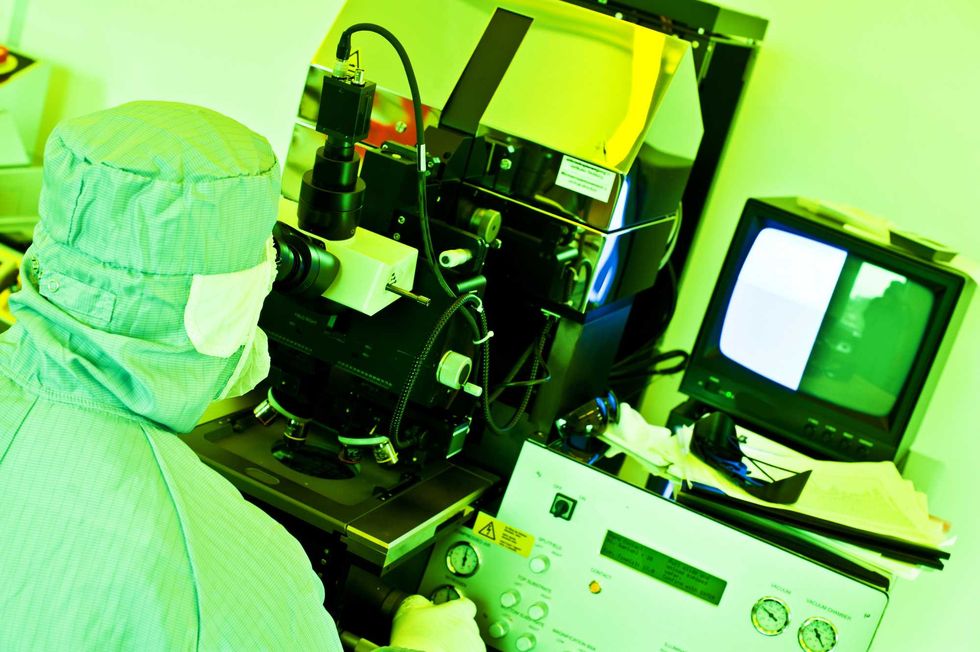
There is a building in Veldhoven, in the Southern Netherlands, where engineers fire droplets of molten tin through a vacuum chamber 50,000 per second. Each droplet is intercepted by a laser, vaporized into plasma, and impelled to emit light at a wavelength of 13.5 nanometers, less than a thousandth the width of a human hair. The plasma is briefly 40 times hotter than the surface of the sun.
Freedom Is Back
In Style
Premium domains for sale
The machine that does this work is called an EUV lithography scanner, made by a Dutch company named ASML, the only such manufacturer. Your smartphone only works because of it.
Welcome to the Veldhoven choke point.
The EUV lithography scanner is, by some measures, the most complex manufactured object on earth. In 2025, ASML recorded revenue of 32.7 billion euros, of which it spent €4.7 billion on R&D. The scanner itself weighs more than 150 metric tons. Shipping one requires roughly 250 crates, 40 freight containers, several cargo planes, and 20 trucks.
The ultimate printing press
Lithography is a printing process: a pattern on a mask is optically projected onto a silicon wafer coated with photoresist, and the exposed regions are chemically altered to form circuits. Smaller features require shorter wavelengths of light according to the Rayleigh criterion. For decades, the industry shortened wavelengths incrementally, moving from visible light through ultraviolet to deep ultraviolet at 193 nanometers, squeezing extra performance through immersion fluids and clever tricks of computational correction.
What looks like ubiquitous computation is, underneath, managed scarcity.
The next step, extreme ultraviolet at 13.5 nanometers, required a fundamentally different machine: vacuum chambers, because EUV is absorbed by air; reflective mirrors rather than glass lenses, because EUV is absorbed by glass; mirrors polished to picometer tolerances, because at that wavelength any surface irregularity is an error. Zeiss, in Germany, makes these mirrors. They are roughly a meter across. Each mirror has more than 100 alternating layers of molybdenum and silicon, each layer a few nanometers thick. The largest ones are the smoothest objects humans have ever made.
ASML did not arrive at this position through genius alone. The company began in 1984 as a joint venture between Philips and ASM International, in a shed behind the Philips campus, with a staff that was given little funding and told to figure things out. Its first commercial product failed. The company survived by licensing technology aggressively and co-developing with suppliers. When EUV became the industry’s necessary next step, ASML had already positioned itself at the center of the effort. It acquired Silicon Valley Group in 2001, inheriting proximity to the U.S. research base that had done foundational EUV work. It acquired Cymer in 2013, bringing the light-source development in-house. It launched a co-investment program in 2012 in which Intel, TSMC, and Samsung paid €1.38 billion for the right to help fund EUV’s development and own a piece of the company that would sell them the tools.
The first commercial electronics enabled by EUV appeared in 2019. The research had begun in the 1980s. Nikon and Canon, both serious competitors in earlier generations of lithography, fell behind because they lacked the network. They did not have the suppliers, the customer co-investment, the acquired capabilities, or the tolerance for 30 years of deferred returns. Dominance in hard technology can look like the patient assembly of dependencies.
Printing money
The scanner imposes a disciplined way of seeing matter at scales that have no analogy in ordinary experience. A human hair is approximately 70,000 nanometers wide. ASML’S next generation of scanner, the High-NA EUV, has a resolution of roughly 8 nanometers. This required a redesigned optical system called anamorphic optics, in which the image is scaled differently in horizontal and vertical directions.
It would be a mistake to think of ASML’s dominance as residing in the scanner. The actual dominance is in the installed base of machines already running in fabs in Taiwan, South Korea, and the United States; in the €8.2 billion in annual service revenue that grew 26% in 2025; in the field engineers who operate on a 24-hour global rotation, resolving roughly 95% of issues locally, constituting a permanent guild of expertise that no competitor can easily replicate.
RELATED: The Trump phone is here — and so is the controversy. Is it any good?
 BasSlabbers/Getty Images
The Dutch government has restricted exports of ASML’s advanced tools since 2023, with additional restrictions added in 2024 and 2025. The United States has pressed allies toward wider controls. China, which generated roughly a third of ASML’s 2025 sales, has been cut off from the most advanced systems and is expected to account for only about 20% of revenue in 2026. In May 2026, the Dutch government publicly objected to proposed U.S. legislation that would extend restrictions further. A private firm in Veldhoven has become a standing item in diplomatic correspondence between sovereign states.
ASML employs more than 44,000 people of 143 nationalities across more than 60 locations, and approximately 80% of its components come from a global supplier network. The machine that prints the world’s smallest features is assembled from a wide collaboration: German optics, German lasers, American light-source expertise, Belgian research infrastructure, Taiwanese and Korean and American customers. What looks like a Dutch company is a Dutch-coordinated actor network that has been stabilized, over decades, into something that behaves like a single artifact.
We speak of the digital world as if it were weightless, as if computation were a condition of the atmosphere rather than a product of factories in specific places run by specific people under specific export licenses. EUV lithography makes the concealment harder to maintain. The allegedly frictionless economy runs on tin plasma, picometer-smooth mirrors, and the continued willingness of the Dutch government to issue the right permits. What looks like ubiquitous computation is, underneath, managed scarcity: a single network managed from Veldhoven.
More from this network:
Domains for Sale · GOTPeople.org · TheDSAPlatform · The Truth About Socialism
What's Your Reaction?
 Like
0
Like
0
 Dislike
0
Dislike
0
 Love
0
Love
0
 Funny
0
Funny
0
 Wow
0
Wow
0
 Sad
0
Sad
0
 Angry
0
Angry
0

I am just an average American. My teen years were in the late 70s and I participated in all that that decade offered. Started working young, too young. Then I joined the Army before I graduated High School. I spent 25 years in, mostly in Infantry units. Since then I've worked in information technology positions all at small family owned companies. At this rate I'll never be a tech millionaire. When I was young I rode horses as much as I could. I do believe I should have been a cowboy. I'm getting in the saddle again by taking riding lessons and see where it goes.
Premium domains for sale




















Comments (0)