

One More Step Toward Ending WOTUS Overreach
Premium domains for sale
Freedom Is Back In Style
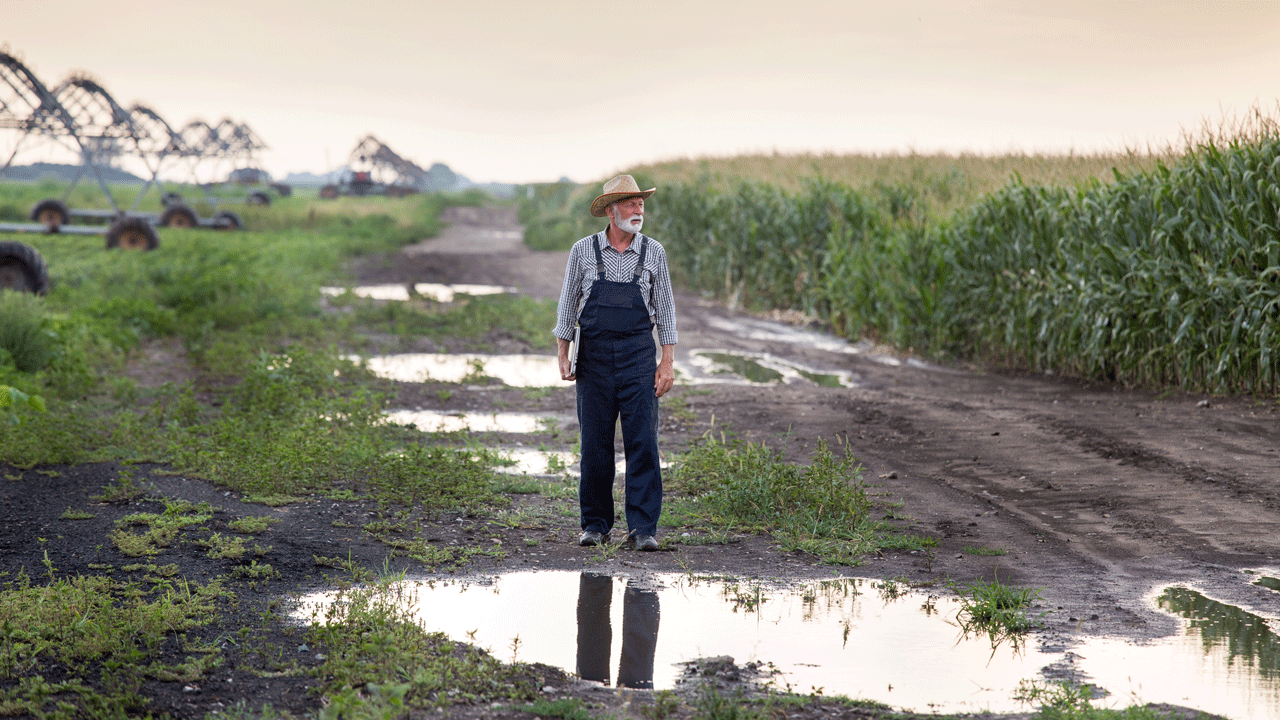
For decades, farmers, homebuilders, small businesses, and property owners have struggled to determine whether ordinary features on their land qualify as “waters of the United States,” or WOTUS, under the Clean Water Act.
Freedom Is Back
In Style
Premium domains for sale
If a feature falls within the federal definition, landowners need a federal permit before building, farming, or making other ordinary changes that could affect it. The result can be months of delay and tens of thousands of dollars in permitting, consulting, legal, and mitigation costs.
Now, the Environmental Protection Agency and Army Corps of Engineers have an opportunity to provide much-needed clarity to the “waters of the United States” definition in their supplemental proposal.
The Clean Water Act gives the federal government authority to regulate discharges into navigable waters, defined by the law as “waters of the United States.” But that phrase does not mean every pond, ditch, damp field, or parcel of land that holds water after heavy rain is subject to federal control.
In 2023, the Supreme Court made that limitation clear in Sackett v. EPA. The court ruled that federal jurisdiction covers “relatively permanent” bodies of water, such as rivers, lakes, and streams. Wetlands fall under federal authority when they have a continuous surface connection with those waters, making it difficult to tell where the water ends and the wetland begins.
The EPA and Army Corps of Engineers’ original 2025 proposal did not fully implement that standard. It would have allowed waters flowing “at least during the wet season” to qualify as relatively permanent.
But “wet season” is not a clear standard. Wet seasons differ by region, change from year to year, and offer little guidance about how long water must actually remain present. A landowner should not need to hire consultants merely to understand whether they can develop their own land.
The supplemental proposal released in September offers a better approach. It would replace the wet-season concept with standards focused on perennial waters and actual, continuous surface-water connections. “Perennial” would generally mean having standing or continuously flowing water throughout the year under ordinary conditions. The proposal also provides limited allowances for temporary interruptions, such as droughts or regularly occurring dry periods that occur for less than 30 days.
This is much closer to the Supreme Court’s ruling. A wet season describes the weather. It does not necessarily establish that a ditch, streambed, or other feature is a relatively permanent body of water. Likewise, seasonal dampness or physical proximity does not automatically make a wetland indistinguishable from a federally regulated river, lake, or stream.
Clearer boundaries make it easier for farmers and property owners to determine whether federal permitting requirements apply before investing substantial time and money in a project. They would give agency personnel a more objective standard to administer. They would also allow federal resources to be focused on waters that actually fall within the Clean Water Act rather than on litigation over jurisdiction.
A clearer federal boundary does not leave waters unprotected. The Clean Water Act still protects waters and wetlands that are not intermittent. Further, states and tribes remain free to protect wetlands, intermittent streams, ponds, and other resources outside the federal definition. They can tailor those protections to local hydrology, land use, and environmental conditions rather than relying on a single federal rule for every region of the country.
The supplemental proposal can still be improved. The final rule should include objective criteria for determining “ordinary conditions” and clearly explain how the 30-day limit will operate. Most importantly, the agencies should expressly reject the original wet-season approach.
Because the supplemental notice adds alternatives without withdrawing the 2025 proposal, the ambiguous wet-season language remains under consideration. Keeping both approaches would recreate the very uncertainty the supplemental proposal is supposed to resolve.
Protecting water quality and respecting property rights are not conflicting goals. Both are advanced when agencies follow the law, establish understandable jurisdictional boundaries, and direct federal resources toward waters Congress actually placed under federal authority.
The EPA and Army Corps of Engineers deserve credit for reconsidering the original proposal. They should now finish the job by adopting the supplemental definitions, rejecting the wet-season standard, and giving landowners the clarity the Clean Water Act has lacked for far too long.
More from this network:
Domains for Sale · GOTPeople.org · TheDSAPlatform · The Truth About Socialism
What's Your Reaction?
 Like
0
Like
0
 Dislike
0
Dislike
0
 Love
0
Love
0
 Funny
0
Funny
0
 Wow
0
Wow
0
 Sad
0
Sad
0
 Angry
0
Angry
0

I am just an average American. My teen years were in the late 70s and I participated in all that that decade offered. Started working young, too young. Then I joined the Army before I graduated High School. I spent 25 years in, mostly in Infantry units. Since then I've worked in information technology positions all at small family owned companies. At this rate I'll never be a tech millionaire. When I was young I rode horses as much as I could. I do believe I should have been a cowboy. I'm getting in the saddle again by taking riding lessons and see where it goes.
Premium domains for sale











Comments (0)