

Our favorite weight-loss apps for summer — no drugs needed

Premium domains for sale
Freedom Is Back In Style
Summer is here, and if you’re looking to shed some pounds before you slip into your swimsuit, we have something that can help. These apps are all designed to count calories, track your weight, and reclaim a healthier, fitter you. The best part? They actually work.
Freedom Is Back
In Style
Premium domains for sale
The great American epidemic
According to the Centers for Disease Control and Prevention, a staggering 72.4% of American adults over age 20 are either overweight or obese. Even worse, cases of “severe obesity” have tripled since the 1960s, signaling an extreme weight crisis for the country.
Growing obesity and degrading American health are the pinnacle of Secretary Robert F. Kennedy Jr.’s MAHA movement, which aims to end childhood chronic diseases by reforming America’s “food, health, and scientific systems.” As part of the initiative, the USDA and HHS reconfigured the food pyramid to prioritize protein, fruits, and healthy fats while minimizing carbs — a complete reversal of the original national food pyramid adopted in 1992. Kennedy has also pressured food processors to eliminate artificial dyes and use cleaner ingredients.
These apps are available for free, and they support paid subscriptions.
These are all good steps toward giving Americans access to better food, but when it comes to actually shedding the pounds, this can only be tackled on the personal level. Some people have tapped into sheer willpower to lose weight. Others turned to controversial miracle drugs, like GLP-1s, to drop the pounds. Then there are the tech nerds like me, who look to smartphones for relief.
The science behind weight-loss apps
I am not a specimen of perfect health. Far from it. Like nearly three-fourths of the nation, I fall into the CDC’s obese category, and like most people in this crowded bracket, my weight has yo-yoed up and down over the years. Throughout this journey, only one thing ever actually made that dreaded number on the scale go down — weight-loss apps.
The reason these apps work is simple: They take your raw data — like your age, height, current weight, and target weight — and use it to determine the ideal calorie limit for your goals. Then they combine this with calorie-counting and activity-tracking algorithms to compare the amount of calories you ingest against calories you burn for the day. If you take in more energy than you expel, you will gain weight, and if you lose more, you will lose weight (barring a medical condition that is physiologically keeping you overweight).
Simple math, right?
There are a couple of caveats to keep in mind.
- First, in order for these apps to work, you have to log everything you eat. Even a single missed snack will throw off your numbers for the day, leading to weight-loss stagnation or even unintended gains.
- Second, you will need to either pair the app with a supported fitness tracker or use the pedometer feature on your phone (if you do this, make sure you carry your phone at all times to capture your steps). Taking steps throughout the day adds to your calorie bank, so the more active you are, the more you’re allowed to eat. When you run out of calories for the day, you’re done.
My favorite weight-loss apps
There are plenty of weight-loss apps on the app stores, and only you can decide which ones work for you. If you’re not sure where to start, these are my top three favorites. Note that these apps are available for free, and they support paid subscriptions to unlock additional features.
MyFitnessPal
As the app that has helped me lose more weight than the others, MyFitnessPal includes a robust food library that makes it easy to find the exact foods you eat and log them into your diary under “breakfast,” “lunch,” “dinner,” and “snacks.” After all, it is impossible to log your calories correctly if you can’t find the exact thing you just ate. The paid version makes this even easier with an included barcode scanner for processed foods and a meal scanner that logs foods simply by taking a picture, but it’s not a necessity.
RELATED: This new app for new moms is a game-changer
 This new app for new moms is a game-changer ArtistGNDphotography/Getty Images
If you want to nerd out on your food data, MyFitnessPal lets you take a closer look at your calories for the day, providing insights into which meals were the most calorically dense, as well as nutrients and macro information that tells you all about the proteins, carbs, fats, fiber, and sugars on your plate. This is especially helpful for people on specific limited diets or for those who simply want to better understand their food choices.
Finally, MyFitnessPal offers free meal plans with complete recipes that show you how to make healthier food with no guesswork.
Download: Apple App Store, Google Play Store
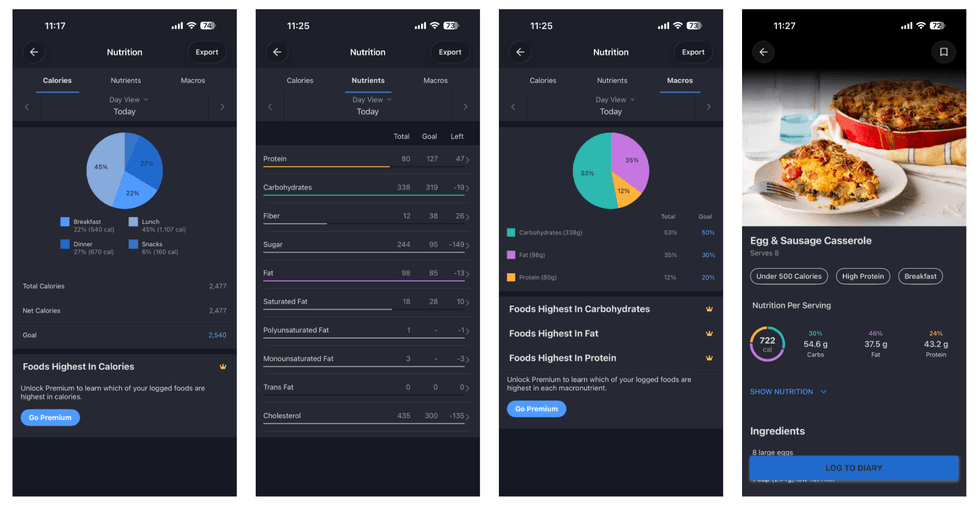 Screenshots by Zach Laidlaw/MyFitnessPal
Lose It
Where MyFitnessPal excels at raw data, Lose It wins points with its attractive design. Food metrics are all laid out in a neat interface that clearly highlights calorie intake, macronutrients, daily logging streaks, weight progress over time, and calorie bonuses from daily exercise. Lose It also offers a broad food library that makes it easy to find the foods you eat and log them properly.
Unfortunately, Lose It locks some of its more interesting features behind a paywall, including personalized nutrient information, granular nutrient goals, and health insights that tell you how you're progressing. Luckily, it makes up for this in its free Discover feed that provides health articles, a friends list to lose weight with friends and family, and community groups where users can chat with like-minded individuals on their weight-loss journeys.
Download: Apple App Store, Google Play Store
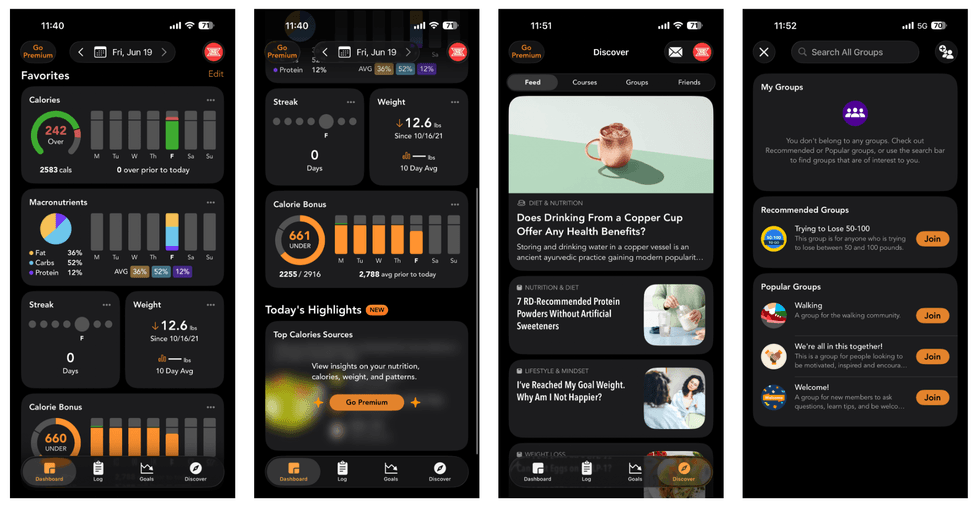 Screenshots by Zach Laidlaw/Lose It
Google Health
This one ranked third. I haven’t had a lot of time to test it yet, but the brand-new Google Health app has impressed me so far. When I first looked at Google Health, I was mostly focused on the exercise metrics that went along with the new Fitbit Air. However, its food tracking features were a surprising benefit. Unlike MyFitnessPal, Google Health lets you scan the barcode of processed foods for free, though in my testing, the food library isn’t as robust, so this feature may or may not be helpful for some. Of course, if you can’t find your food item by barcode, you can always type it in the search bar manually.
On the daily view, Google Health clearly lists your calories, all divided by breakfast, lunch, dinner, and snacks. You also get a quick view of your macros and nutrient information. Also unlike the other food tracking apps, Google Health offers a window of ideal calories to hit instead of a rigid cutoff, giving you some wiggle room from day to day. The way it is laid out, Google says that reaching the first number in the window consistently will help you lose up to two pounds per week, while hitting the higher number will only result in one pound per week.
Finally, if you spring for the premium subscription with AI Coach powered by Gemini, you can take photos of your food or tell the Coach to log them manually, and AI will mark them down. I found this feature to be especially useful for foods that weren’t available in the barcode scanner. Even though the food library didn’t have them, Coach can use a photo of the label to create a new item in your log with little hassle.
Download: Apple App Store, Google Play Store
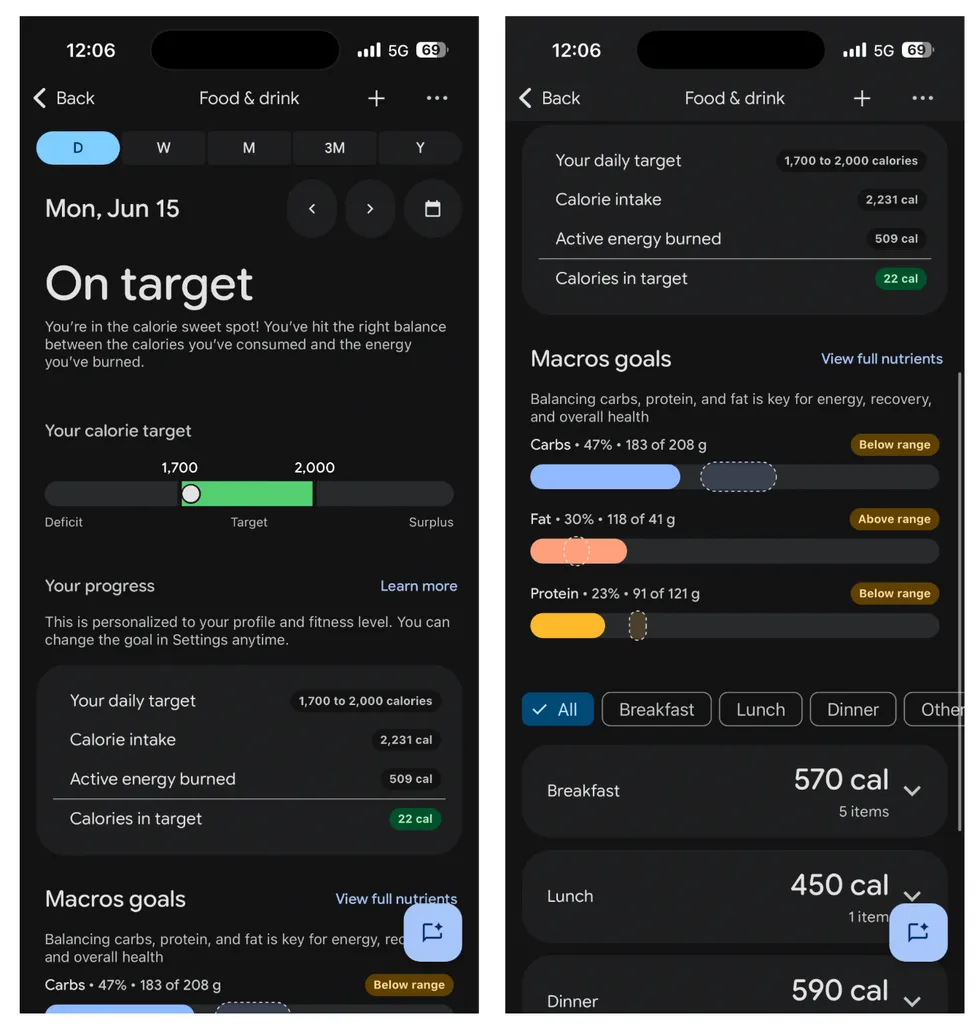 Screenshots by Zach Laidlaw/Google Health
A path to sustained weight loss
The important thing to keep in mind is that weight-loss apps are all about the long game. Unlike GLP-1s that help you drop weight fast and put it back on when you’re done with the injections, weight-loss apps provide education on the foods you eat and modify your eating habits.
They’re designed to keep your body in a caloric deficit that is both reasonable and sustainable. If followed consistently, you’ll lose an average of 1-2 pounds per week without any major energy crashes or side effects. At the same time, you’re retraining yourself on how to choose better foods that support a healthier lifestyle and a thinner waist for years to come.
More from this network:
Domains for Sale · GOTPeople.org · TheDSAPlatform · The Truth About Socialism
What's Your Reaction?
 Like
0
Like
0
 Dislike
0
Dislike
0
 Love
0
Love
0
 Funny
0
Funny
0
 Wow
0
Wow
0
 Sad
0
Sad
0
 Angry
0
Angry
0

I am just an average American. My teen years were in the late 70s and I participated in all that that decade offered. Started working young, too young. Then I joined the Army before I graduated High School. I spent 25 years in, mostly in Infantry units. Since then I've worked in information technology positions all at small family owned companies. At this rate I'll never be a tech millionaire. When I was young I rode horses as much as I could. I do believe I should have been a cowboy. I'm getting in the saddle again by taking riding lessons and see where it goes.
Premium domains for sale























Comments (0)