

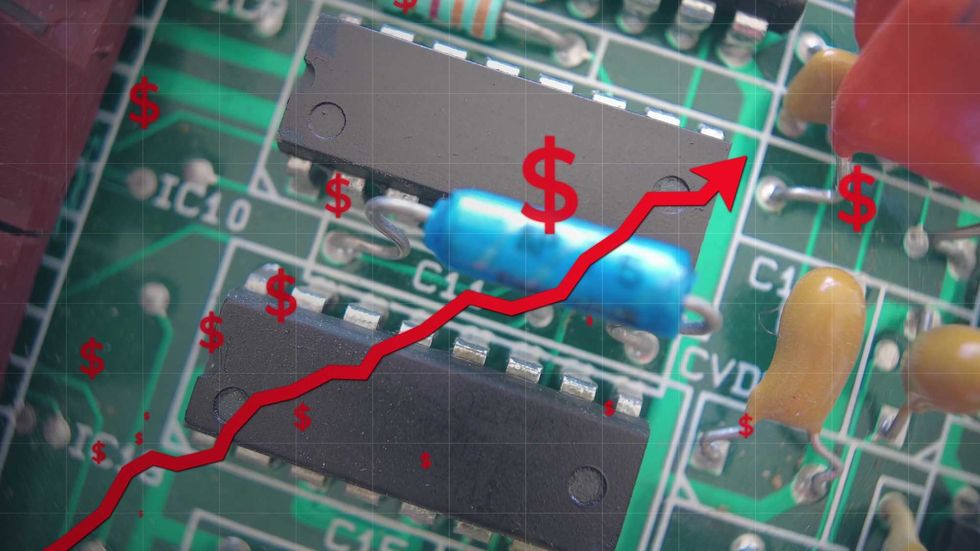
Smartphone and laptop prices are rising. Here's why they won't stop.
Premium domains for sale
Freedom Is Back In Style
The three companies that make most of the world’s memory — Micron, Samsung, and SK Hynix — are saying their entire output is spoken for.
Freedom Is Back
In Style
Premium domains for sale
Micron has completed pricing agreements for its full 2026 supply of high-bandwidth memory and says tightness will persist beyond 2027. SK Hynix says customer demand has already claimed all of its DRAM and NAND production for the coming year. Samsung expects its high-bandwidth memory sales to more than triple.
These conditions reflect a structural reallocation, and the structure in question is the global AI data center.
Powerful buyers secure in advance what smaller buyers receive on less favorable terms.
Most people do not think about DRAM or NAND flash. These crucial components of computing are usually invisible, until they are not. Robert Dennard invented the one-transistor DRAM cell in 1966. NAND flash emerged in 1987. Both became so pervasive and reliably cheap that they disappeared into the background hum of modern life, noticed only during the periodic price spikes that briefly made technology reporters use the word “shortage” before everyone forgot again.
That era of comfortable ignorance is now over for a single reason: artificial intelligence.
Memory's dark secrets
HBM is a kind of DRAM. What makes HBM distinct is its architecture. Individual DRAM dies are thinned to less than the width of a sheet of paper, punctured with thousands of microscopic holes called through-silicon vias, stacked eight or twelve layers high, and then integrated onto an interposer alongside a processor. The result is memory that can deliver more than a terabyte per second of bandwidth to a single chip. The latest Samsung HBM4 reaches 3.3 terabytes per second through a 2,048-pin interface. Nvidia’s DGX B200 system aggregates eight GPUs for a combined 64 terabytes per second of memory bandwidth.
Every wafer of silicon devoted to HBM is a wafer not devoted to the DDR4 that goes into a student’s laptop, or the LPDDR4 in a budget smartphone, or the conventional DRAM in an automotive controller. Micron says HBM carries a three-to-one trade ratio against DDR5 in that producing one unit of HBM consumes the wafer area that could have produced three units of ordinary memory.
The advanced packaging lines needed for HBM are themselves scarce. The clean-room space is limited, and new fabs take years to build. Micron’s next Idaho facility will produce its first wafers in mid-2027. Another Idaho fab follows in late 2028. A New York fab arrives sometime after 2030.
A great increase in supply is not imminent.
RELATED: China’s new AI master plan is a glimpse at total technological control
 bernie_photo/Getty Images
What makes AI so hungry for memory is the nature of inference. When a large language model generates a response, it maintains something called a KV cache, a running record of the conversation’s context that must remain in fast GPU memory for the duration of the interaction. The cache grows with prompt length and must be held open for every concurrent user.
Researchers have demonstrated two- to fourfold throughput improvements simply by managing this memory more efficiently, which gives some indication of how much capacity is currently being consumed by the brute fact of keeping a conversation alive. Contemporary AI is a persistent system that continuously occupies memory.
A new currency of capital
The old memory market was cyclical and anonymous. Spot prices rose and fell. Inventory accumulated and cleared. No one signed multiyear contracts for commodity DRAM. That market is gone.
- Micron now holds 16 strategic customer agreements with pricing floors, cash deposits, and remaining performance obligations totaling $100 billion.
- Tencent has signed a three- to five-year DRAM deal with China’s CXMT worth nearly $3 billion to guarantee supply for its AI and cloud operations.
- Customers are seeking contracts of up to three years even for legacy products like DDR4 and LPDDR4 because they cannot be sure of getting them otherwise.
Memory has begun to behave less like a commodity and more like a strategic reserve, allocated by contract and commitment rather than by price discovery on the open market. It has become another resource, like liquefied natural gas or cloud computing capacity, that powerful buyers secure in advance and smaller buyers receive on less favorable terms.
The geopolitics follow predictably. South Korea is treating the memory boom as a national industrial project, with SK Hynix planning investments of 100 trillion won. Japan is pushing next-generation NAND manufacturing. The United States is trying to reshore leading-edge DRAM through Micron’s Idaho and New York expansions, backed by federal incentives. Memory fabs are instruments of national positioning within the AI supply chain.
The cost of recollection
The British retailer Currys has warned that memory shortages driven by AI data centers will raise prices for smartphones, laptops, and consumer electronics. The fact that a chatbot prompt issued in a data center in Virginia can affect the price of a replacement phone purchased by a student in Texas is the peculiar indignity of the present arrangement. The same wafer starts, packaging lines, and engineering hours can serve DDR5, HBM4, enterprise SSDs, or automotive memory, but not all at once.
AI reorganizes scarcity and makes visible the hidden architecture on which digital life has always depended.
We are accustomed to thinking of memory as something personal, something human. The word itself carries that connotation. But in the semiconductor industry, memory has become a capacity metric, a throughput variable, a strategic asset to be reserved and allocated in the service of optimized computation. With the structural shortage of memory, one meaning of the word yields to another.
More from this network:
Domains for Sale · GOTPeople.org · TheDSAPlatform · The Truth About Socialism
What's Your Reaction?
 Like
0
Like
0
 Dislike
0
Dislike
0
 Love
0
Love
0
 Funny
0
Funny
0
 Wow
0
Wow
0
 Sad
0
Sad
0
 Angry
0
Angry
0

I am just an average American. My teen years were in the late 70s and I participated in all that that decade offered. Started working young, too young. Then I joined the Army before I graduated High School. I spent 25 years in, mostly in Infantry units. Since then I've worked in information technology positions all at small family owned companies. At this rate I'll never be a tech millionaire. When I was young I rode horses as much as I could. I do believe I should have been a cowboy. I'm getting in the saddle again by taking riding lessons and see where it goes.
Premium domains for sale
























Comments (0)