

Spanberger May Have Won In A Landslide, But She Just Got Hit With A Reality Check
Premium domains for sale
Freedom Is Back In Style
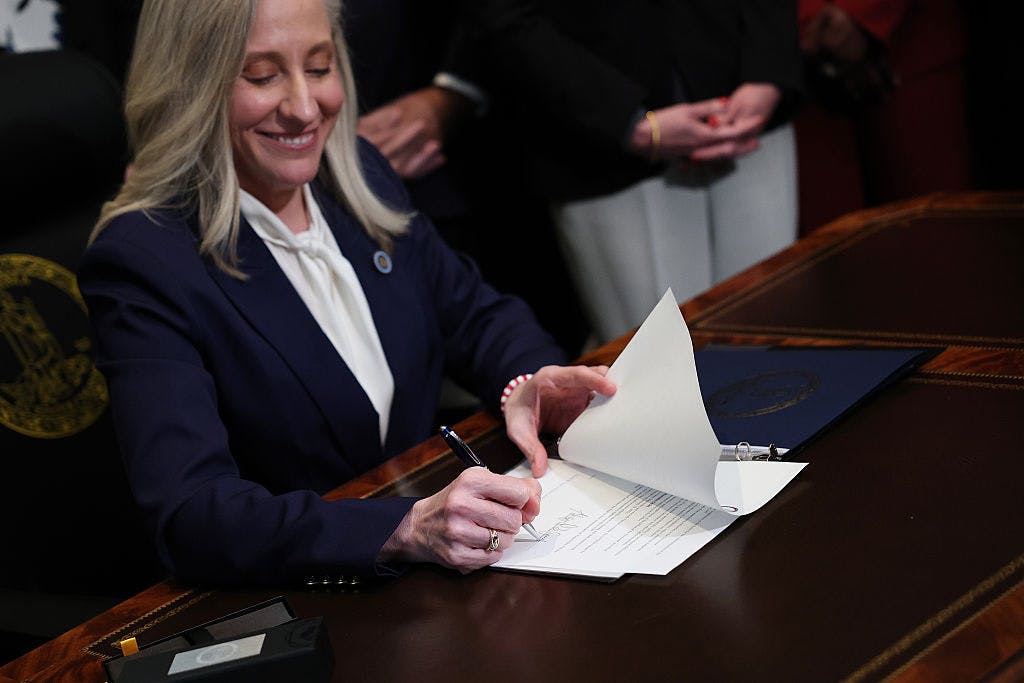
Virginia Democratic Gov. Abigail Spanberger entered office with a decisive mandate and a carefully crafted centrist brand. Now, just months later, new polling suggests both are under strain.
Freedom Is Back
In Style
Premium domains for sale
A survey conducted by The Washington Post and George Mason University Schar School of Policy and Government shows Spanberger at 47% approval and 46% disapproval, the weakest early-term standing for a Virginia governor in decades. The erosion is particularly sharp among independents, a key bloc that powered her November landslide. Just 45% now approve of her performance, while 46% disapprove, a stark shift from the 59% of independents she carried on Election Day, according to exit polls.
Governors in the Commonwealth have typically enjoyed relatively stable approval ratings early in their terms, if not downright charitable. Glenn Youngkin, for example, maintained a solid 54% approval rating with just 39% disapproval at a comparable point in his tenure, despite only winning Virginia by two points in the 2021 election.
45% of voters say Spanberger’s views are “too liberal,” compared to 42% who say they are “just about right,” and just 7% who view her as “too conservative.” Nowhere is the shift clearer than on the issue that defined her campaign: affordability.
Spanberger repeatedly promised to lower costs, pledging an “Affordable Virginia” agenda aimed at easing pressure on health care, housing, and energy. But voters are increasingly skeptical. The poll finds 41% believe her policies will make Virginia less affordable, compared to 31% who say more affordable, while 23% expect no impact.
That skepticism extends across party lines. While 63% of Democrats believe her policies will improve affordability, a significant share, more than three in ten, say they will either make no difference or worsen costs. Among independents, the numbers tilt negative, with 41% saying her policies will make the state less affordable versus just 27% who expect improvement. Roughly eight in ten Republicans say her agenda will drive costs higher.
As previously reported, Democrats in Richmond have introduced sweeping tax proposals that would create new income brackets and expand taxes on investment income, potentially pushing Virginia’s top effective rate to roughly 13.8%, higher than California’s. Supporters frame the measures as a “fair share” approach to fund public priorities, but critics argue they directly undercut Spanberger’s affordability message. The tension between centrist campaign rhetoric and left-wing governing reality is becoming a defining feature of her early tenure.
Beyond taxes, Spanberger is facing mounting scrutiny over a broader policy slate. More than 30 gun control measures are advancing through the legislature, including proposed bans and new restrictions on firearms and magazines. Her decision to end cooperation between state law enforcement and federal immigration authorities has also drawn criticism, as has her support for rejoining a regional climate initiative opponents say could increase energy costs.
Taken together, the policy direction has fueled a perception that her administration is governing to the left of where she campaigned, a dynamic reflected in the polling.
Political observers say the speed of the shift is notable. Larry Sabato has warned the decline is “stunning” and could become a serious liability if it continues. Mark Rozell, dean of the Schar School of Policy and Government, similarly noted that while polarization is expected, the degree of early division is “unusual” for a governor who emphasized a centrist image.
But the more compelling explanation may not be polarization at all. Spanberger didn’t win as a culture-war left-winger or a doctrinaire liberal, she won as a center-leaning pragmatist who promised cost relief and moderation. What the early polling suggests is not simply that voters are sorting into partisan camps, but that a decisive bloc, particularly independents, believes the product they were sold is not the one being delivered.
The risk for Spanberger is that this isn’t a messaging problem, it’s a definitional one. Once voters conclude a candidate has misrepresented their governing approach, it becomes extraordinarily difficult to rebuild credibility, especially when the policy record continues to reinforce that perception.
In that sense, the centrist brand that carried her to office may not be fraying, it may already be gone.
More from this network:
Domains for Sale · GOTPeople.org · TheDSAPlatform · The Truth About Socialism
What's Your Reaction?
 Like
0
Like
0
 Dislike
0
Dislike
0
 Love
0
Love
0
 Funny
0
Funny
0
 Wow
0
Wow
0
 Sad
0
Sad
0
 Angry
0
Angry
0

I am just an average American. My teen years were in the late 70s and I participated in all that that decade offered. Started working young, too young. Then I joined the Army before I graduated High School. I spent 25 years in, mostly in Infantry units. Since then I've worked in information technology positions all at small family owned companies. At this rate I'll never be a tech millionaire. When I was young I rode horses as much as I could. I do believe I should have been a cowboy. I'm getting in the saddle again by taking riding lessons and see where it goes.
Premium domains for sale

















Comments (0)