

The California Paradox And The Search For A Reform Coalition

Premium domains for sale
Freedom Is Back In Style
This piece is part of MI x DW, a collaboration that brings Daily Wire readers exclusive commentary and research from the Manhattan Institute’s world-class team of scholars.
Freedom Is Back
In Style
Premium domains for sale
***
California wants change. It just doesn’t want Republicans delivering it.
That is the central tension in a new Manhattan Institute survey of likely voters statewide and in Los Angeles. Californians recognize many of the failures of their governing class. On homelessness, infrastructure, public-sector unions, and government waste, they express an appetite for reforms that would challenge the state’s progressive orthodoxies. Yet their dissatisfaction stops well short of a willingness to hand Republicans power.
The resulting political vacuum is consequential. A lethargic Democratic establishment can continue winning without delivering much. And where voters do demand an alternative, the organized far Left is positioned to supply it. California’s problem is not simply the absence of sensible policy ideas. It is the failure to assemble a politically acceptable coalition capable of putting them into practice.
Click here for more Manhattan Institute content.
Our poll, conducted September 24 through October 1, surveyed 1,000 likely voters statewide and a separate sample of 449 in the City of Los Angeles. Its findings make it difficult to interpret Democratic electoral dominance as public satisfaction with Democratic governance.
Only 32% of Californians believe their state is headed in a better direction than other states; 45% say worse. Fifty-six percent consider California less business-friendly than its peers, compared with just 14% who say more. Voters rate the state’s infrastructure worse rather than better by 43% to 16%. Eighty-one percent say its homelessness problem is larger than elsewhere. Cost of living, taxes, and jobs dominate their priorities: 47% select that category as the most important issue, far surpassing government waste and corruption, at 17%.
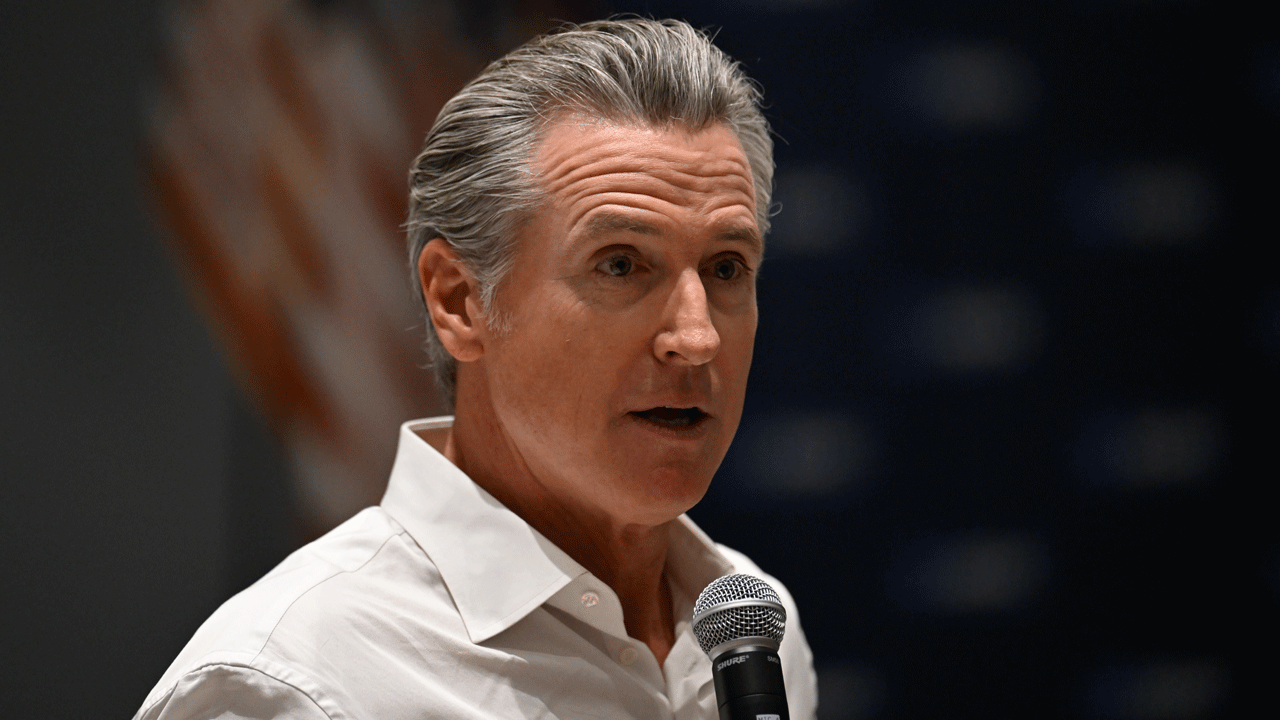
The politicians most associated with California’s Democratic establishment are hardly beloved. Gavin Newsom is viewed unfavorably by 52% of voters and favorably by 46%. Kamala Harris is also underwater, and nearly a quarter of her own 2024 voters now view her unfavorably. In Los Angeles, Karen Bass’s standing is considerably worse: 61% unfavorable, just 33% favorable.
Republicans might ordinarily expect such numbers to present an opening. But Xavier Becerra leads Steve Hilton in the gubernatorial contest by 55% to 38%. Even independents and other unaffiliated voters — who say California is headed in a worse direction than other states by 49% to 26% — prefer Becerra to Hilton by 48% to 39%. Dissatisfaction with the state’s performance coexists with a preference for the party running it.
These findings expand on what Christopher Rufo and I heard in our recent Los Angeles focus groups. Participants described unaffordable lives, disorderly streets, high taxes, and a government that seemed incapable of performing basic functions. Yet many interpreted those failures through the same progressive framework that helped produce them: the money was going to the wrong people. Officials were insufficiently committed. A more authentic version of progressive government would finally make the system work.
The polling reveals both the limits of that worldview and its enduring political force.
Consider homelessness. By 60% to 29%, Californians cite addiction and mental illness over housing costs as the primary explanation for the crisis. Housing supply plainly matters, but voters reject the proposition that cheaper housing alone would enable most homeless people to live independently. By 62% to 20%, they consider treatment without consent more compassionate than protecting an addicted person’s right to refuse it and remain on the streets. A majority of Democrats agree.
Los Angeles voters are even more supportive of that conception of compassion: 66% favor treatment without consent. Among voters backing Nithya Raman, Bass’s Democratic Socialists of America (DSA)-affiliated challenger, 60% take that position, while 53% identify addiction and mental illness as the primary drivers of homelessness. A vote for a socialist candidate cannot automatically be read as an endorsement of the left-wing activist approach to street disorder — even if that is what it delivers.
The same distinction appears in attitudes toward organized labor. Californians generally like unions. But 63% support limiting the power of public-sector unions if doing so would make it easier to discipline poor performers, reward good ones, and provide better services at lower cost. That conditional proposition wins support from 53% of Democrats. In Los Angeles, majorities of both Bass and Raman voters favor it.
Voters are similarly skeptical of government’s management of their money. Seventy-one percent are concerned about waste, fraud, and abuse in California’s welfare programs. When asked what should change, 53% prioritize cracking down on those problems, compared with 32% who prioritize making benefits easier to obtain. On transportation projects such as high-speed rail, 42% want to stop wasting resources on delayed, over-budget undertakings; another 27% say California needs major improvements but distrust its current leadership to deliver them. Only 25% choose continued investment despite the overruns and delays.
Nor is the electorate clamoring for every progressive revenue or redistribution proposal. Proposition 40’s one-time, 5% billionaire wealth tax draws 35% support and 50% opposition. Only half of Democrats support it. Fifty-one percent of Californians would restrict Medi-Cal to people with legal status, while 31% would offer it regardless of status. Fifty-three percent say racial preferences in hiring and admissions are discriminatory, compared with 37% who believe past discrimination obligates their use today.
This is not evidence that California has secretly become conservative. Los Angeles is more progressive than the state overall, including on racial preferences and Medi-Cal eligibility. Statewide Democrats remain supportive of several policies the broader electorate rejects. But there is a substantial constituency for government that spends responsibly, enforces standards, and treats public services as obligations to residents rather than privileges for organized interests.
The Los Angeles mayoral race shows what can happen when that constituency lacks a compelling political home. Raman leads Bass by 38% to 32%. With undecided voters pressed to choose, the gap narrows to 39% to 36% — a competitive race, not a settled verdict. Still, the incumbent’s weakness has created an opening for a challenger affiliated with the DSA.
One of the survey’s most revealing experiments suggests that socialism itself is not the necessary ingredient. We randomly divided respondents and presented two hypothetical mayoral choices with the same respective policy descriptions. One emphasized rent freezes, free buses, city-run grocery stores, and higher taxes. The other emphasized housing construction, less business red tape, stronger enforcement against street disorder, and treatment.
When these were described as an unnamed democratic socialist and moderate Democrat, Los Angeles voters preferred the moderate by 47% to 39%. When identified by name and office as New York City Mayor Zohran Mamdani and San Francisco Mayor Daniel Lurie, voters preferred Mamdani by 43% to 35%.
This was a comparison between separate randomized groups, not individual voters changing their answers. Nor does it isolate whether familiarity, reputation, or some other association explains the difference. But it demonstrates the danger of treating candidate enthusiasm as a straightforward policy mandate. The moderate agenda can compete. The political identity attached to it matters enormously.
Spencer Pratt illustrated the other side of that problem. As Danielle Shapiro and I argued, the former reality TV star’s campaign for Los Angeles mayor gave voice to a useful form of local populism: directing anger toward officials responsible for the failures residents could see around them. But as Matthew Knee and I subsequently showed, his appeal remained too confined to a Republican coalition with localized additions to carry him into the runoff.
Pratt’s gains were concentrated in affluent, white, and wildfire-affected neighborhoods. He ran behind Donald Trump in heavily Hispanic precincts and failed to break double digits in black precincts. His local message had not overcome the partisan barriers in the constituencies he needed to reach.
Businessman Rick Caruso recognized those barriers in his 2022 race against Bass. A former Republican, he became a Democrat, hired a Democratic campaign team, and presented himself as a civic fixer. He still lost, but he reached the runoff by giving Democratic voters permission to consider an alternative without feeling they were joining the Right. Pratt’s campaign, by contrast, remained unmistakably Republican. That helps explain why a popular critique of City Hall did not become a sufficiently broad electoral coalition.
Former White House Deputy Chief of Staff Taylor Budowich’s recent response to Pratt’s denunciation of political consultants made the relevant distinction. Mobilizing Republicans for a talented candidate is not the same thing as building a winning coalition in California. Third place should prompt an examination of whom the campaign failed to reach, not supreme confidence that more viral social-media content will solve the problem.
Our survey finds that half of Pratt’s primary supporters plan to leave the mayoral race blank, compared with 28% backing Bass and 10% backing Raman. Their frustration is understandable. But it also captures the impasse: a substantial bloc of dissatisfied voters has ended up without a candidate it wants to support, while the socialist challenger remains well positioned to inherit the demand for change.
San Francisco offers a more hopeful example. In our focus groups there, participants described cleaner streets, a reviving downtown, and a government taking public order more seriously. Many credited Lurie’s competence and focus on the city’s practical needs.
That impression has substance behind it. Lurie has consolidated fragmented street-crisis responses and launched PermitSF to make housing and business permitting faster and more predictable. His fiscal challenges remain formidable, but restoring responsibility for basic services is a meaningful departure from a politics that cast every visible failure as someone else’s fault.
The coalition behind him is also worth paying attention to. As Jay Donde has documented, local Republicans and the Briones Society supported Lurie alongside his Democratic constituency. The result illustrates how conservatives can contribute to a change in governing direction even where a Republican electoral takeover remains implausible.
San Jose mayor Matt Mahan tried to bring a similar approach to Sacramento when he ran for governor this year. His candidacy offered a Democratic alternative to the state’s governing establishment, grounded in his record running California’s third-largest city. As described in The Economist, Mahan has emphasized reducing housing fees and red tape and bringing homeless people into shelter quickly, rather than allowing the expense and delays of permanent construction to excuse years of continued street homelessness. His willingness to acknowledge tradeoffs reflects a seriousness too often missing from California politics: government must choose, execute, and account for results.
Mahan failed to advance in California’s top-two gubernatorial primary, which sends the two leading candidates to November regardless of party. Becerra and Hilton moved forward instead. That outcome illustrates how the partisan reflex operating on the Right can reinforce the very establishment that conservatives oppose. A Republican place in the runoff may satisfy party loyalists while leaving the governing direction of the state almost entirely unchallenged.
A Becerra–Mahan contest would have forced a choice between two different approaches to Democratic governance. Our poll does not tell us who would have won that hypothetical race. But a reform-minded Democrat could plausibly reach voters who agree with conservatives about California’s failures yet remain unwilling to vote Republican. The political reality is that changing how California governs may require a coalition whose members disagree about national politics. Lurie’s coalition accommodated that reality. The gubernatorial contest left voters with a familiar partisan choice — and a commanding Democratic lead.
The Abundance movement deserves credit for acknowledging some of those problems. Ezra Klein and Derek Thompson helped make it permissible for liberals to discuss how their own regulations impede housing and infrastructure. But diagnosing the obstruction is easier than confronting the coalition that sustains it. As Charles Fain Lehman argues, procedural burdens and special-interest concessions are often integral to the political bargain, rather than unfortunate mistakes added afterward.
The test for so-called abundance liberals is therefore political as well as intellectual. Are they willing to challenge public-sector unions, activist vetoes, and candidates whose broader agendas undermine the reforms they claim to favor? If admiration for Mamdani or hostility to Republicans overrides those concerns, then abundance becomes just another byword for accommodating the Left rather than changing how it governs.
California’s partisan loyalties give its Democratic establishment considerable insulation from failure. They also give the far Left an advantage when it claims to be the only available alternative. Our poll suggests that neither arrangement fully reflects what voters want from government.
A reform coalition would have to bridge the gap between the policies Californians are willing to support and the political identities they are willing to accept. Lurie’s experience shows that such a coalition is possible. Los Angeles shows what happens when it fails to materialize.
California has no shortage of voters who understand that something is broken. What the Golden State lacks is a durable political vehicle for fixing it.
***
This is republished with permission from the Manhattan Institute’s City Journal. The original can be found here.
Jesse Arm is the vice president of external affairs at the Manhattan Institute.
More from this network:
Domains for Sale · GOTPeople.org · TheDSAPlatform · The Truth About Socialism
What's Your Reaction?
 Like
0
Like
0
 Dislike
0
Dislike
0
 Love
0
Love
0
 Funny
0
Funny
0
 Wow
0
Wow
0
 Sad
0
Sad
0
 Angry
0
Angry
0

I am just an average American. My teen years were in the late 70s and I participated in all that that decade offered. Started working young, too young. Then I joined the Army before I graduated High School. I spent 25 years in, mostly in Infantry units. Since then I've worked in information technology positions all at small family owned companies. At this rate I'll never be a tech millionaire. When I was young I rode horses as much as I could. I do believe I should have been a cowboy. I'm getting in the saddle again by taking riding lessons and see where it goes.
Premium domains for sale












Comments (0)